
Lobuche to Gorak Shep via Everest Base Camp!
April 14, 2011
Trip Day #16, Trek Day #10
A huge part of the trip has been about getting to Everest Base Camp, and today was the big day.
Wait, didn’t we just cross the 17,782′ Cho La Pass the day before, and wasn’t that an incredibly long and challenging day, at the end of which I thought I’d never hike again? Yeah. Well.. there will be plenty of time for rest.. later.. in a week or two.
Today will look like this:
– Hot tea at about 7:00am, breakfast around 8:00, leave Lobuche, elev 16,100′, by 8:30.
– Climb 1000′ feet in about 2.5 to 3 miles and reach the small settlement of Gorak Shep, 17,100′, for a good, hot lunch.
– After lunch, climb another 500′ over another 2.5 to 3 miles to Everest Base Camp (17,598′), hang out, explore, take it all in!
– Return to Gorak Shep for dinner and stay the night.
(By the way, are you noticing these elevations!)
By normal hiking standards, this (7 1/2 to 9 miles) seems a reasonable day’s outing, but thin air and cold temperatures will turn it into something fairly strenuous, particularly since most of the day we’ll be walking up and down over rocky dunes and moraines. We’ll also cross a giant, dry lake bed (or sand pit)–the former Gorak Shep Lake. For most of the day, we’ll be traversing the immense and famed Khumbu Glacier, and will, in fact, drop right onto its receding, rocky slope as we ultimately pick our way to the base camp. Whew.
But let’s start at the beginning.
So. Sleeping at 16,100’… I adjusted to that just fine. Up in the middle of the night to go to the bathroom–because, you know, you have to drink like a fish to stay hydrated and keep altitude sickness at bay–with temperatures, say, around 5-15 degrees fahrenheit? That was never an easy adjustment.
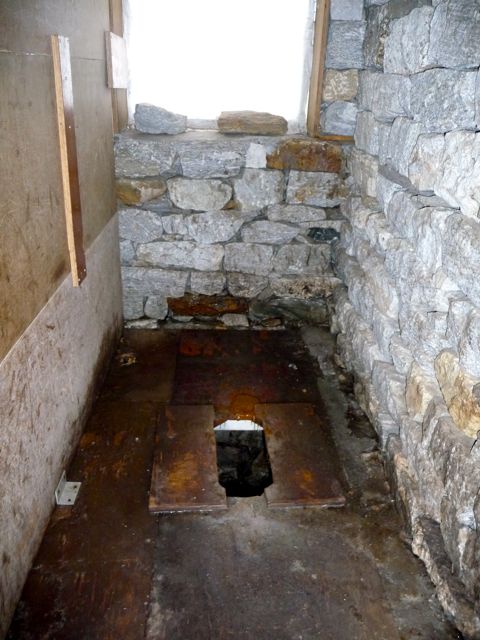
Here’s a shot of said bathroom down the hall. Rick took this during daylight hours (because at night, with only a headlamp for illumination, photos don’t come out well). There is no bucket of rinse water in this one (which would be frozen anyway) because there is no basin, just a hole in the ground. And note the open-air window. Fresh. And those are pee-soaked boards, made slick by the below-freezing temps. No comment.
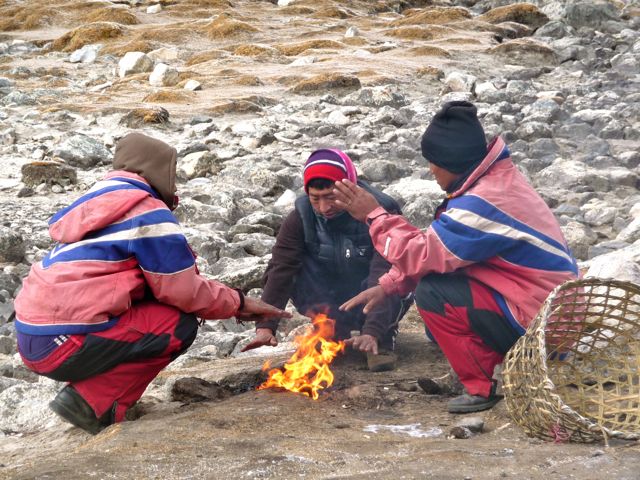
This was a particularly cold Thursday morning. Here’s a shot Rick took of some porters warming up around a fire. They had likely slept in tents outside the teahouse. Teahouses along the main EBC trail are far more crowded than what we’d seen during our days spent on the alternative route to the Gokyo Lakes region (so recommended).
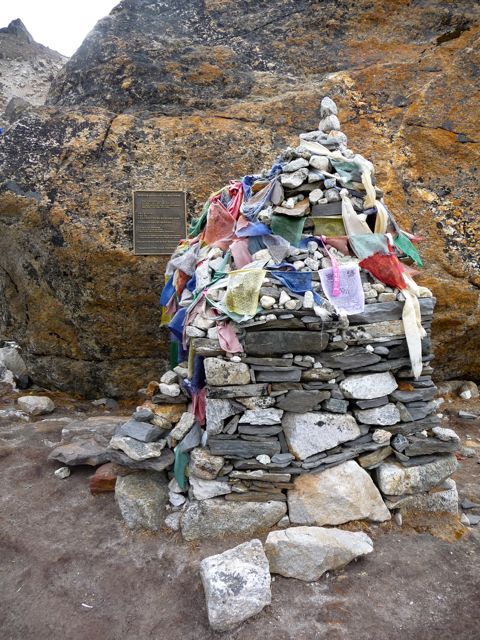
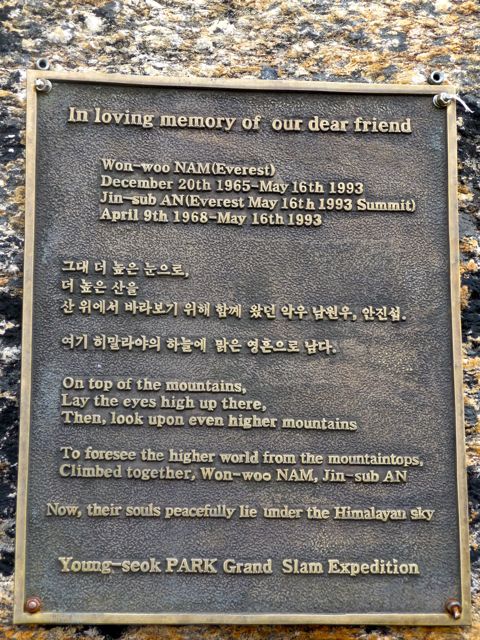
Following a great breakfast, we hiked for about an hour and soon arrived at one of many makeshift memorials to climbers who’ve died on Everest.
And then proceded to climb a very significant hill…
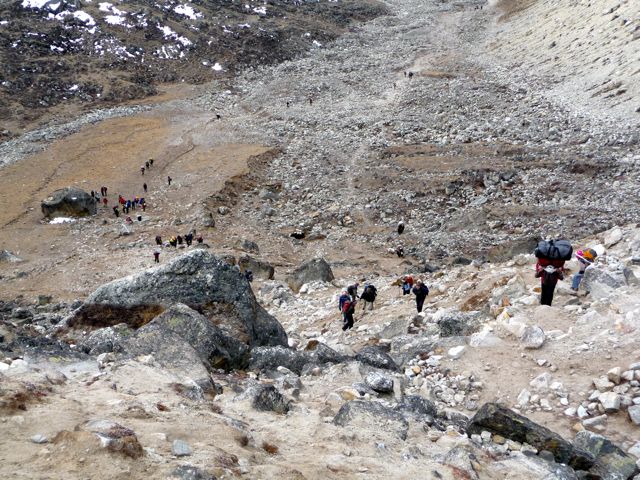
…(those black dots at the bottom are people) and pretty soon, on the left side of this picture, our right, we’re getting a good look at the Khumbu Glacier, which is “gurgling and moaning under a blanket of ground-up rocks and gravel.” Lonely Planet goes on to say:
“As a result of global warming, the glacier is shrinking away from the moraine wall at an alarming rate. The route of the path changes regularly as the edge of the moraine tumbles onto the glacier. This enormous tongue of ice marches down the slopes of Everest at a rate of up to a meter per day, breaking off into brittle seracs–towers of ice–at the Khumbu Icefall.”
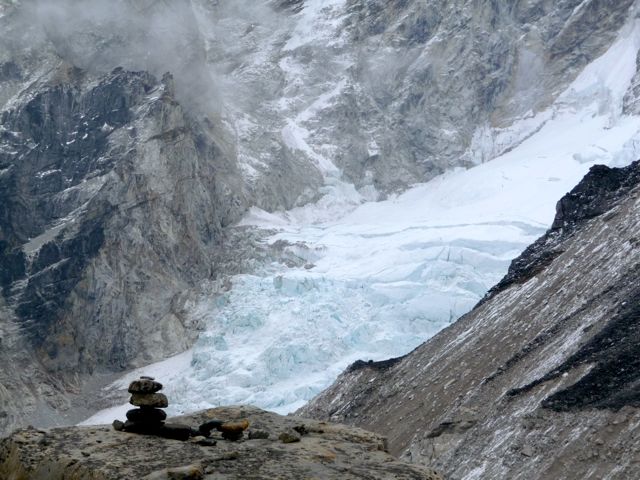
Here’s a shot Rick took of an icefall cascading off of Nuptse (25,801′ and the 20th highest mountain in the world. Ho hum.) and feeding into the Khumbu Glacier (note cairns marking the ever-shifting trail). You just can’t appreciate the scale of the formations in any of these shots…
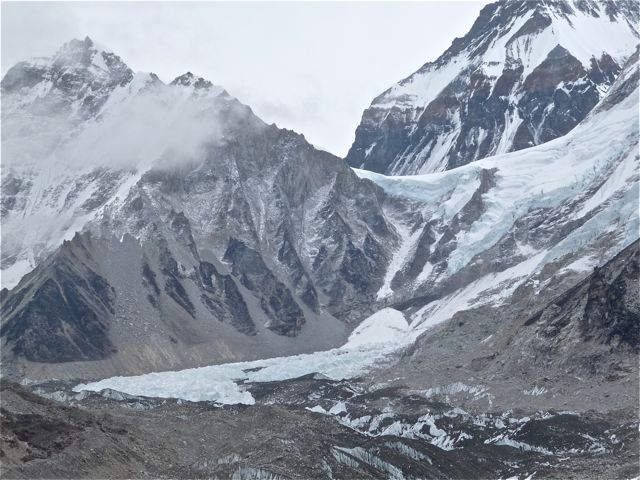
You could actually see Everest Base Camp from here, though it was still about another four miles away. In this picture, you cannot make out the tents, but they are clustered, a couple hundred of them, mostly yellow, at the left side of the picture, at the edge of the Khumbu Icefall. Again, the scale is humbling. The peak to our immediate right, Nuptse, rises 8,300′ (from glacier floor to peak) straight up. Really, you’re standing right next to a mountain that towers 8,300′ above you! This is Rick’s shot:
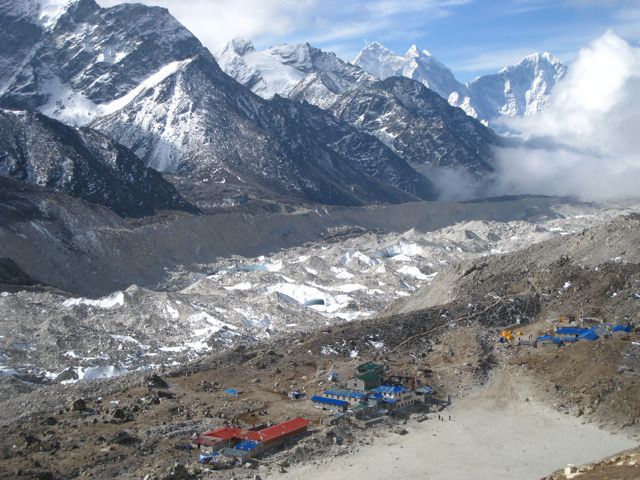
After another hour or so we arrived in Gorak Shep. This is a fantastic picture that Leslie took (actually, the following morning from atop the 18,176′ Kala Patthar). It gives a great perspective on the setting for Gorak Shep (17,100′) at the edge of dried up, dusty Gorak Shep Lake, in foreground, and the vast Khumbu Glacier between the settlement and that wall of mountains. We’ve come into GS from the far right, having traversed the glacier most of the morning.
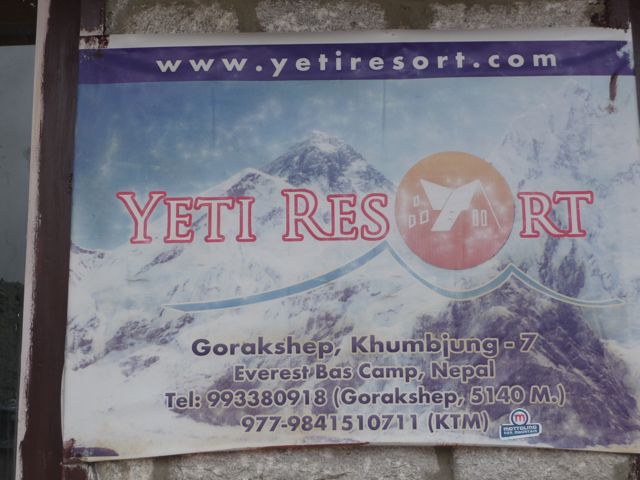
We checked into our teahouse, the Yeti Resort (again, an overstatement), and had lunch. Karen, me and Laura in the foreground. Eating dal bhat, no doubt (dal = lentils, tomatoes, spices; bhat = rice).
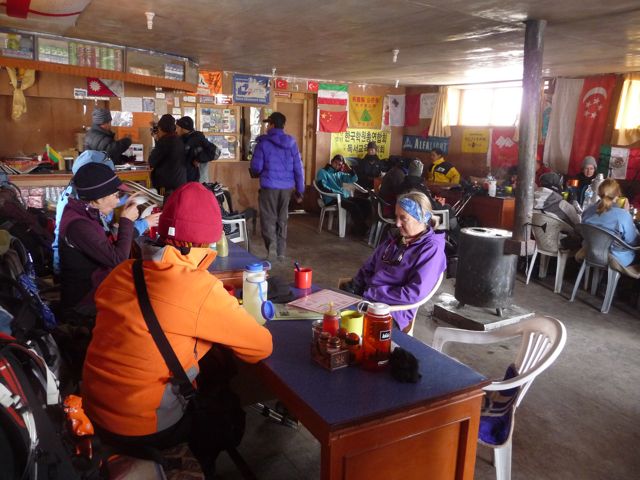
I remember feeling so much better, after the previous day’s amazing Cho La Pass crossing and evening of queasiness. Bring on the food! Pretty crowded little spot. This is what rejoining the main trail is about.. lots of trekkers. I remember, in particular, a family with a couple young teens and thought, hmm…Peter might really love this! We saw very, very few youngsters on this trip (could probably count on one hand). Still.. doable with the right attitudes.
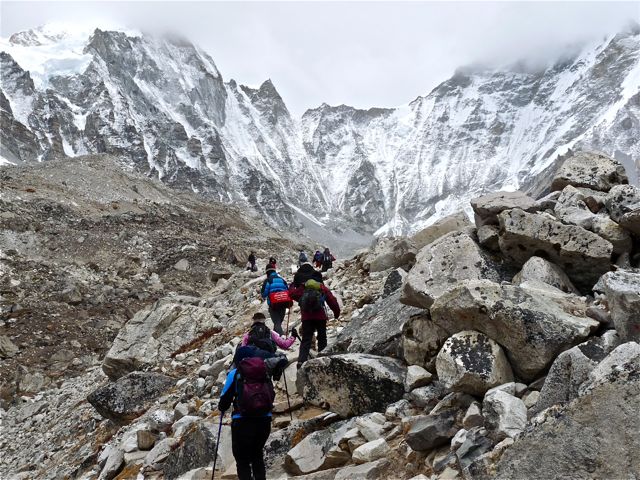
After lunch, we crossed the large sand pit, as did numerous yaks, and began to pick our way through glacial rubble:
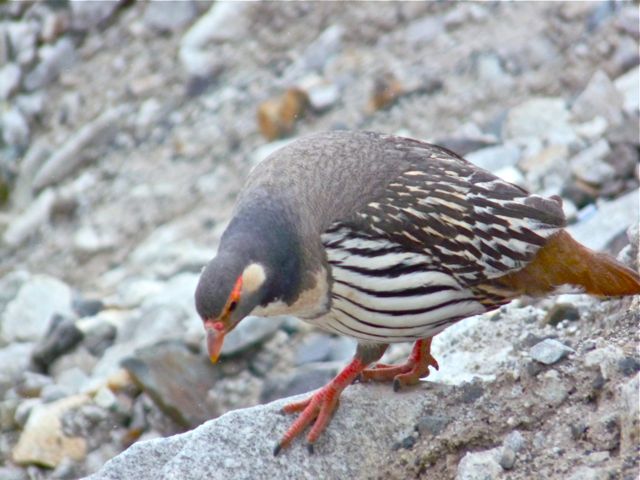
We saw a bunch of these… they are Tibetan Snowcocks, part of the pheasant family, and are found in the high altitude regions of the Western Himalaya and Tibetan Plateau on stony ridges and pastures above tree line.
There were a fair number of trekkers on the trail and lots of yaks bringing supplies to, and removing waste from, base camp. By and by, we came upon these guys, seated high above the trail on a large boulder. Note the laptop:
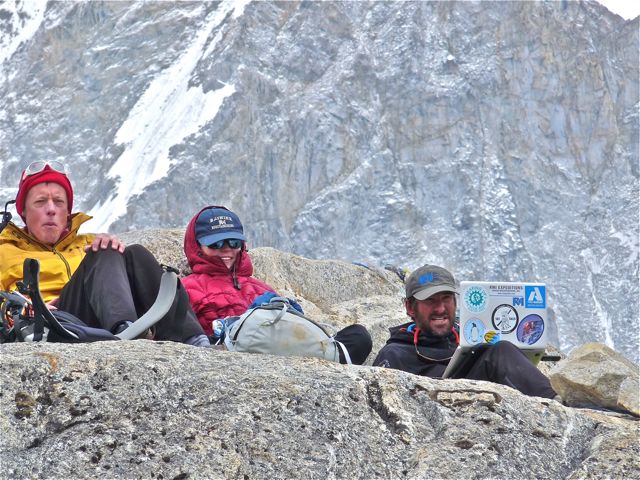
On the far right is Dave Hahn, considered the world’s premiere Everest guide. Five weeks after this picture was taken, on May 20th, he successfully climbed Mt. Everest for the 13th time, the world record for a non-sherpa climber. The other two are a father and daughter from Atlanta (Bill, and Sara, 16 years old) who Dave was leading as part of a Rainier Mountaineering Inc, Expeditions trip (you, too, can book a trip with RMI and Dave for $74,000/person). Bill and Sara did not complete the climb (I learned by reading Dave’s very exciting day-by-day blog detailing the ascent, upon my return,). Dave continued on with a partner and was able to maximize a weather window and had a clear and gorgeous summit day, unlike Allie Pepper’s harrowing adventure 8 days before. Exciting and fascinating to run into so many world class climbers and guides. This was, afterall, the peak of the 2011 climbing season. And, pretty much, you only get one shot per year to ascend Everest (the vast majority of ascents take place during the spring).
We continued on.
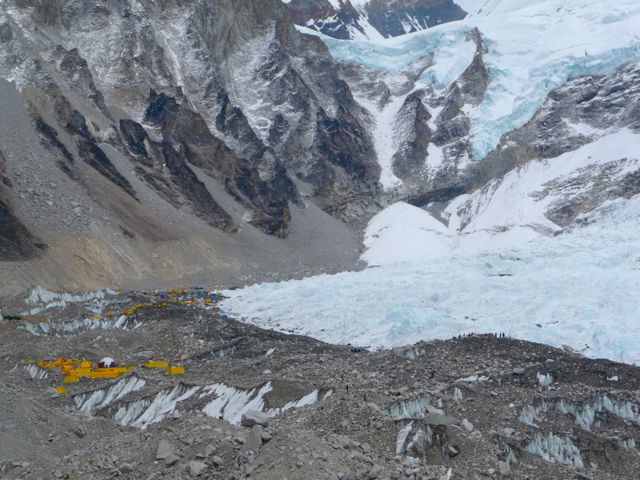
In Rick’s shot below, you can see yellow tents in the foreground; there are many more down on the left edge of the glacier, but hard to make them out in this shot. It’s even harder to see the people on a trail that leads into base camp (feel free to click and enlarge). Again, the scale and size of this area is immense. The other thing you cannot see from EBC is Mt. Everest! It is hidden by the shoulders of mountains in the foreground. There is an EBC lookout point just off camera to the right. We are headed there..
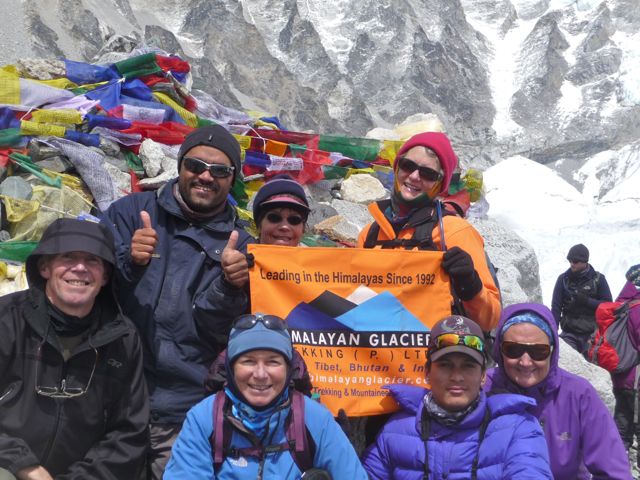
And… we’ve made it! Our grand destination: EVEREST BASE CAMP, 17,598′ We arrived at about 2:30pm. Happy trekkers: Rick, Homnath, Leslie, Karen, Me, Pradip, Laura.
I’m holding a rock that says, “Everest Base Camp 5364” (measured in meters, of course).
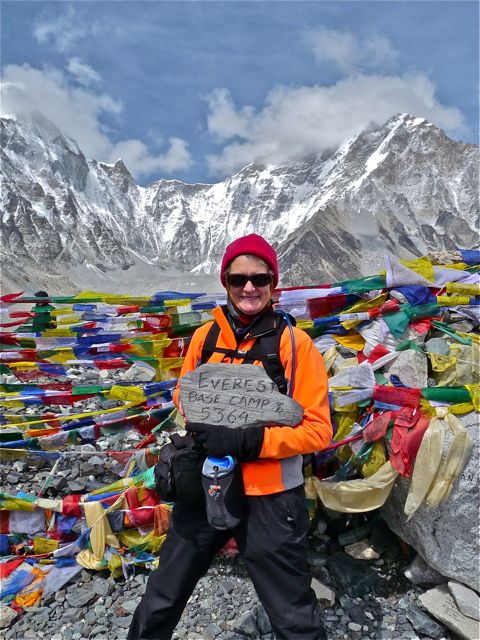
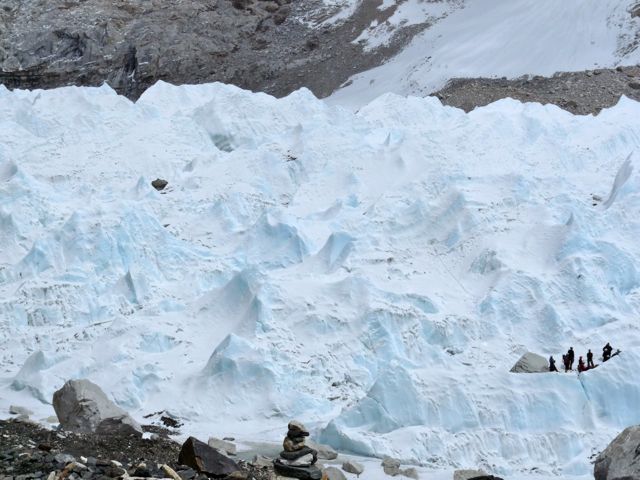
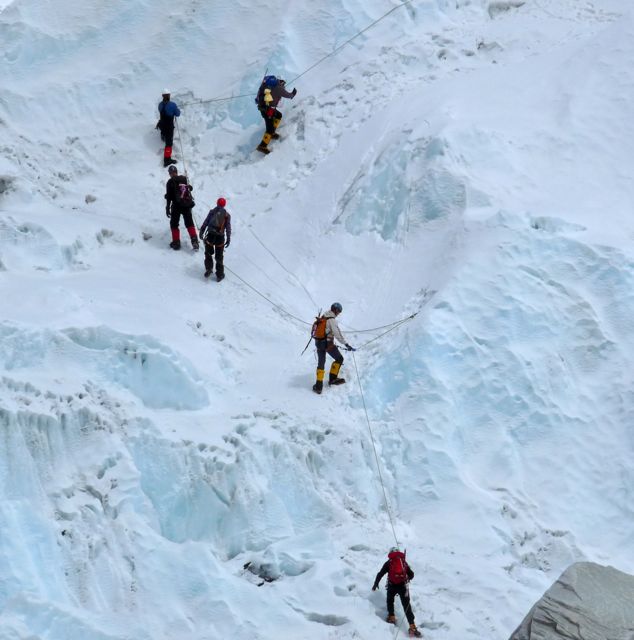
This lookout point is the final destination for most. It’s another half mile or so into the camp proper. Homnath has some connections, so we’re going to head into the camp. Before heading down, we took some pictures. We could see some folks practicing ice climbing on the Khumbu Glacier to our right:
And then we headed into camp..
Says Lonely Planet:
“EBC is a semi-permanent village of brightly-colored dome tents and prayer flags wedged between rocks at the bottom of the Khumbu Icefall. The atmosphere is fascinating, with groups from dozens of different nations playing cards, gambling, eating, reading, strumming guitars and doing everything possible to fill their time while they wait for the green light to climb to the summit. The periodic groans of the seracs in the icefall only add to the tension in the air.”
Rick shot this one: you can see a few of the tents scattered at the edge of the glacier. As you go further, the numbers increase. There are tents precariously positioned in clusters of yellow everywhere, including bathroom tents, shower tents, cook tents and so on. Yaks are all over the place, too, and a very international bunch of super climbers in the best of outdoor gear. It’s an amazing scene.
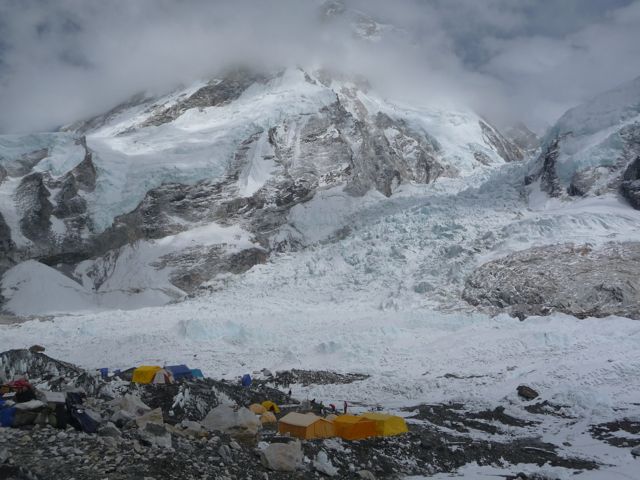
Climbing parties spend a lot of time, perhaps 2-3 weeks, at EBC acclimatizing, training, testing equipment, and practicing ladder and ice work in the Khumbu. When ready, climbers leave EBC, bound for the Southeast Ridge–the most popular of Everest routes. They start by climbing up the steep Khumbu Icefall, a series of seracs (ice towers) crevasses and shifting blocks of ice that make the icefall one of the most dangerous sections of the route. In the picture above, the icefall appears as that section of slope angling up the hill to the right and continuing well out of view. After 2,200′ of precarious, dangerous ice work, climbers end up at camp 1. To continue acclimatizing, climbers will climb ahead to a camp, return to the lower camp to sleep and hang out for a few days, climb ahead again and remain at the next camp for a while, then repeat the pattern until they’re reached camp 4 at the top of the South Col, at 26,000. Summitting happens in a single shot starting from camp 4. Summiting completely depends upon when/if a weather window opens, and climbers have a maximum of 3 days to wait at the super high elevation camp 4, due to the dangers of oxygen deprivation (most start using supplemental oxygen at camp 3 or 4). The summit is 3000 more feet and will take 10-12 hours. This is the most exposed part of the ascent. After an early morning summit, they return to camp 4, and subsequently lower camps. The entire process takes many weeks. Again, a great summary of this process and a fascinating account of one person’s experience is here, written by Allie Pepper who we met on the trail.
The second major route is from the Tibet side. There are maybe 15 other lesser routes. Sir Edmond Hillary and Tenzing Norgay, the first to summit Everest in 1953, pioneered the Southeast route.
I loved learning all about Everest ascents.. though will seek life thrills elsewhere.
Anyway.
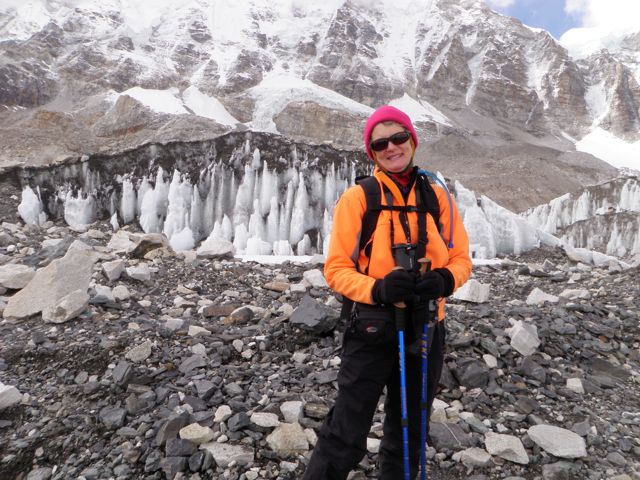
It was cold down in the base camp! Here’s a shot Karen took of some ice formations within the camp. These ice towers were all over the place and were stunning and eerie:
Homnath knows the head cook who works in the International Mountain Guides, Inc mess tent. IMG has one of the biggest operations at Everest Base Camp, as they employ lots of western and local guides for numerous summit groups. (Their Everest ascent costs $100,000/person.) Karen took this picture of their mess tent:
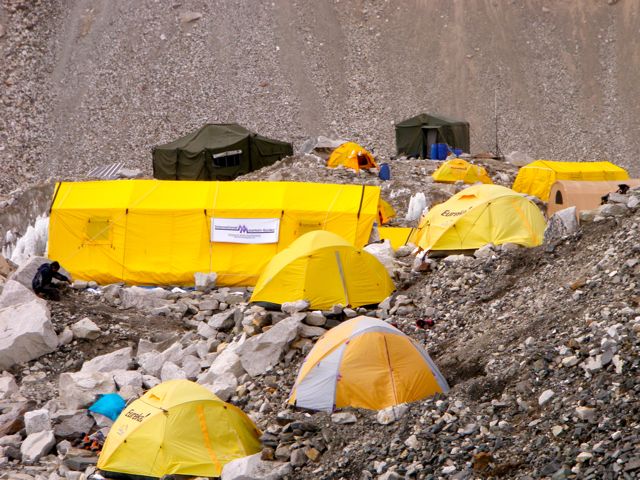
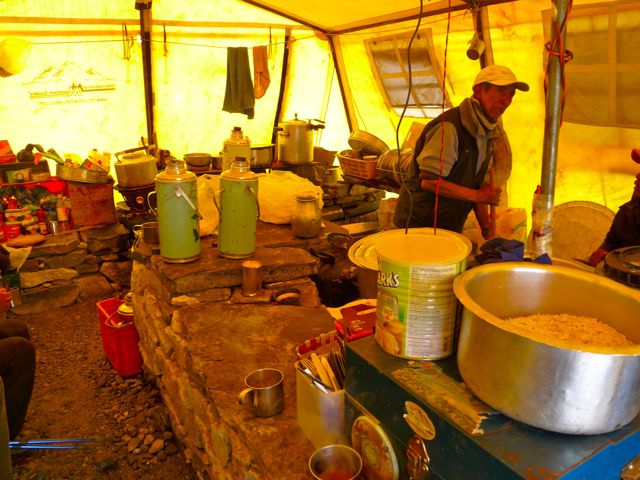
And here are a few shots of the inside. Note rocky dirt floor, makeshift stone dividers and counter tops. Cooks are using stoves to the right; supplies and dishwashing stations are against the back wall:
Making dal.
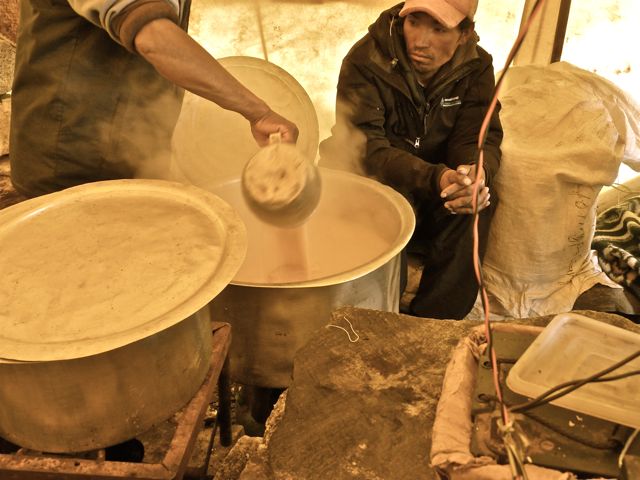
Lots of rice..
Us, getting warmer, drinking hot tea and eating cookies: Karen, Leslie, Rick, Laura, Hom, Pradip.
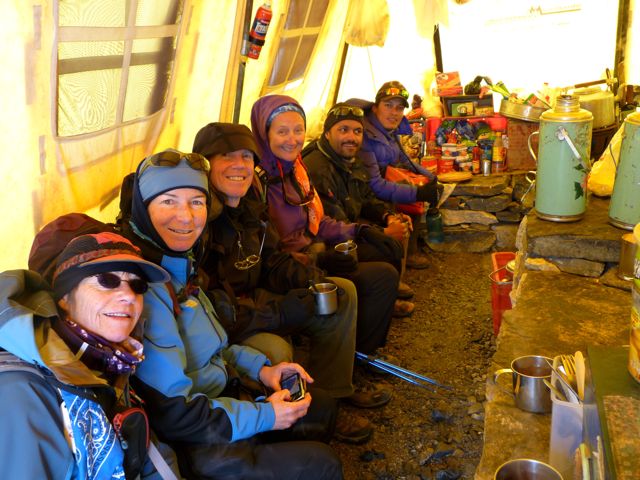
We hung out for about 45 minutes asking questions about camp life. We gave them some candy as a gesture of thanks. It was definitely one of the highlights of the trek.
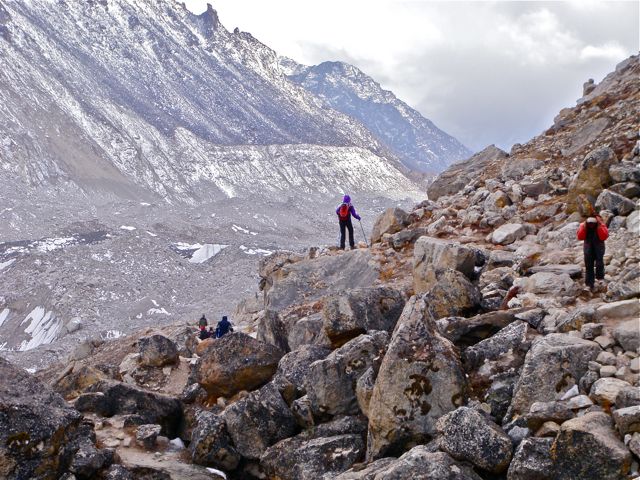
After an hour and half or so at base camp, it was time to head out… here’s a shot Karen took on the way back across the moraine. This was one spectacular, vast valley. The glacier is far below.
A trek through the Himalayas is large and mind-boggling. It’s a combination of physical, cultural and spiritual experiences that are beyond anything I’ve ever encountered. It’s about a lot more than just getting to Everest Base Camp, of course.
But.. the stated goal of this trek was to get to Everest Base Camp. That was the title event, as it were, and on this day, we did that! And it was every bit the satisfying accomplishment it was billed to be and it felt great to have had it in our sights for weeks (and for some in our group, months) and to have made it! So very much could have gone wrong, from injury to weather to sickness to defeat to who knows what. But none of the bad stuff happened and we got there. And that was very, very cool.

 Life of Wry
March 4, 2012 at 11:22 am
Woo hoo! It’s all downhill from there (in a manner of speaking).
March 5, 2012 at 2:15 pm
Kari, you can be so proud!