
Deeper into Kathmandu
April 4, 2011
Trip Day #6
The note in my journal says, “What an interesting day. Can it all be like this, please?”
Always a good sign.
So, today, we traveled deeper into Kathmandu. The nice people at HGT offer, as part of their trek package, a full day of sight seeing. Come for the trek, leave with a few key sights under your belt. This is a cool thing, and we were more than happy to play city tourists for a day.
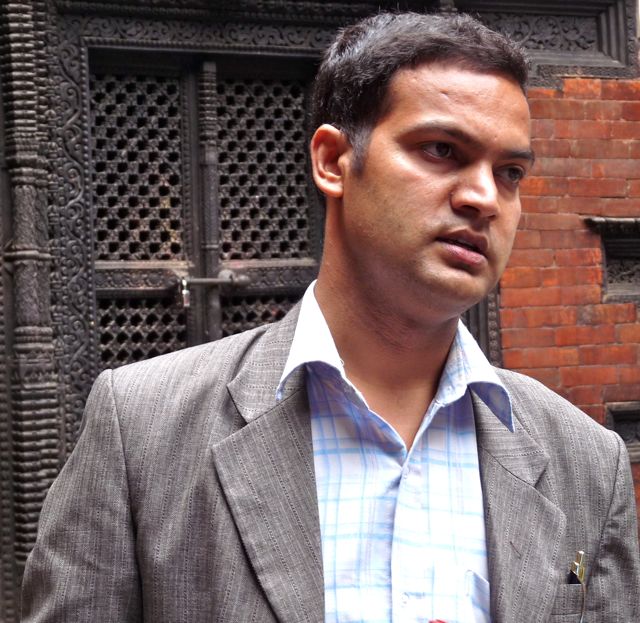
We five, plus two from South Africa and three Aussies (whom we’d get to know pretty well over the next two weeks, as we’d criss-cross the Himalayas), took off in a van with a driver and a guide. This is our guide:
Here’s a funny:
I asked our guide if it was ok to sit in the front seat (always eager to find the seat most car-sick proof), and he said ok. So, as departure time neared, I walked around to the front passenger seat and climbed in. I had to maneuver, with some difficulty, into position, and, as usual, finding the seat belt was a bit tricky, but I did it. Then I tried to settle in, but it felt so cramped, and, well, whatever; I just dealt with it. Then I noted that the passenger side had a steering wheel (must have been pretty preoccupied to have missed that very obvious detail, but I must have had carsick avoidance on my mind). I thought the steering wheel was odd, but in the fleeting moment I considered this fact, I figured it was like those driver education vehicles, where the passenger also serves as a backup driver, in case… you know. Or whatever; probably just a Nepal tour bus thing. Then I saw a bunch of guys outside laughing, and I realized, Ohhh…. I’ve climbed into the driver’s seat… because, duh, they drive on the opposite side of the road here… and… yeah. Felt very silly, suddenly. So… just got out, smiled at all the laughing guys, and got back in on the other side. Awkward.
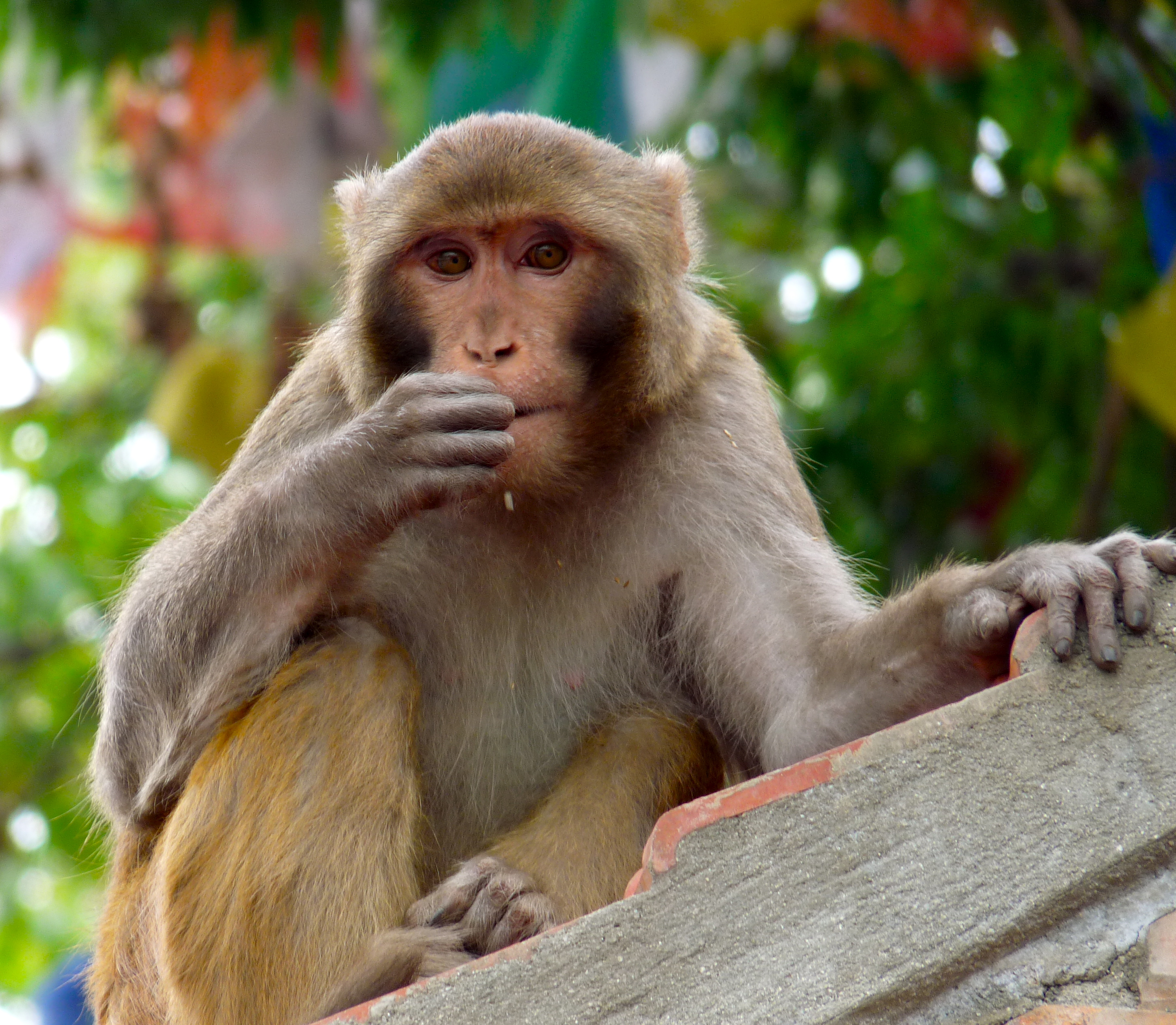
First place we went: Swayambhunath, a bit west of the Thamel district in downtown. It is an ancient religious complex at the top of a hill and offers amazing views of Kathmandu (though it was a hazy day). It is probably the most sacred among Buddhist pilgrimage sites. It is also known as the Monkey Temple as there are holy monkeys, they say, living in many parts of the temple.
Monkeys are everywhere.
The complex consists of a stupa, and a variety of shrines and temples. The site has two access points: a long stairway, with 365 steps, leading directly to the main platform of the temple, and a car road around the hill. At the top of the steps, you see a big vajra (thunder-bolt scepter) and behind that is the vast, round, white dome of the stupa, at the top of which are two giant Buddha eyes.
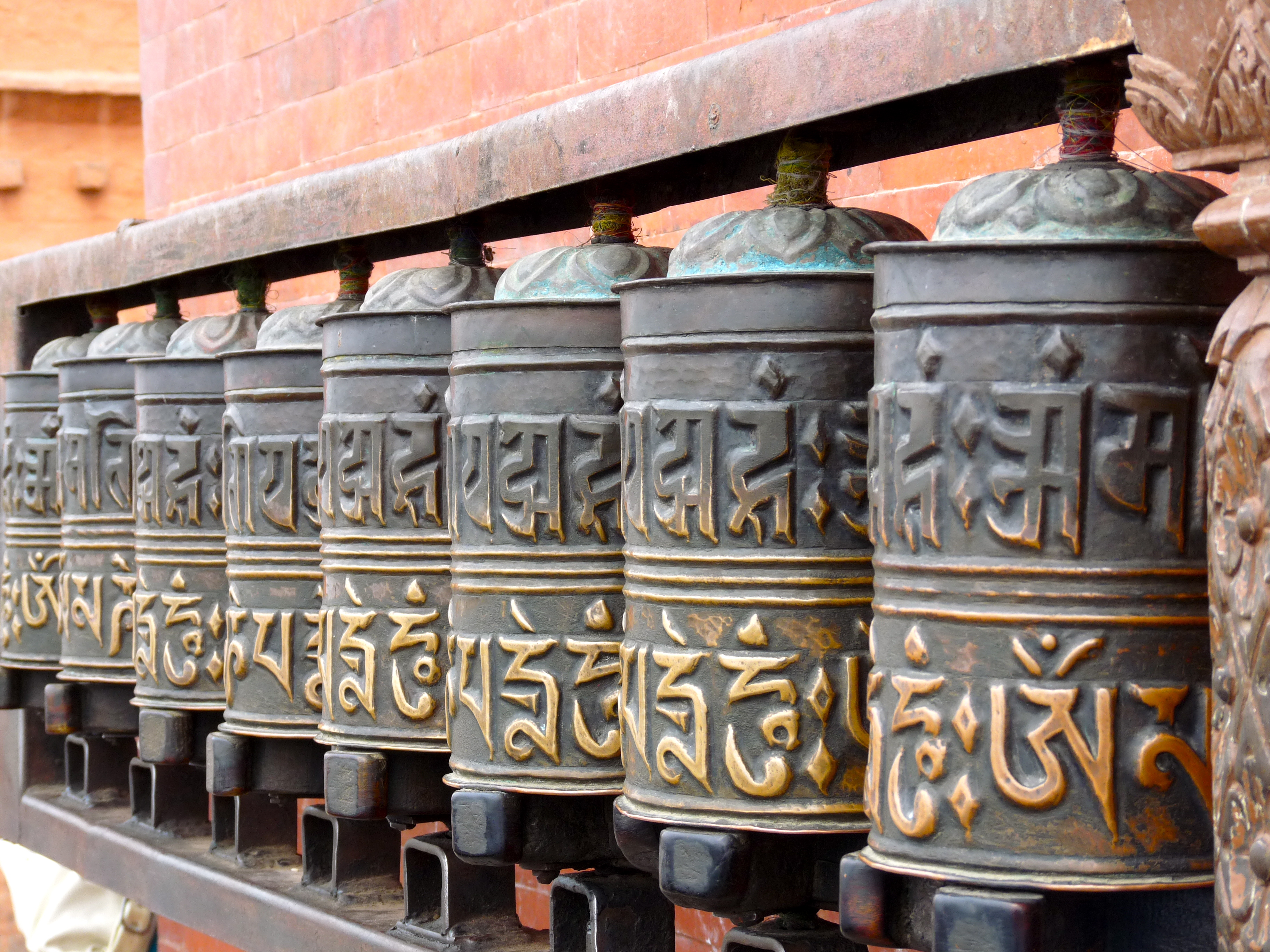
Prayer wheels surround the stupa and people walk clockwise around it spinning the wheels. Spinning the wheel is supposed to help to accumulate wisdom and merit (good karma) and to purify negativities (bad karma).
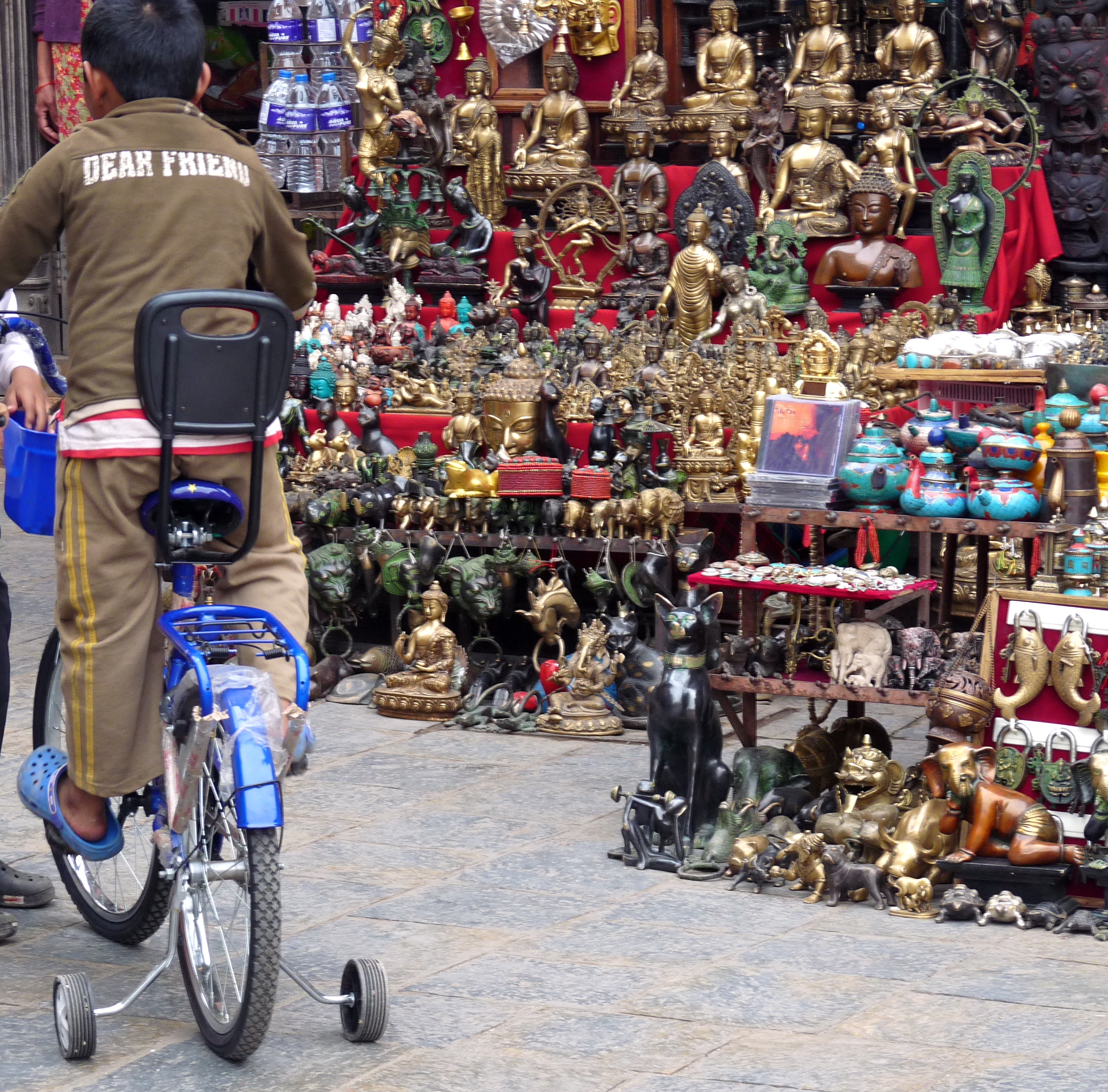
There are a lot of vendors and sales people wishing to sell you singing bowls, jewelry, prayer flags and Buddha paraphernalia. There were lots of candles burning and it smelled great because of all the incense.
Also, in the background, repeating over and over, a beautiful choral chant we’d become very familiar with: Om Mani Padme Hum.
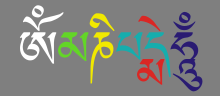
Above are the six syllables in sanskrit. They translate as follows: Om: generosity, Ma: ethics, Ni: patience, Pad: diligence, Me: renunciation, Hum: wisdom.
We’d hear this chant at temples and monasteries. People often chanted while spinning wheels. On the trek, we’d see the words carved on stones, which served as blessings on mountain tops, in towns, along the trail, on memorials, and around stupas.
We visited Durbar Square next, a bit south of Thamel. Durbar Square is made up of a few loosely linked squares and is considered the traditional heart of Kathmandu’s old town and represents an amazing legacy of traditional architecture. Dozens of gorgeous buildings.. I had no idea the significance or history.. we were here only a short time.
But, there is a *lot* of activity in this area and lots of temples. The plaza with all the pigeons and cows seems to attract a lot of attention.
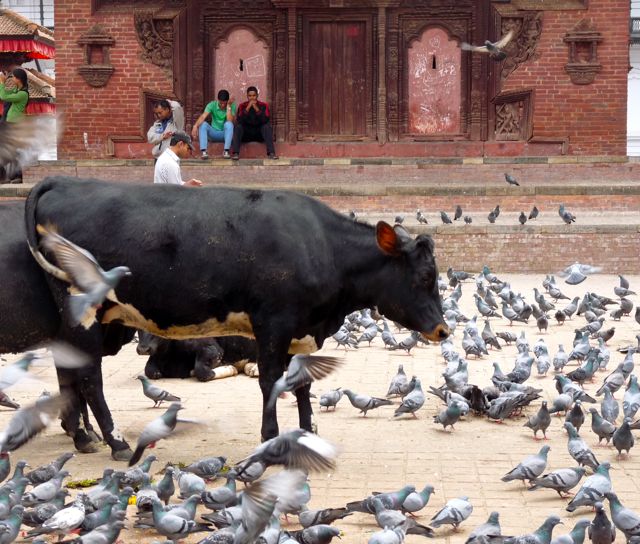
Among many other things (open air markets, shops, restaurants, hotels), the Royal Palace is here, though the King does not live here anymore.
Also in this area is the Kumari Bahal–a three story red brick building with intricately carved windows–home to Kumari, the town’s selected “living goddess.” In Nepal, the Kumari is famous. She is selected when she is very young and remains the goddess until her first period. After this, she returns to mortal status and a new Kumari is chosen. We saw her–she came to a window to wave at us–I think she was about 6. I have no pictures because they were not allowed.
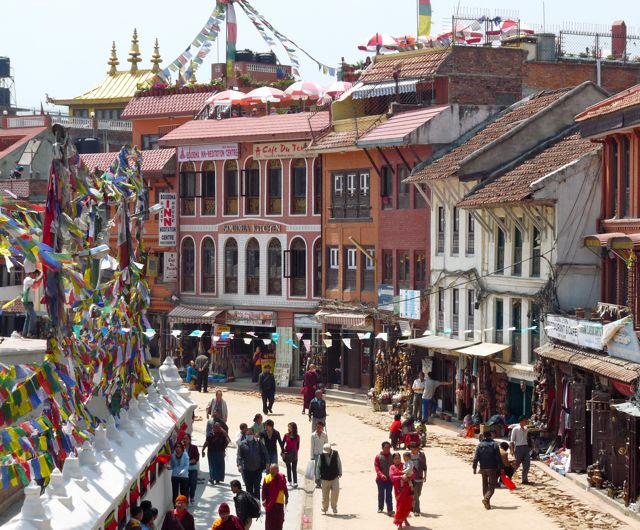
We loaded up the van and headed next to Bodhnath, on the northeastern outskirts of Kathmandu. Bodhnath is considered one of the holiest Buddhist sites in the city. It has one of the largest spherical stupas in Nepal which dominates the skyline and is also one of the largest in the world (note those eyes!). Prayer flags hang everywhere, and around the perimeter of the stupa are prayer wheels, so people walk around and around.
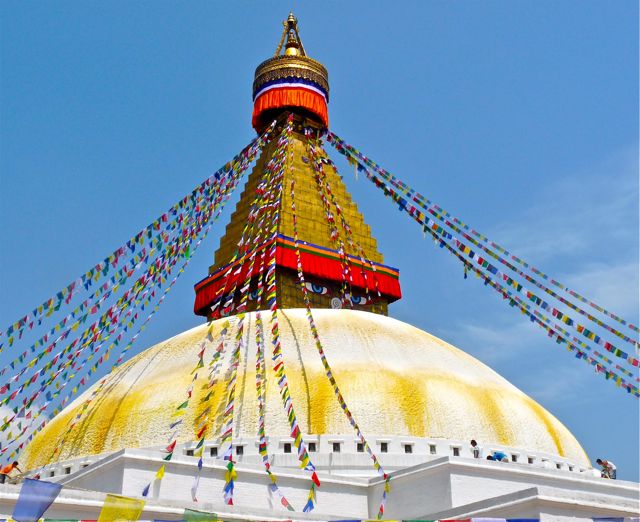
Our focus here seemed to be on shopping. Our guide took us to a number of places where we learned about (and/or purchased) singing bowls, cashmere/pashmina fabrics and scarves, and Thankas.
I’m not much of a shopper, but I appreciated the chance to learn a little about some of Nepal’s art and cultural life. We helped the local economy, I’m sure our guide got some pretty good commissions… so, you know: win, win. It was a lively, bustling place (and like everywhere, smelled great). Stores surround the circular plaza, completely bulging with stuff.. paradise for the shoppers.
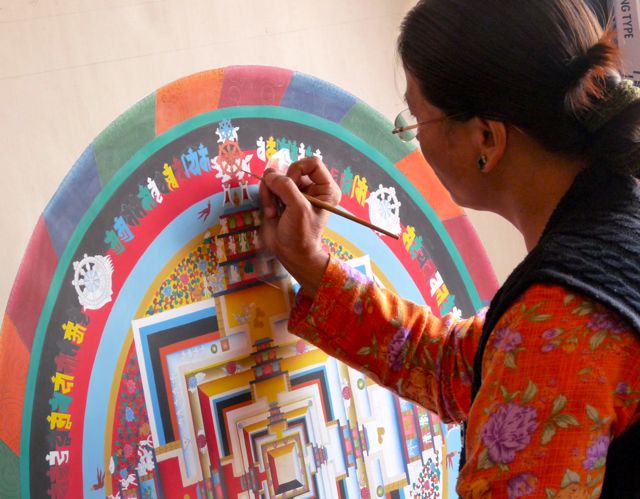
Here is a Thanka painting school where we spent a lot of time and sat in on a lecture and demonstration of this ancient process.
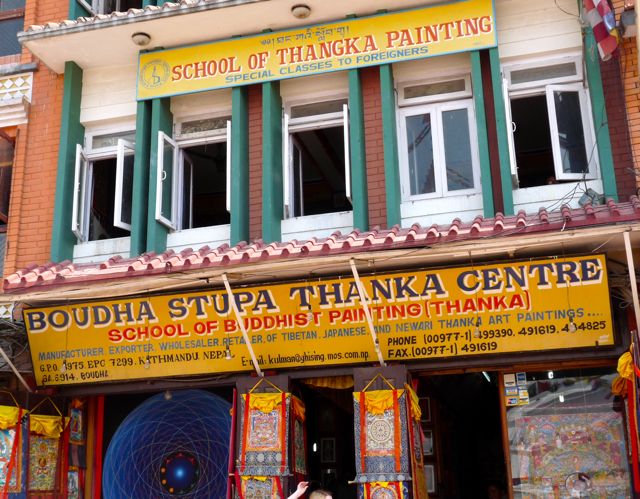
Thankas consist of a picture panel which is painted on textile or embroidered, over which is laid a cover, usually silk. It is sometimes called a scroll-painting. Images of deities and/or the life of Buddha are depicted, which describe historical events, or are a retelling of myths. They often become a teaching tool. Perhaps most importantly, this form of religious art is used as a meditation tool to help bring one further down the path to enlightenment. I found them very interesting… and.. bought one.
We had a great lunch in Bodhnath before taking off for our final stop….
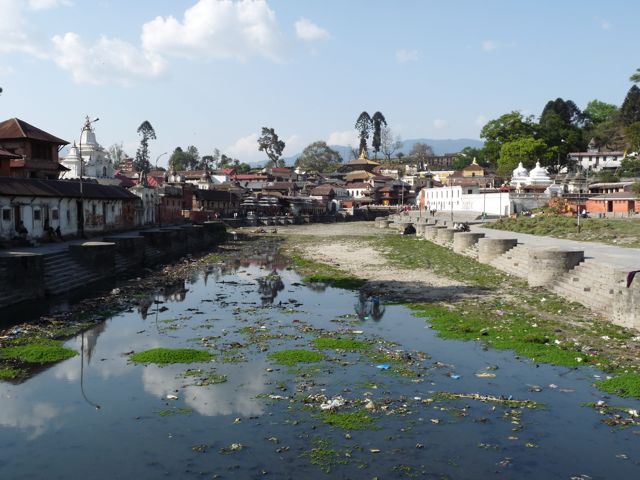
Out on the western side of downtown, near the Tribhuvan International Airport, along the banks of the sacred (if dirty, polluted, and full of garbage) Bagmati River, is one of Nepal’s most important Hindu temples and cremation sites: Pashupatinath. Here, in the middle of town, in full view of passers by, they perform open air cremations, with humanity and traffic in chaotic bustle all around. It’s hard to make out in this picture, but you can see the ghats–concrete platforms which are used for the cremations–along the river banks. The formal public viewing (and where we sat) is across the river on the right, on concrete risers, not quite viewable in this picture.
Funerals of ordinary Nepalis take place daily on the ghats. Bodies are wrapped in shrouds and placed on wooden pyres. We saw corpses in various stages of the process (I think it takes about 2-3 hours to fully burn). We saw the beginning of one ceremony, where family members walked around the body, tossed flowers, burned incense, etc., after which straw was placed upon the body and the whole thing was set on fire.
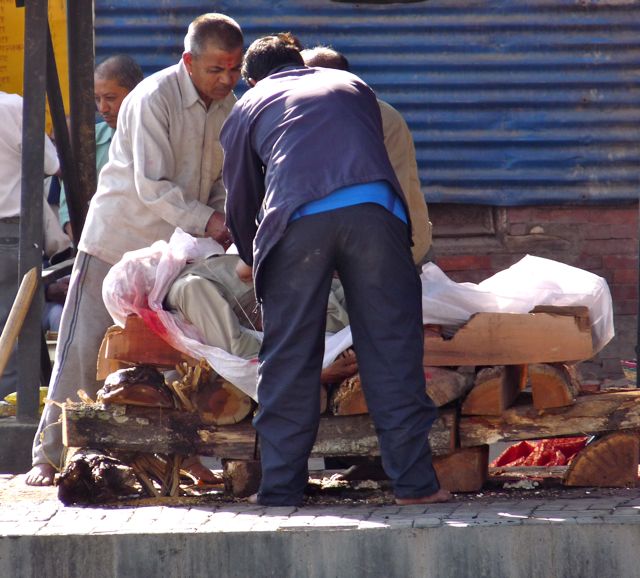
We saw the end of another process where, once fully burned, the final remains (and clothes, shoes and the structure itself) were tossed and/or swept into the river.
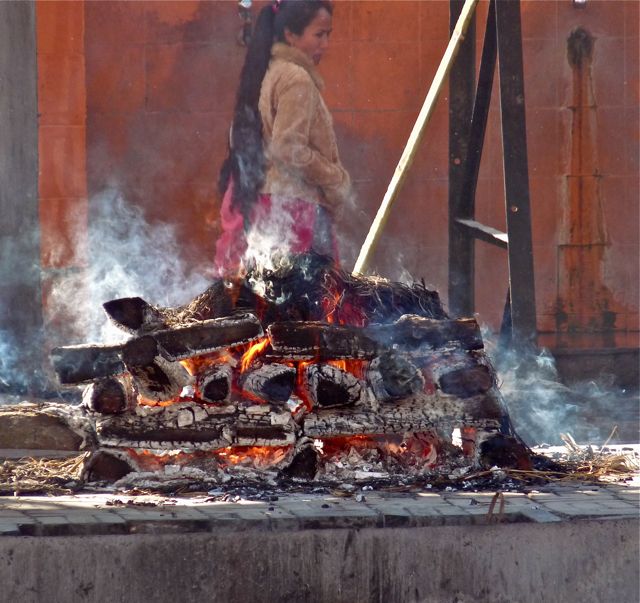
I’d somehow missed our guide’s explanation of where we were going, so it took awhile for me to fully grasp what was happening. It was at first disturbing, but then I found it fascinating. In our culture, death is such a private event; few of us get close to the experience of it, so it’s mysterious and remains sort of forbidden. But here, in this setting, it was very public and, while I’m certain people grieve the loss of their loved ones, death seemed clearly a part of people’s everyday reality of life. I was grateful for the experience of it. Much to think about.
The entire tour today offered a lot; the sights were fascinating, beautiful, extra-experiential and macabre. There is a lot more to learn about Nepali life and culture, Hindu and Buddhist practices, but there was much today to ignite the senses and make curious travelers out of us all.


