
Around Namche Bazaar
April 7, 2011
Trip Day #9, Trek Day #3
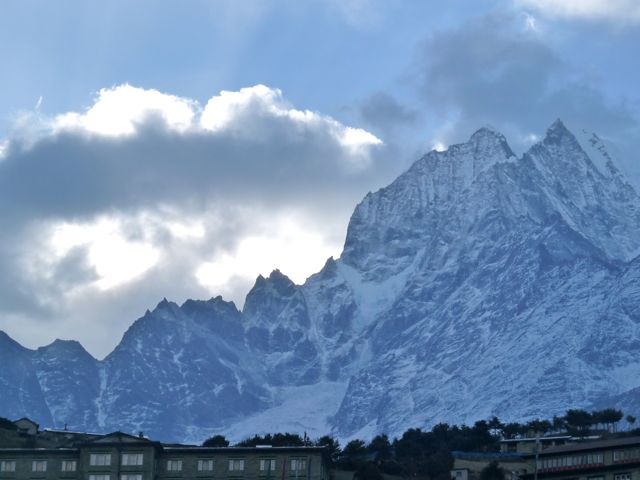
Woke to the sounds of village life echoing off the buildings: barking dogs, the hammering of new construction, herders moving their yaks along. The sun was dramatic behind snow covered Thamserku (21,675′) that towered over us and the air was cold as we came out from beneath our electric blankets to open the door for our morning tea delivery.
My head was still pounding when I woke up. I’d been hesitant to treat the headache the night before with my usual concoction of motrin and tylenol since I’d taken a half dose of Diamox (the medication used to treat Acute Mountain Sickness, or AMS) and didn’t know about its reaction with the others. Karen, ever resourceful, emailed our nurse friend Betsy, but had not yet heard back. But by morning, I was so tired of hurting so much, I went ahead and took the double dose of headache stuff, and, whattaya know, the headache went away quickly. This was a great sign that I wasn’t, in fact, having altitude issues. Yay!
Day #3 was going to be all about acclimatization. That meant we were going to remain in Namche Bazaar for one more night in order to let our bodies adjust to the altitude. Acclimatization is a Very Big Deal in high altitude trekking. AMS can be life threatening if not recognized and treated, so we were on altitude sickness watch pretty much all the time.
Acclimatization and AMS are both fascinating. Some really good basic information is available here.
In a nutshell, the key to avoiding AMS is to let your body adjust to altitude at an appropriate rate. You need time to generate extra red blood cells (they carry oxygen), to compensate for the diminished concentration of oxygen at higher elevations. You keep your ascents to a certain number of feet per day, stay super hydrated and watch for signs. First sign is a headache and is itself not a threat. But, a headache plus one or more additional symptoms gets worrisome (nausea, lack of appetite, vomiting, stomach ache, fatigue, dizziness, insomnia, shortness of breath… and a few more). Again, the incidence of my intense headache, coupled with nausea was a bad sign (Hom thought it was certainly altitude, but I suspected cigarettes because that’s how I frequently react to cigarettes), but with a rapid ascent to 11,200′ you just never know.
Suffice to say, it was always on our minds.
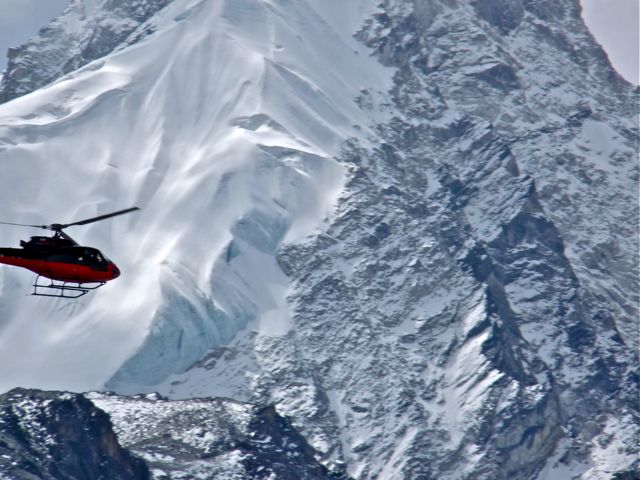
We saw a LOT of people struggle with altitude and heard a number of stories about people being sent home. We saw the helicopters flying up and down the valleys daily, transporting the more serious cases off the mountain.
There are several small medical facilities located along the main trails, and each of them offers lectures on AMS and its more deadly variations–high altitude pulmonary edema and high altitude cerebral edema (HAPE and HACE).
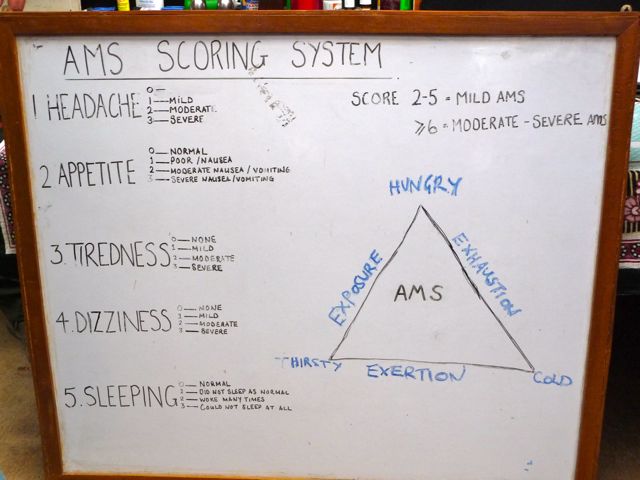
Trekkers are strongly encouraged to attend a lecture at least once at one of these facilities. We attended a lecture on day 5 when in the tiny settlement of Machermo (14,649′). More on that later.
Anyway, our second day in Namche was all about red blood cell production. A good rule of thumb is to hike high, sleep low. Meaning, spend your day hiking at high elevations, then come back to a relatively lower elevation to sleep (this is when your body goes to work producing those rbcs). So, we did that.
After breakfast, we took off. And headed up. I can’t tell you how tired I was. It was very steep (started to dislike those stone steps) and my legs felt very weak. I just didn’t get it… I was very surprised. Never have I been that tired hiking.
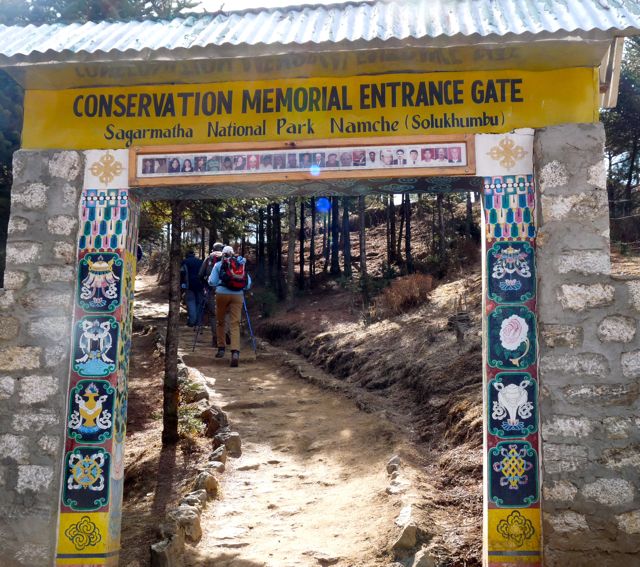
First stop was the Sagarmatha National Park Visitor Center.
It sits at the top of a hill (of course) that gave us our first official view of Mount Everest (29,029′) and these surrounding rock star mountains: Nuptse (20th highest in world, 25,801′), Lhotse (4th highest 27,940′), Ama Dablam (24,493′), Thamserku (21,675′)… and lots of supporting players.
Below is Everest — the distant-most rounded peak with cloud formations (ever present) trailing off its right side.
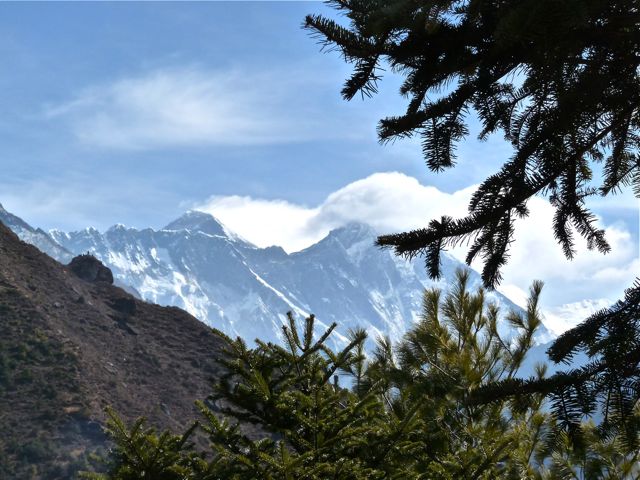
I actually teared up upon seeing Everest. Couldn’t stop thinking of Peter. Kept saying to myself, “you’re going to love this, Peter, when you get here.” We’d get much closer for better views as the trip went on, but this was the most exciting vista, since it was the official first on the trek.
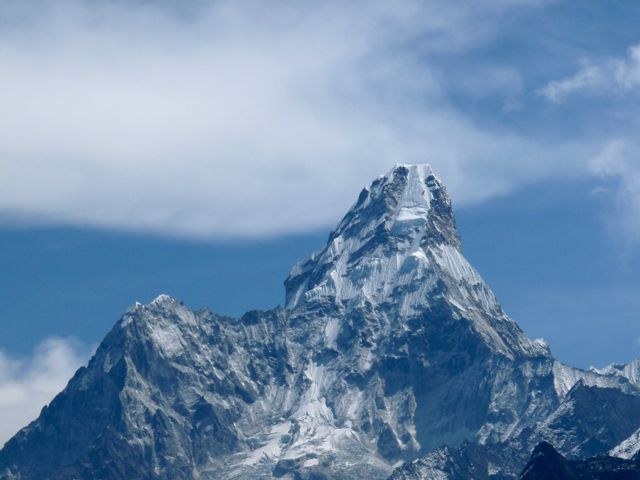
Here’s the very prominent and easy-to-spot Ama Dablam. It’s sort of like the Matterhorn of the Himalayas because it is so recognizable; it is the subject of many a painting!
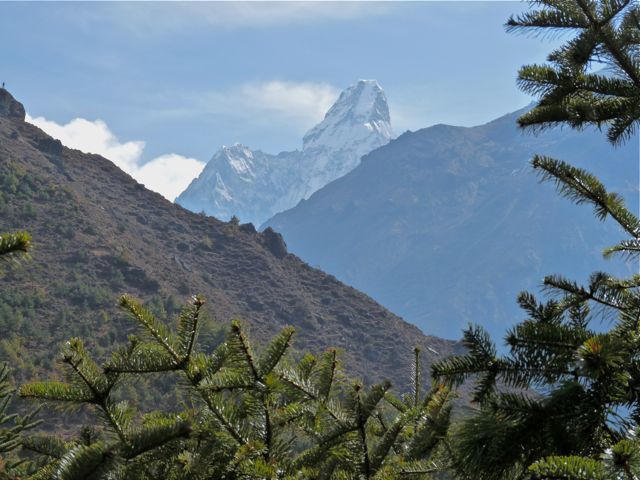
After taking in the view, we spent about an hour in the visitors center and Sherpa Culture Museum looking at displays on Himalayan flora and fauna and the sherpa culture of the Khumbu region.
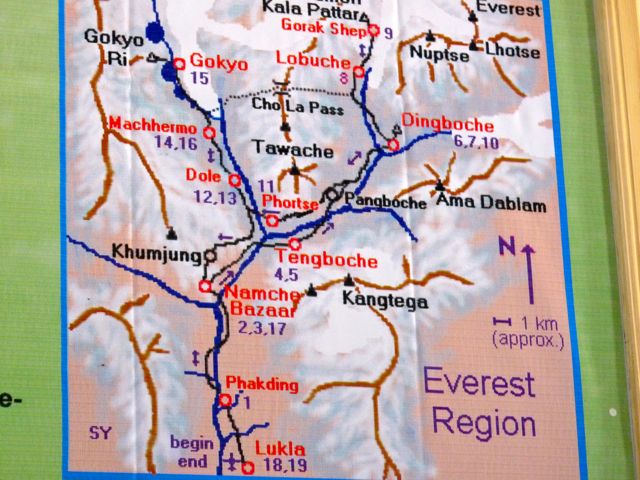
This is a good time to show you the entire trek route, since, in Namche, we are at a crossroads. At the bottom, you see Lukla, where the airport is, and where the trek starts for the vast majority of trekkers in this region. Hiking north we spent the first night in Phakding, and then our two nights in Namche. From here we’ll bear left and go through (and stay one night each in) the villages of Dole and Machermo before reaching Gokyo, where we’ll stay another two nights in order to acclimatize to that elevation. From there, we’ll cross the famed Ngozumpa glacier to the east (receded where we cross) and stay overnight in a settlement that doesn’t show on this map, Thaknak, sometimes called Dragnag. The next day, we’ll cross the Cho La Pass and spend that night in Lobuche. Then we’ll trek north again to Gorek Shep, where we’ll stay for a night (and from where we’ll hike to Everest Base Camp, not shown on the map, but just north of Gorek Shep). Then, it’s back down. We’ll stay in Pangboche, pass through Tengboche, and stay once again in Namche. Our last day is a long one, from Namche all the way to Lukla, where we’ll stay overnight before flying back to Kathmandu. Thirteen nights and somewhere between 75-90 miles.
Here’s some good info about the Sagarmatha National Park:
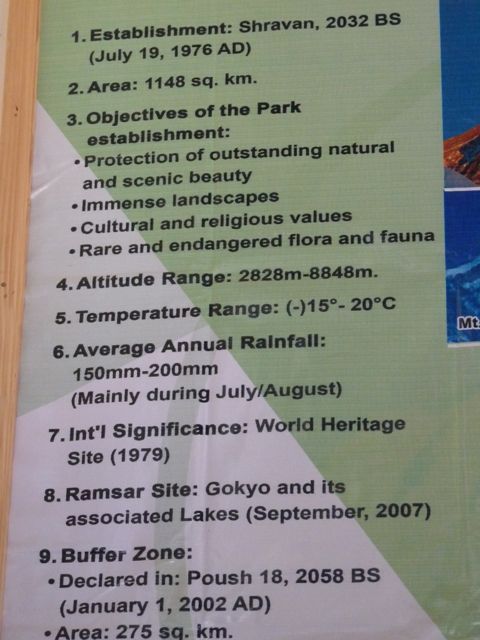
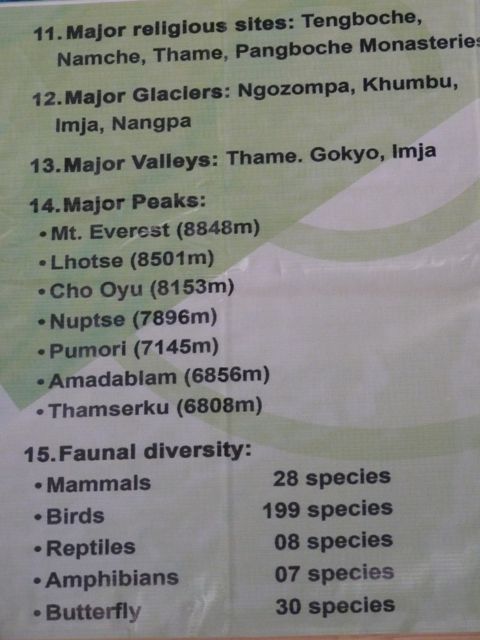
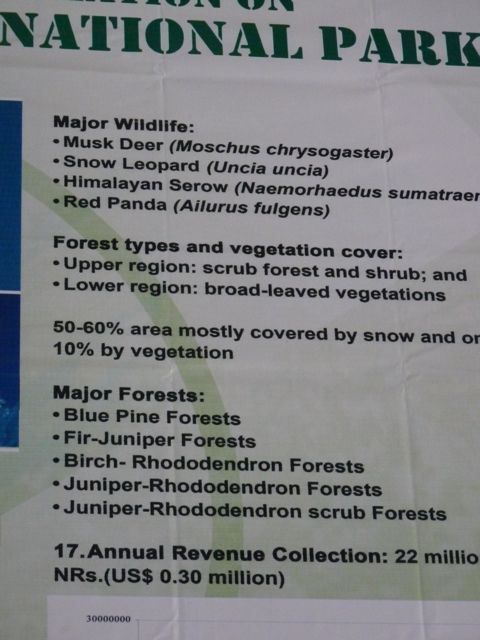
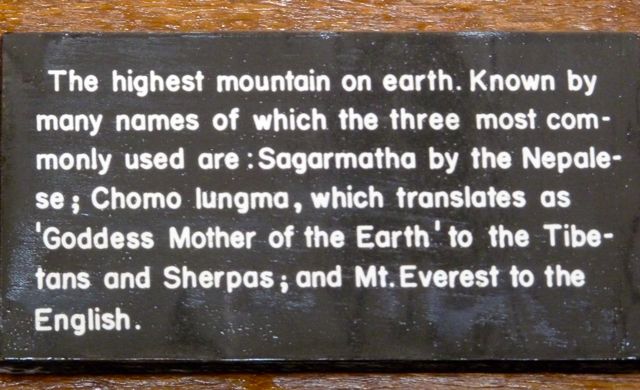
And a couple other neat things:
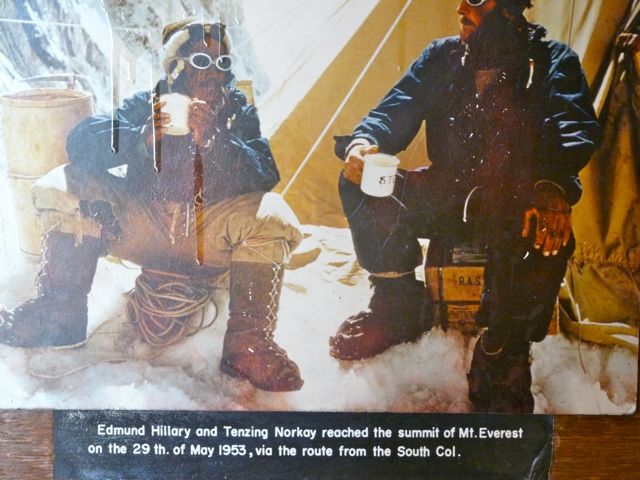
First ascenders of Everest: Sir Edmond Hillary and Tenzing Norgay.
After all this, we headed out for a big climb up the mountain. It was actually a surprisingly steep climb. In all, we’d climb another 1500′ this day before returning to Namche to sleep (climb high, sleep low). Slow going, but steady.
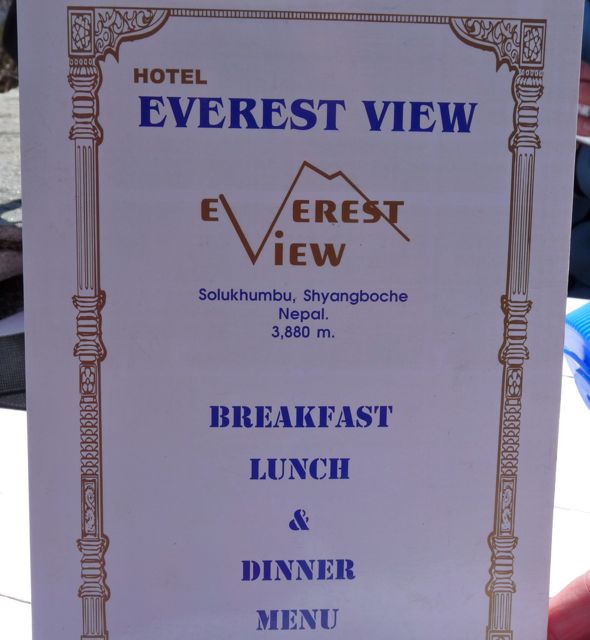
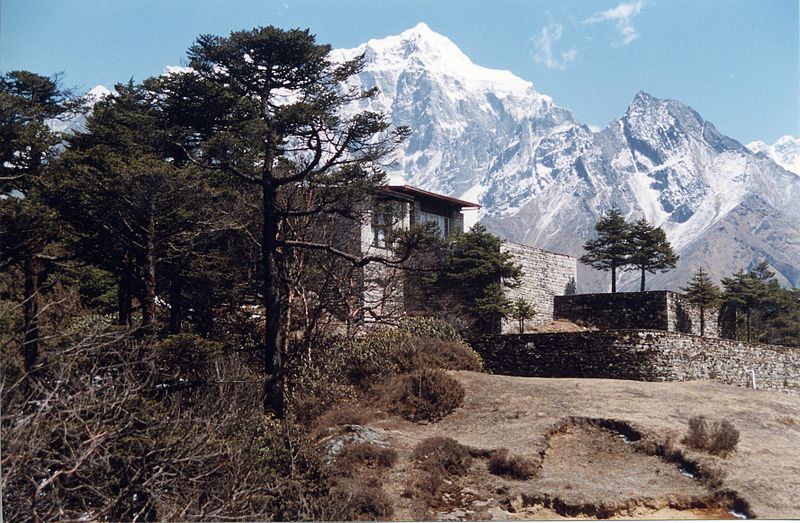
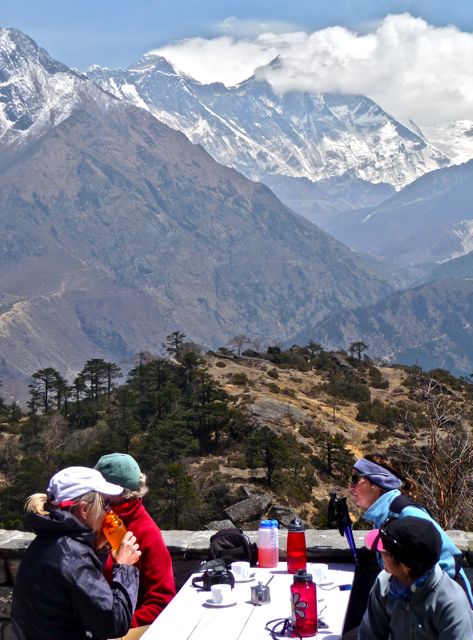
We went first to the Everest View Hotel. It was built by a Japanese company in 1968 and is said to be the highest hotel in the entire world with panorama views from all rooms. When it was first opened, they’d pipe oxygen into each room, though found this was not a good strategy and discontinued the practice. We’d read, while in Kathmandu, that the newly married British royal couple was planning to honeymoon here a few weeks after our visit, but that didn’t seem to materialize. Those funny royals. We, of course, did not stay there, but did have tea on the balcony.
Here’s the hotel (not my picture), and below that, a shot of us sipping our tea on a gorgeous, if cold, day (also not my picture; this one taken by Rick).
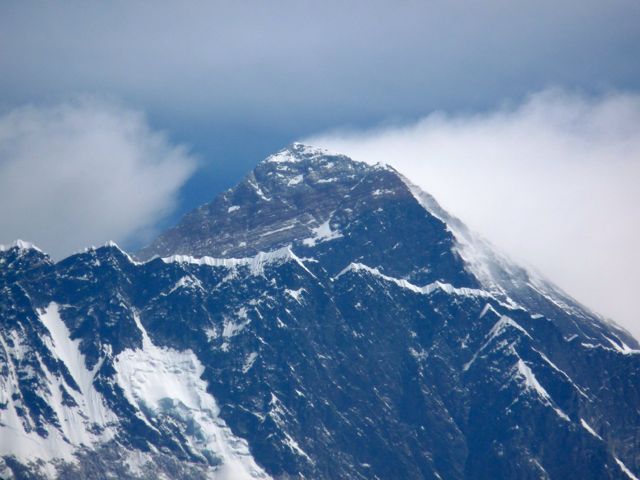
We did have fantastic views. Yep: EVEREST! And below that, one of Ama Dablam.. nothing like a zoom lens, huh?
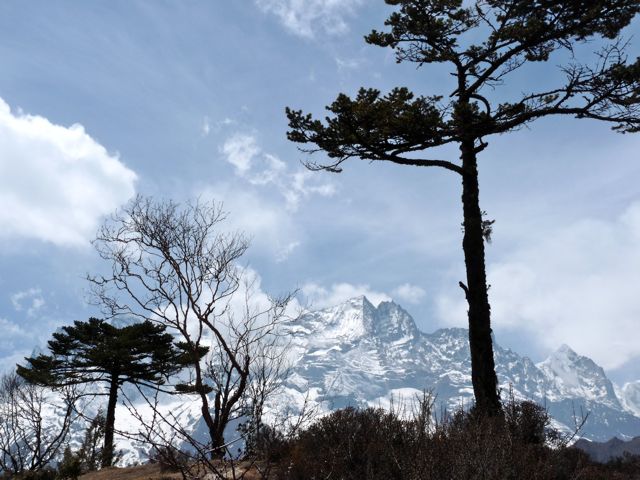
After this light and lovely repast, we headed down to the very picturesque village of Khumjung for lunch. Here’s a view along the way.. probably looking at the sacred peak Khumbila 18,901′.
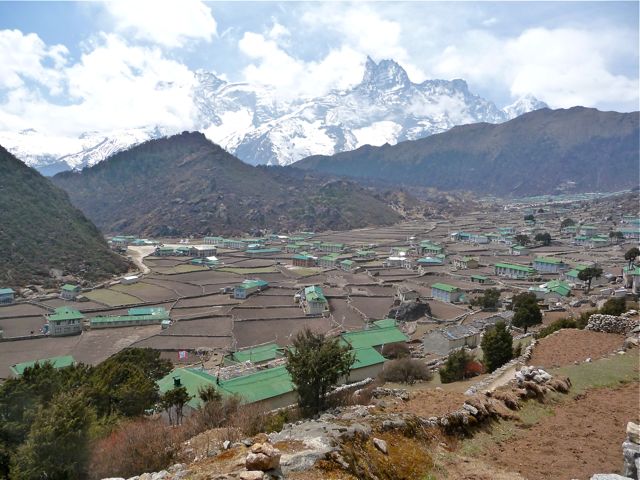
Khumjung is the largest village in the Khumbu region. The houses are “large and ostentatious,” says Lonely Planet. Below is an overview of the village (taken by Rick) as we dropped down the mountain from where the hotel was.
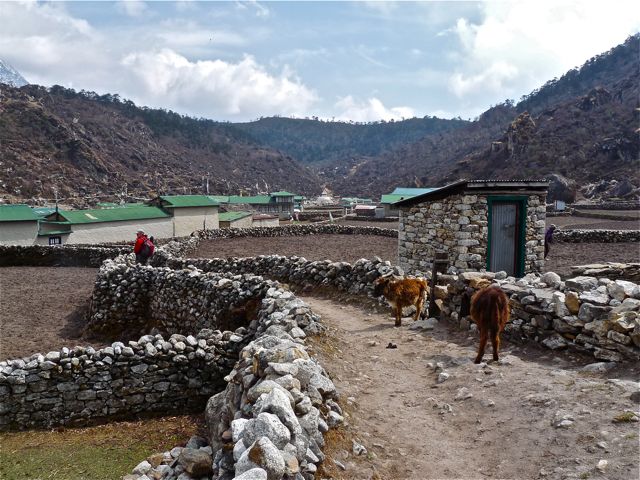
Here’s what it looks like as you’re walking through the village. Property is separated by stone walls. Animals roam.
First we had lunch on the top floor of a nice restaurant. Garlic soup and hash browns with cheese. I’m not the only one who’s pooped; this is Laura, who catches cat naps whenever possible:

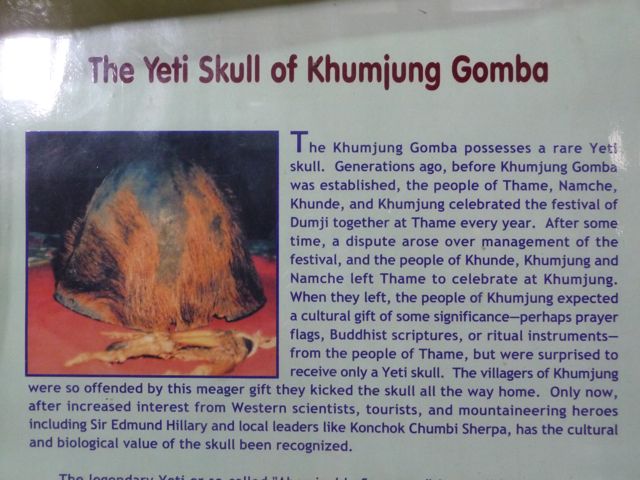
Then we visited the Khumjung Gompa to see a Yeti skull. Yetis are mythical, hairy, human-like animals. Countries all over the world seem to have legends about these mythical figures. We call him the abominable snowman. Nepalese and Tibetan people call him a yeti. There is a lot of interesting reading about yetis here.
We had to find the guy who had the key, and after a while he turned up and let us in to the monastery that houses the skull.
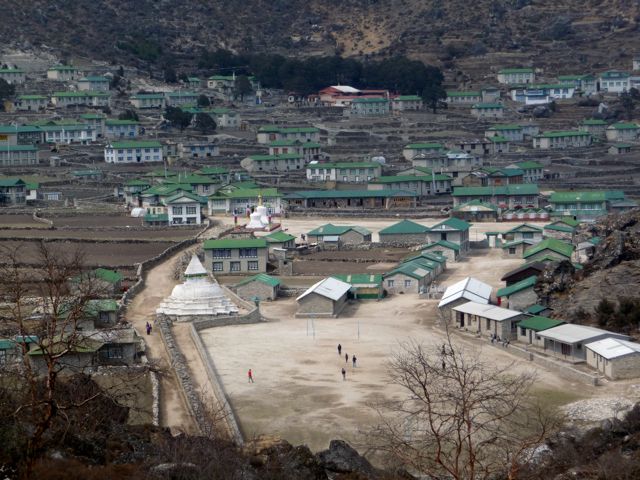
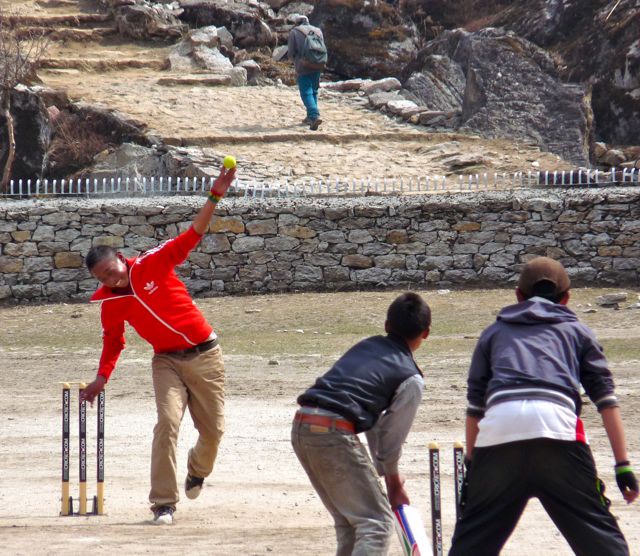
Here’s another of Rick’s shots of Khumjung, this one looks down on the famous Hillary School (foreground), established in 1961 by Hillary. Today it provides elementary education for more than 350 children from surrounding villages. Those kids down on that field are playing cricket (that’s my shot of them from field level).
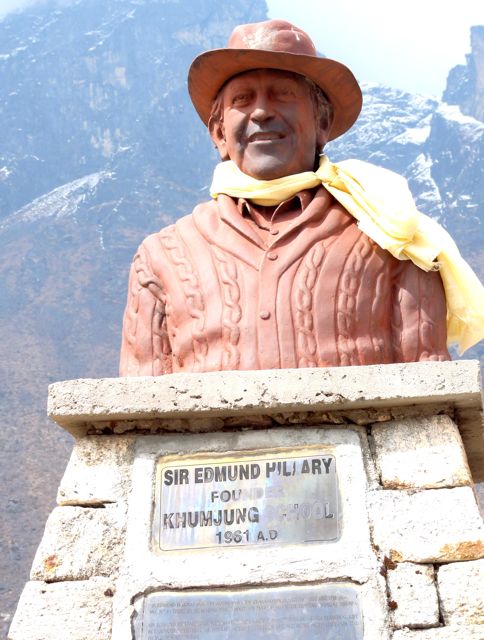
There’s a big statue of Sir Edmond Hillary outside the school. It’s very nice. He gave a tremendous amount of money and support to this area after he climbed Everest. He is very much a local hero.
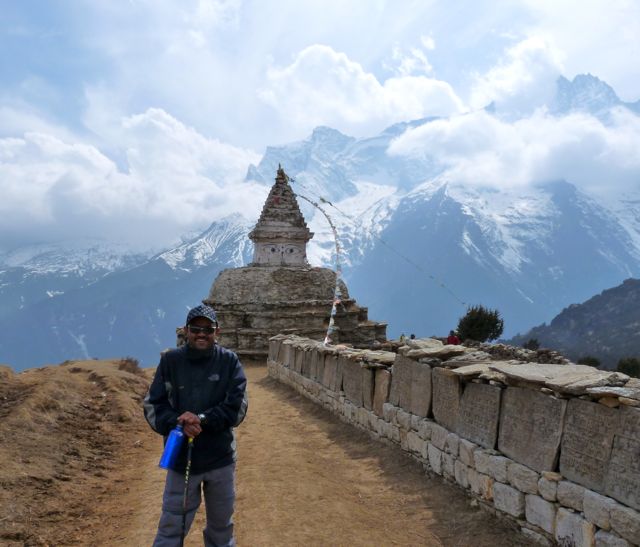
We climbed a big hill out of Khumjung, then before we started a massive and steep descent, we passed this stupa and a wall of mani stones. Here’s Hom standing along the trail. It was so glorious, the views so breathtaking.
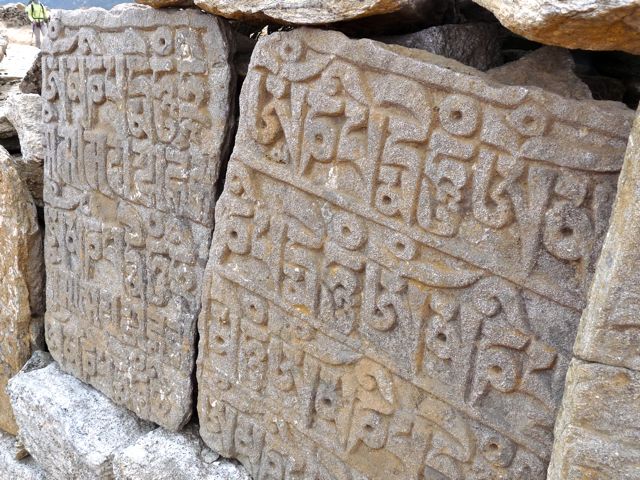
Here’s a close up of a mani stone, on which is written, om mani padme hum.
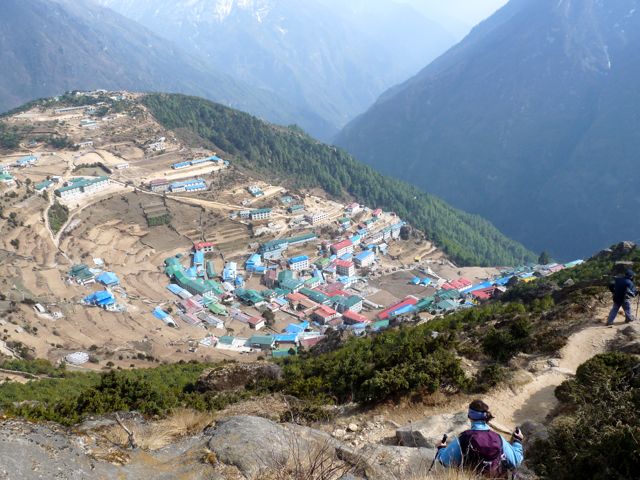
On the way down, we passed a small airport, Shyangboche, considered the highest domestic airport (more like a grass landing strip and a wind sock) in the world. Huh. About 1500′ feet later, and super sore knees, we arrived again in Namche. It was a stunning approach:
And that was that day.
When we got back to our hotel, the hot water didn’t work, so took cold showers (not so nice), then met for tea and cookies at the Namche Bakery (pretty good!). I spent some time on the internet, then we went out shopping for gear. More gear! With lots of help from Karen, I ended up buying a down coat (really a down “sweater”), a soft shell (for wind and warmth), some down booties (to wear in my sleeping bag at the higher and colder elevations), and some huge gloves with a water proof shell. We also stocked up on iodine tablets to purify our water (since our steri-pen turned out to be dysfunctional), and neutralizers to make the water taste less horrible after sterilizing. Good shopping spree, lots of bargaining. The items could be knock offs, could be real. Hard to say. They were very cheap.. and totally did the trick.
Dinner of Namche soup (a thick vegetable soup, not unlike the sherpa stew we’d order later on the trek) and fried rice. So hungry. Ate like crazy people. Then slept really well. Probably went to sleep around 8:00.

 Life of Wry
June 13, 2011 at 12:07 am
I’m loving these trip reports! The photos are great.
June 13, 2011 at 7:40 am
Thank you so much! It’s sort of a slog (slow blog) to get through them (to write them, that is)… but also fun, and i’m sure it’ll be worth it, for the value of looking back on them. Writing it mostly for Peter.
Just got to keep going..