
Dismantling Christmas
January 4, 2011
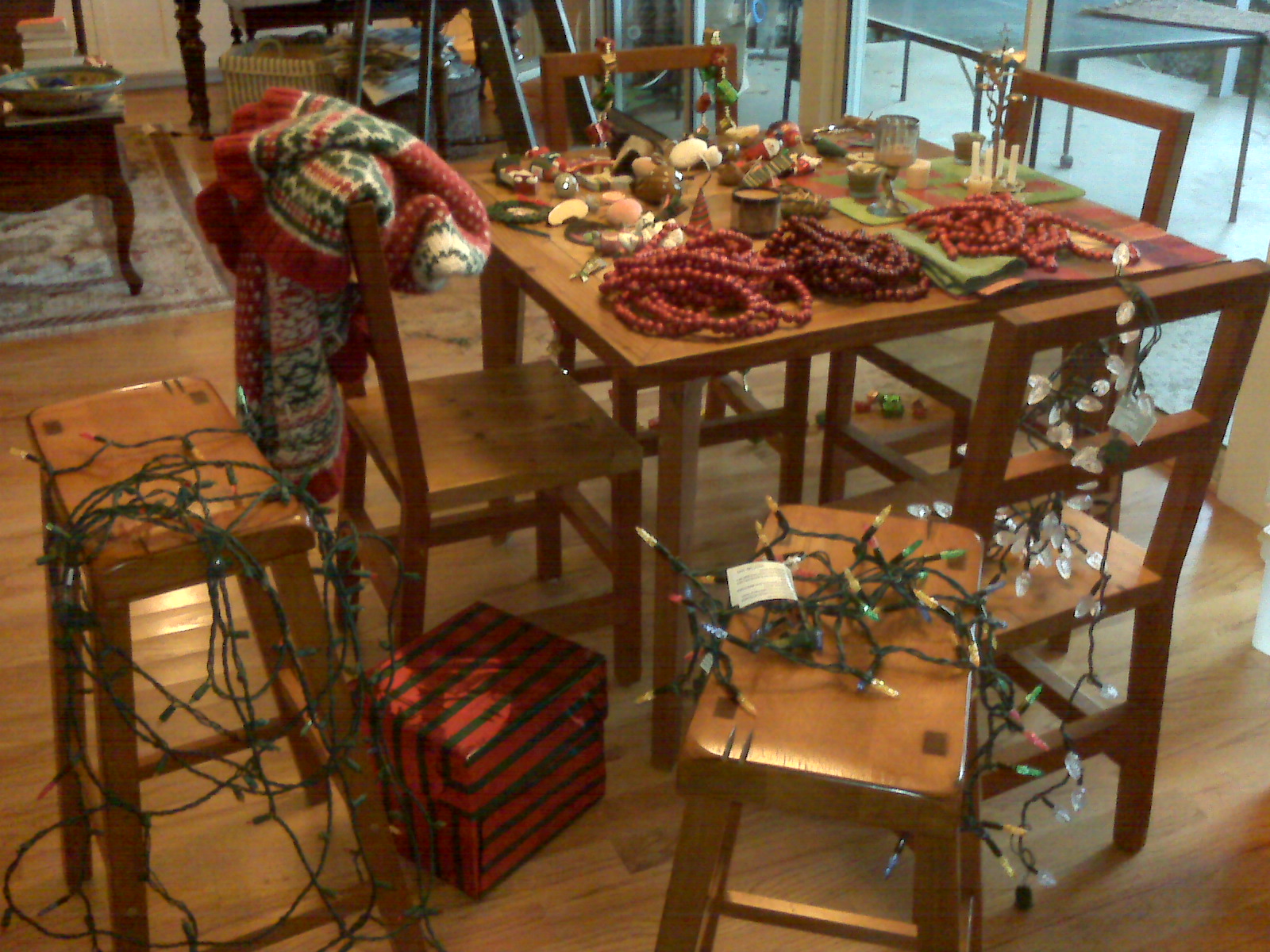
A Ladder Where the Tree Used to Be
Blah. So disappointed.
Dismantling the tree and packing up Christmas tonight. That is not the disappointing part. I’m happy, more than happy, to wrap it up for the year. Though tedious, I’m ok with returning everything to the 7 large boxes that will be stored on shelves high above the master bedroom.
What is disappointing is that the holiday season just feels so desperately wrong and I’m sad that I’m happy that it’s done. Way too happy. I dread its coming, I’m glad when it’s over. That’s just really a bummer, isn’t it? It’s a month-long sprint to get through a massive list of tasks in a timely manner, and spend a boatload of money, and, when it’s all over… who cares? It’s just a lot of money and a lot to get through…and what exactly was the value?
While packing things up, I did have this great urge to open all the doors and windows and let the cold, 40-degree air blow through the house, as if to clear it all out, freshen everything, thinking that by doing so, I’d rid the house of over-spent, expectation-laden, fattening, beaten-into-submission energy. So I did that too… until I got looked askance at.
Sat in Jim’s office and whined until he booted me out. Said to go write about it, it’s obviously potent. I said it’s not going to be pretty or nice. It’s going to ugly up my blog a LOT. Then I decided what the hell. I’m the only one who reads it. [So, I did do that, sat down and wrote furiously about why I hate Christmas. It was a little more interesting to read before I cleaned it up. If I think that Peter might discover this blog one day, I’ll probably remove this entirely, even this cleaned up version, because he doesn’t need to see his mama completely effing up his memory of Christmas.]
The truth is though, I despair of the repulsive commercialism and consumerism that is Christmas. Who doesn’t, I know. Nothing new there. I’ve grown just so incredibly weary of the holidays and resentful of the expectations, and I know I’m not alone. But worse, I have felt increasingly angry that I haven’t somehow managed to find some work-around, or been successful in creating some smaller, more personal, more meaningful traditions for my family. We can do better than this. It’s my job, because I have a kid, to create what will become his Christmas memory. I did for a lot of years, but then .. man.. he got older and more single minded and it got harder and more crass. And I grew cynical. But now I feel like I’ve allowed myself to be taken hostage by my cynicism, and can’t seem to view Christmas as anything but a trial. And now that’s making me mad. And I feel like a shitty mom.
This is probably what happens when you have a 12-year old for whom Christmas is about presents. Only presents. And who does not really take responsibility for or care about present buying for his family or friends. Just the getting. It’s dispiriting, but I don’t blame him, it’s not his fault; he’s 12.
I thought I had this Peter thing figured out a couple months ago, well in advance of Christmas. I decided to lighten up, accept it as a developmental reality, a very real limitation of his age. I convinced myself that, developmentally, 12-year olds are simply incapable of truly feeling empathy and compassion, and for them, the magic of Christmas (I only use that term because it’s in all the literature) is beyond them. For kids–mine anyway–it’s about presents. So… let’s just let it be that for him and do away with expectations to the contrary.
I figured we could ride it out. Give him exactly what he wants, make it age-appropriate magic. I thought we could provide gentle and consistent reminders along the way and by the time he IS old enough to pay more than lip service to the “real meaning of Christmas” he’ll have a pretty good sense of what those things are because he will have heard about them from us. But no need to beat him over the head with values he simply cannot get his greedy little hands around. Let’s just go where he is and let him have fantastic, memorable wrapper-ripping fun.
This is what I thought. I was quite happy with the idea. But my cynicism still festered, as my cheery ideas for this event or that activity were assaulted, one right after the other. “Do we have to do this?” “Can I stay home?”
Just my god.
In true beat-self-up fashion, I feel totally responsible for Peter’s lack of empathy and compassion. We should have done a better job of teaching him what this, Christmas, and life in our world is all about. Nobody said it would be easy to teach kids values, but it is still our responsibility to raise them to be reverent, kind, honorable, compassionate humans. I do realize that a lot of activities that we might foist upon him hold no meaning–let’s say serving food at the annual Community Meal, or delivering presents to needy children, or donating his old toys to the shelter, or, as a family, choosing a charity and sending money, or volunteering or whatever. Believe me, at one time or another, we’ve tried. It’s all been a part of our holiday effort, feeble though it’s become. Feeble because I didn’t keep it up; it felt forced and it became easier not to suffer through it again. Felt like an empty gesture, so, after a while, I gave up.
[Never mind that life is about kindness and giving, not just December. A topic for another time… today, it’s a Christmas themed rant.]
So there’s that. And then there’s this:
Since I’m the mom, the organizer, the social coordinator for our small tribe, I bear most of the brunt of Christmas chores, and I’m utterly anal about it. I recycle the same to-do list every year, making small adjustments and updating the deadlines. It’s 7 pages long and very comprehensive–takes me through gift ideas, shopping lists, decorating, baking, wrapping, shipping, cards.. all of it, right down to thank you notes. I can get plenty of satisfaction out of getting it all done, ridiculously, but, really, is this what it’s come to? Project management?
And then there’s the guilt.
I feel really guilty for having such a bad attitude. “What can I do to make it better?” Jim genuinely asks like a true and willing problem solver. And I think to myself, when did I get to be such a downer? Maybe I’ve made this more complicated than it is. Really, how hard is it to find the joy? Really? This is what we have to complain about? Do what you enjoy, enjoy it, and leave the rest. Want to give? Give. Want to bake? Bake. Want to not spend so much money on superfluous gifts? Don’t. Don’t want to haul 7 large boxes out and decorate the house? Don’t do it. Oh, wait, you do want to? Well, then do it, and shut up. Am I taking my cynicism too seriously? Has it become a rote response to the season’s crassness? I think maybe it has.
Lighten up. It’s the season of light, right? Will Peter grow up and mature and eventually get it? Probably. Maybe not in my lifetime, but just keep putting it out there; it might penetrate on some level, sometime. Let’s just stop with the attitude. Move on.
It’s not that parts of it aren’t lovely. I could write about all the stuff that works, because a lot of it does; there really are some gatherings and events and activities that are truly enjoyable. Maybe I’ll write about these sometime. But that doesn’t take away from the fact that so much of it is just not right. They’ve screwed the whole damn thing up. But maybe we can deal.
When I started writing this, I was in a very marginal state of mind. It seems now that passion has morphed into calm. Angst has turned philosophical. And in deference to future generations, I’ve edited out most of the swearing. This isn’t the blog I started two nights ago…which in some ways is too bad. But in other ways, I may have worked out a few things. Blog as therapy. Today, the 7 boxes are repacked and replaced on the shelf high above, the house is clean and free of Christmas clutter, and the sun’s out, so, you know, it seems better. I’m thinking that if December is just going to keep rolling around, year after year, it’s going to have to be a season that we all look forward to, and a time that we all look back on with happiness and satisfaction.
So it goes. We’ll see about 2011.
Places: Winter Morning on Putah Creek
January 3, 2011
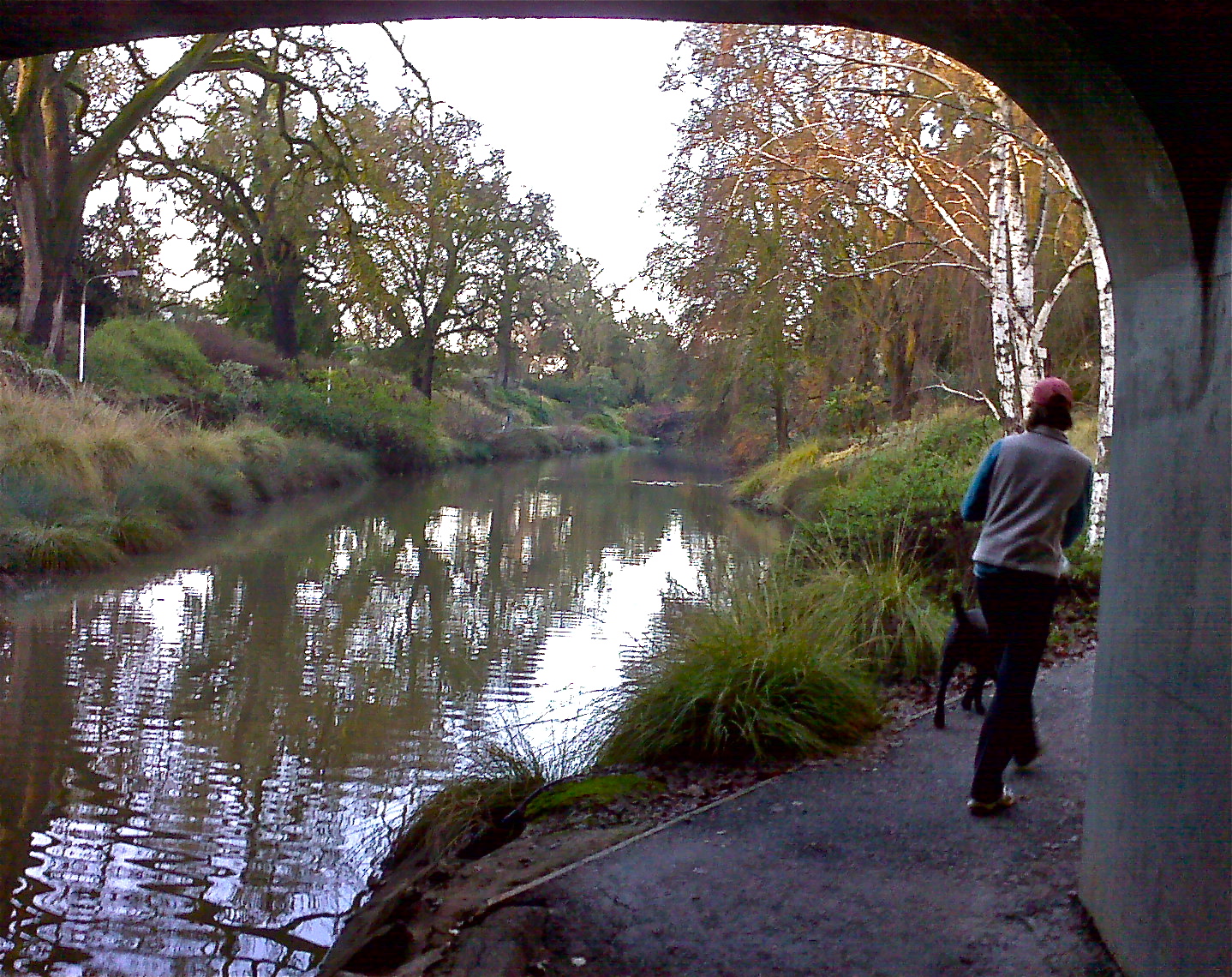
Walks figure prominently in my life these days. They’re a good thing. I mean, really, time for daily (mostly) long walks? When I’m alone, it’s thinking time. When I’m with a friend, it’s talk time. And always it’s exercise–exercise that supports a pretty lusty eating habit. (She’s a good eater.)
Definitely a good thing.
On those alone days, I take a lot of pictures.. now that I have this here Blackberry. I record ideas and notes-to-self (before on a recorder, now on my BB). I sometimes text. Sometimes, I even use my cell phone to make calls (zounds). When I’m not digitally multi-tasking, I’m just thinking. I work out a lot-o-shit. I get distance on the daily minutia. Walks are just a big hunk of time to do stuff I don’t have time for in my non-walk life.
I do cherish the alone walk days.
I also love the friend days. I have friends who are way smarter than me and so damn thoughtful, whose experiences and perspectives truly enrich me. No other way to say it. It’s like being at a TED talk. Or a TED walk. (Until I figure out how to linkify a word: ted.com).
Today’s walk was with Lorilyn and Aqua the lab, who had the same long, thick stick in her mouth for most of the morning (gotta love them). We talked about the holidays, our boys (both 7th graders teeming in hormones and self-absorption), the passage from one decade to the next, other people’s marriages, her upcoming trip to Vietnam, our thoughts about a trip to Africa. Stuff like that.
The Putah Creek loop takes about an hour, usually followed by another 30 or 40 minutes drinking coffee somewhere; today: downtown Peet’s. Davis cafes at mid-morning are typically filled with workers on break, yoga moms, retirees.. and people like us–former professionals, not currently in day jobs, doing a lot of non-paid work for the schools or nonprofits. Or whoever. And, depending on which cafe we end up in, there might be students. With laptops.
It’s a scene–the daytime cafe scene.
Forever, it seemed, I looked at this scene from the other side–the working stiff side–and totally envied it. To be that person, sitting with that other person, bent intently over mugs of frothy coffee, thoughtfully listening, talking eruditely, laughing, or gesticulating classily.
Or really, I just envied having the time. Downtime, leisure time. Time to walk, talk, think, read, write, process, plan, and the time to carry out those plans.
If I’d have given it any real thought (which I NEVER HAD TIME TO DO), I don’t think I’d have expected to be having this kind of time in my 50s, but I guess I do. And I really do enjoy the walks, especially the walk by Putah Creek, and today its wintry beauty.

In this case, at least for now, the grass is as green as it looked from the other side.
The View from Here
January 2, 2011
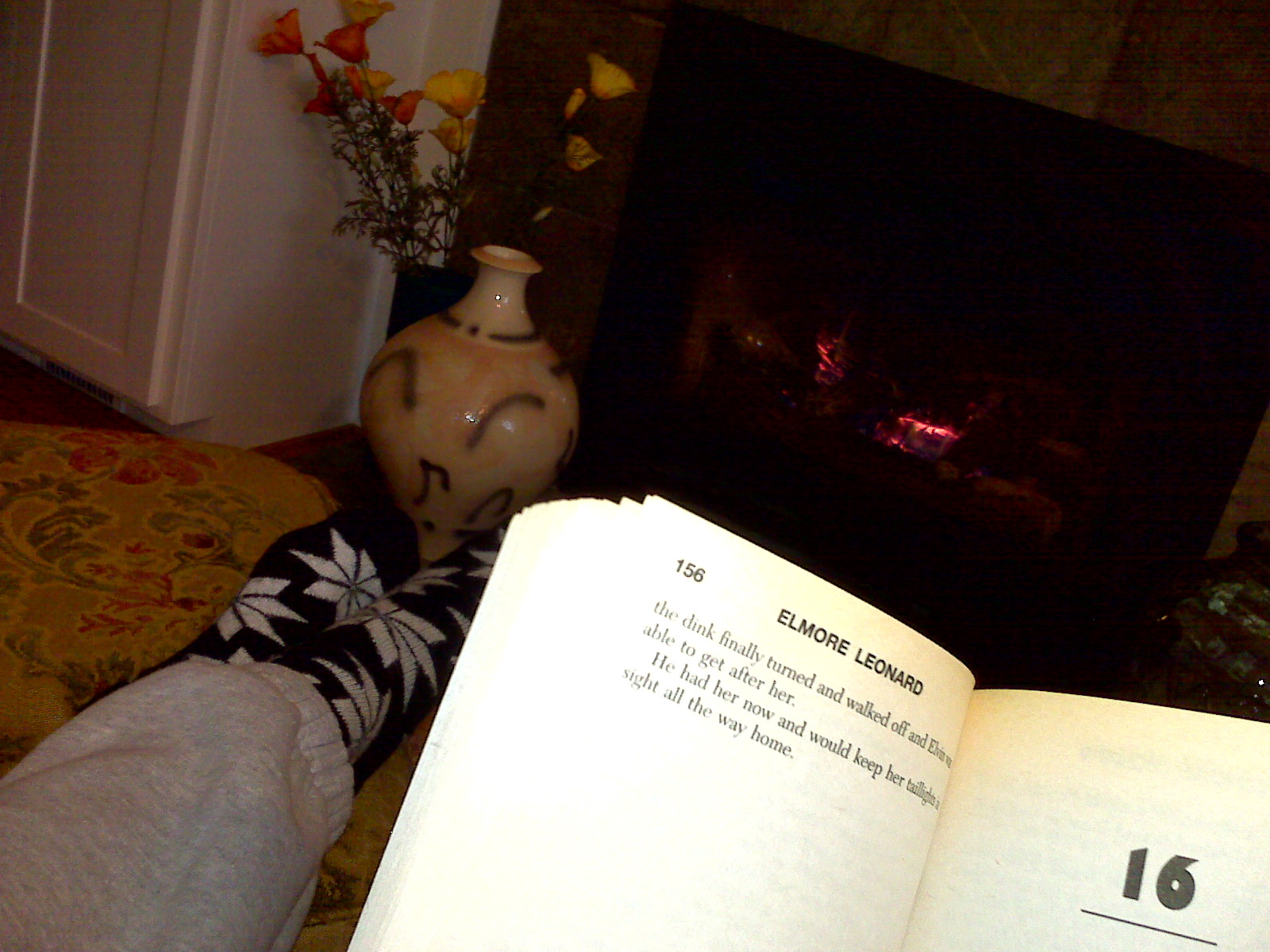
Maximum Sloth
January 2, 2011
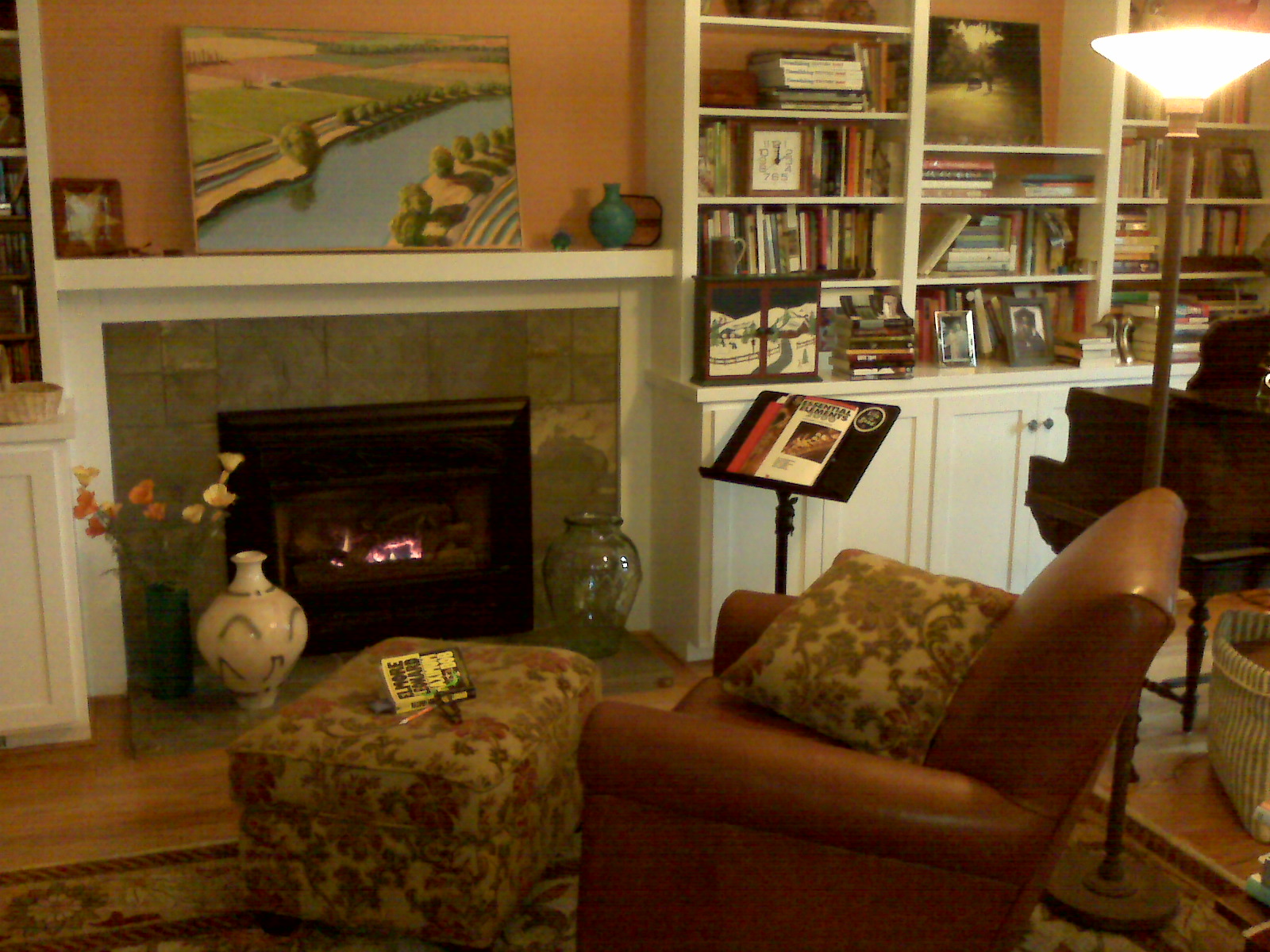
Ingredients for a perfect day: Inclement weather, empty house, fire in the fireplace, good book.
Been waiting for this.
Poker
January 1, 2011
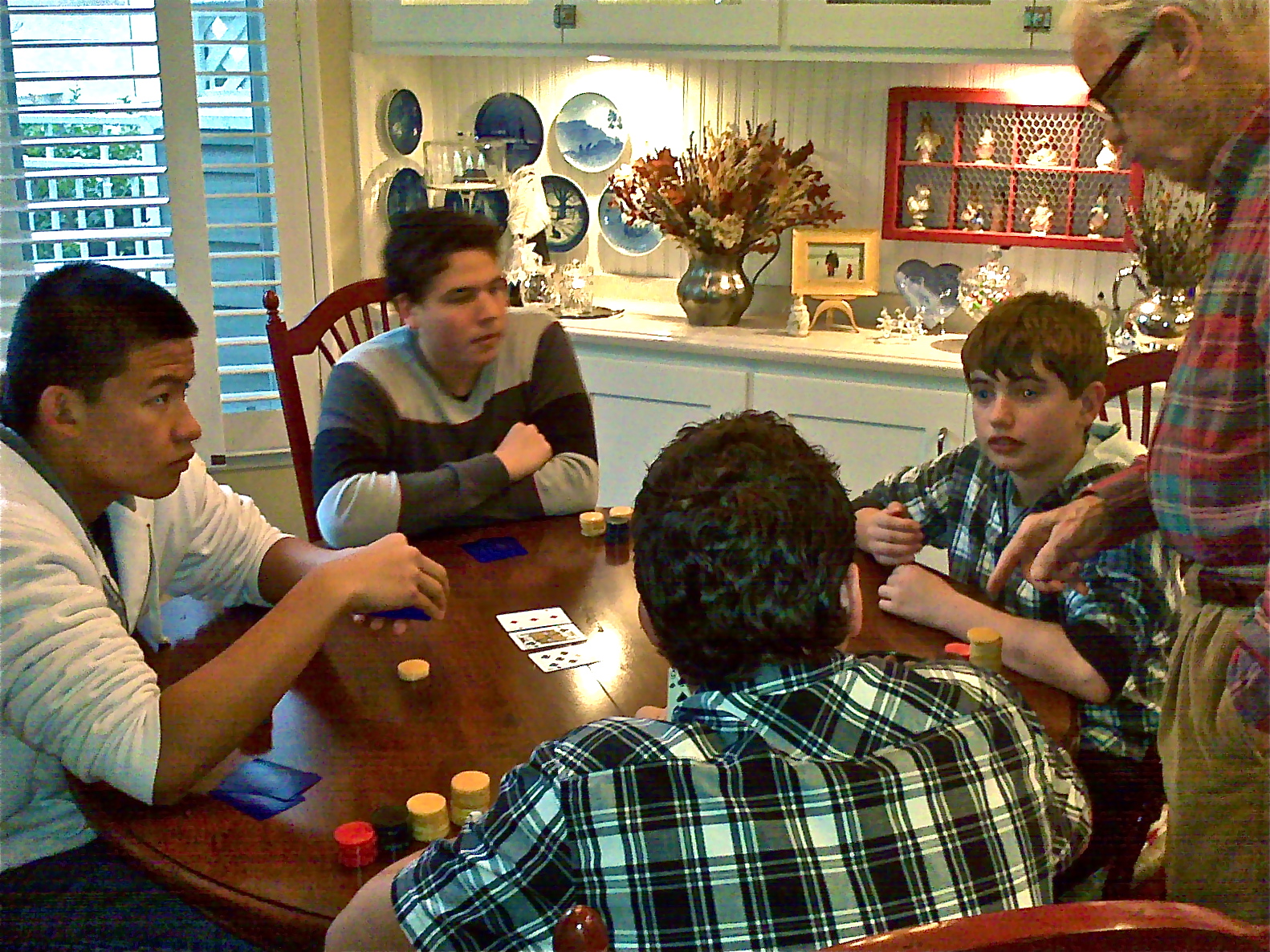
Ok. First picture. See? Nothing remarkable, just a marginal photo I took with my cell phone.
It’s Peter being schooled by his great Uncle Vic on the fine points of poker. Actually, it’s Peter’s first-ever game of poker, so the fine points included basics like what’s an ante, what’s a flush, what’s a full house, etc. He’s playing with his cousins Miles and Conner–twins who are three years older than Peter–and one of their friends.
I’m pleased with this happy little scene because of what we had to endure leading up to it. Peter had complained for most of the hour-long drive from Davis to Pleasanton–a drive already difficult because of rain and wind–about having to spend his second-to-last day of winter break with relatives instead of friends. “You didn’t ask me what I wanted to do today,” he whined annoyingly, as pre-teens do.
And yet..
He got to hang with the big boys, watch football on TV, drink vanilla cream sodas, eat a ton of chips and nuts, cookies and candy, and, AND, learn how to play poker.
And he had a blast. A happy start to the New Year.
Starting a New Project
January 1, 2011

Thought about it, picked out a new year’s resolution. Following the lead of a few Facebook and Flickr friends over the years, I’m going to take a picture a day for a year. Starting today, January 1. And I will do it through 2011, because, well, I’m tidy that way.
This has multiple benefits:
- It serves as a ready writing prompt. My idea is to post a daily photo and–this is key–provide a caption. The caption could be as little or as much as I like, but I’ve got to write something. Once the photo is there, a caption should easily follow. If moved, I could write more. If not, just a caption. No pressure, but I have to write something.
- Writing requires discipline. I’ve been committed to writing for a couple of years, minus the discipline of actually doing it. I’ve had this blog since, what, March 2009? And I’ve got a handful of posts. Without a thing, though–a goal, a project, a deadline, or whatever–writing for me seems not to happen. So I’ve created a thing.
- The exercise of taking a picture daily might also cause me to look at the world more deeply… really see or think about things around me. We’ll see. Would hope that it becomes just an extension of my day and not something contrived. Will try not to get neurotic about it.
- By the end of the year, it might tell an interesting story. Or at least a story of the year 2011. The year in pictures. Why not?
I thought about using Facebook or Flickr as the platform, but decided since it’s really more about writing, I’ll do it here. I also gave some thought to setting up a separate “2011: Year in Pictures” blog, but decided, nah.. this is fine. Right here’s good.
So, that’s what I’m doing.
Spontaneous V. Deliberate
September 22, 2010
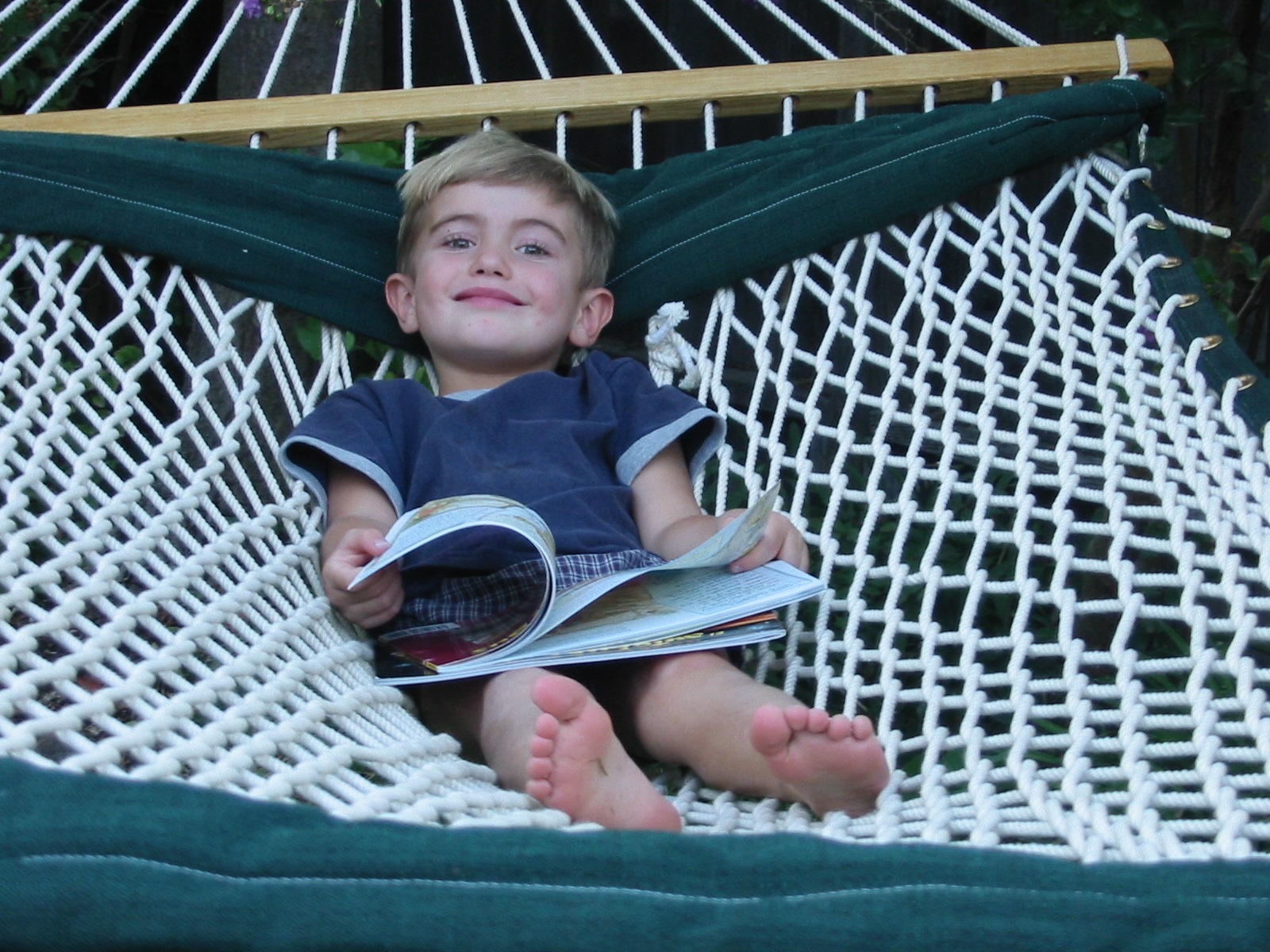
(This picture doesn’t really go, but I’m being spontaneous. And oh my god, but I love this picture.)
Coming along at a perfect moment this morning – I was drinking a cup of coffee, reading, and thinking about if or what I might write today – was this comment about spontaneous versus deliberate writing:
Deliberate writing [..] so often ends up dense and ponderous, as we over-pack every word and phrase with so much meaning. Spontaneous writing is what you’re thinking now, it’s immediate and […] takes surprising turns.
Like I said in my first post (waaay back in March 09), this blog, at least in part, is about experimenting with various writing styles. If anything, I tend toward more deliberate and less spontaneous. I tend to over write, which I think is a sign of lack of writing confidence .
It’s funny, after heavy journal writing for about 20 years, followed by nearly 20 years of email, twitter, chat and various other social media platforms, you’d think spontaneity would reign. It does, but when I write for real, it tends toward overworked.
I like technical writing or at least writing technically. I like my writing deliberate, structural and orderly. Not a surprise, I suppose. I tend to be literal, linear, precise, detail and process oriented. I seek clarity in all things. I like to work a piece of writing until I’ve squeezed all the excess juice out of it.
I like to focus for focus’s sake. I’m a person who sorts M&Ms into rows of like colors and arranges the bathroom cabinet by body part. (Is there a therapist in the house?) I see the world in patterns. I like my world tidy, categorized and containerized. I imagine technical writer types are puzzle people, people with OCD tendencies, declutterers, linear thinkers, organizers, planners.
Makes some sense, huh?
I probably missed a bet when choosing careers; I could have written vacuum cleaner manuals.
What seems really liberating, though, is a writing process that is more spontaneous, less intentional, less uptight, less careful. The kind where you open up and let it flow — personal, intimate, authentic, unmeasured. Straight from the heart.
Stepping out – to be spontaneous, uncontrolled, messy, suggestive, seductive, vulnerable – seems hugely challenging. But, hey, maybe I’ll surprise everyone and write a poem. It could happen.
Bea and Jack
September 20, 2010
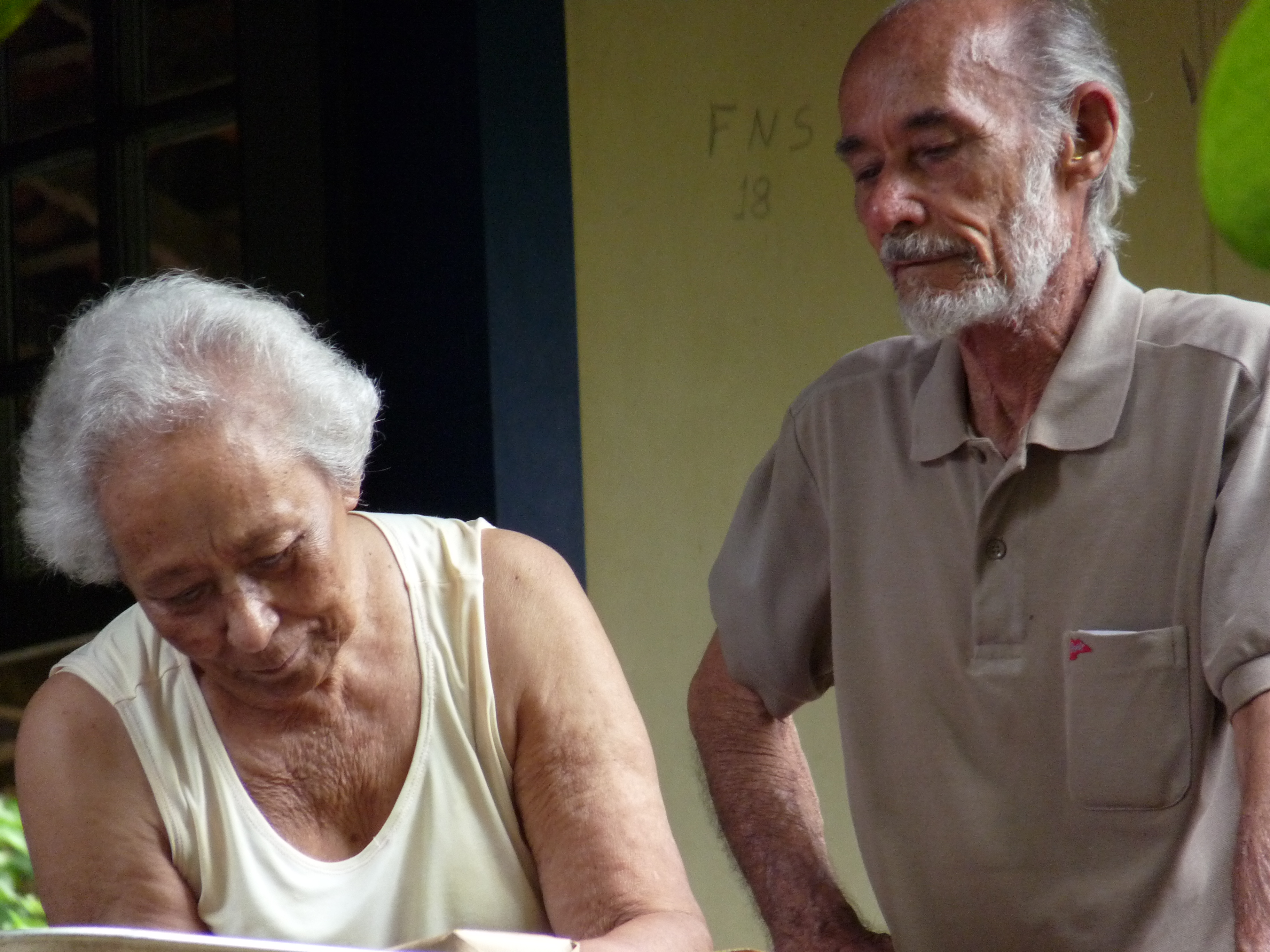
[I’m goofing around with fictional prose. This piece has no beginning nor end.. and I probably won’t return to it. The characters are based on a couple I watched today at lunch. I made up a bit of a story to go with them. For a visual, I grabbed a photo of a pair of older folks… I met them in Brazil last December. They don’t really fit the bill, but it’s better than no picture at all..]
Jack was an elderly man. He moved through the restaurant with an unsteady, uneven gait. His eyebrows, gray and woolly, deepened into a ‘V’ above his eyes, which were trained on an object somewhere ahead. His right hand stiffened into a shape that was part claw, part fist, and in his left hand he clenched a wad of keys. Walking required so much effort, Jack seemed unaware of how unnaturally he held his arms, and how curled — more out of habit than necessity — his shoulders were. Indeed, Jack looked as though he were shoring his entire body against gravity itself. He was irritated with the hostess, who had greeted them warmly at the hostess stand, but who had swiveled so deftly through the densely packed tables in the dining room that she was now completely out of sight. His wife, Bea, was at least a few turns ahead, and he was about to lose her, too. Jack was more than annoyed. But this was not unusual.
Unlike her husband, Bea was not above using a walker. In fact, she loved her walker, which she sometimes referred to as her magic carpet. She admired her husband’s determination and his noble, if not stubborn, fight to remain independent of the tools of old age — the walker, the magnifying glass for reading, the diapers, the Lifeline cord in the bathroom. But at the same time, she grew tired of his futile grasp at youth. She took pride in her effortless glide through the dining room, moving swiftly between the tables, her head held high — maybe a little too high. Part of her felt like she was on display to people who might look pityingly upon a pair of 80 year olds, and part of her was showing off for her obdurate, willful husband, always a few body lengths behind.
Arriving at last at their table, Jack didn’t have the energy to protest the fact it was not the booth he’d requested when making lunch reservations a week earlier… reservations that were, in fact, unnecessary for a Tuesday at 11:30. He sat down heavily, letting gravity do most of the work, and then quickly righted himself and got straight to business like a cat that’s fallen off the edge of a step. He rearranged his place setting, relocated the salt and pepper, and put his Pontiac key ring on top of the napkin dispenser. He didn’t suffer indignities well, but he put a good face on them.
Bea was all smiles, too many of them, Jack thought. Her eagerness embarrassed him. Though, really, if he could be honest with himself, he was less bothered by her eagerness, and more weary of his own crankiness. More and more these days he felt like a spoiler.
Bea was always excited to be eating out. She enjoyed the chance to fuss with her makeup, wear a little extra jewelry and put on some perfume. She looked forward to wearing something other than her well worn housecoat. Today she wore a pair of yellow slacks that were generously cut and held up with a thin, red, faux leather belt. She wore a floral blouse and a pair of red, patten leather loafers. She did not like sensible, rubber soled lace-ups; her shoes were her personal stand against the dowdiness of aging. The more she clip-clopped through a public place, the happier she was. Especially if she clip-clopped at a rapid pace. Her fashion signature was her propensity to wear silly socks. Her choice this day was a pair of white ankle socks with musical notes on them. She knew they hardly matched the pink, yellow and red flowers in her blouse, but she quite enjoyed them anyway.
Jack was oblivious to all of this, but he was not oblivious to her enthusiasm. On some level, it saddened him that he could not be a better companion. Bea was not deterred. She took a few moments to carefully park her walker and place her sweater neatly over the handle. Then she took her seat in a chair to Jack’s right, as was their habit, so she could speak into his good ear. She quietly gestured to him to remove his sunglasses.
The hostess, satisfied that her customers were at last situated, placed menus on the table in front of Bea and Jack.
Jack ordered two Manhattans without looking up. In his prime, he was accustomed to issuing directives. This was as much a part of his young man’s persona as stubbornness and impatience defined him now. These days, he clung to the trappings of his younger, surer self like someone overboard clings to a line, often to Bea’s bemusement. The hostess, also without looking up, replied that their waiter would be along to take their drink orders. She removed the extra place settings and left.
Jack rearranged the salt and pepper.
Bea breathed deeply and fluttered slightly in an unconscious effort to get things back on track.
It’s All About the Humans
September 19, 2010
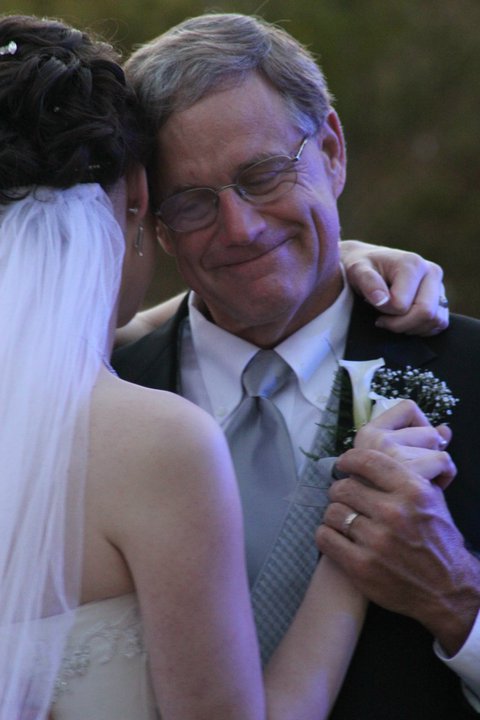
I want to share a picture I ran across today. It is one of those pictures that captures a human moment so fully and so faithfully that it just takes your breath away. And makes you glad to be a human. It also moved me to writing.. something I haven’t done in months.
First, this blissed out man is Bruce, and he is dancing with his oldest daughter Karina, who, of course, has just gotten married (I’m not at this wedding). The mom, not pictured, is Julie, my childhood friend and neighbor. Julie and I haven’t seen each other but a few times since high school. She lived two doors down and, with Katy, the girl who lived in the house between us, we formed a regular threesome. We were part of a larger pack of kids in a very kid-rich neighborhood a long, long time ago. Julie’s father was an extremely kind man, and was the obstetrician who delivered me (and my three brothers) into the world. Julie and I have reconnected on Facebook, and yesterday she posted this picture, one of many from Karina’s wedding this summer. When asked, she said it was ok for me to share.
Anyway, I saw the photo and thought it was moving. So moving, tender, beautiful, and lovely. And as I said, it prompted some thinking.
I’m thinking about how one lives life. What’s good and right and important. What are our wisdoms, how do we give to others, what do we contribute to the greater good, what do we leave behind. At 54, they’re topics worth thinking about. As someone who’s kind of retired, or maybe not, with a 12 year old son and a lot of healthy years ahead, people and actions and priorities are definitely on my mind.
I’ve had a lot of time to think in recent months. A huge part of my summer was spent on a massive organizing project.. where, literally, every storage box in my possession, every drawer and every closet, was emptied and every item therein touched, stared at and resolved. For one thing, it was a long, long trip down many memory lanes, and for another thing, the very fact I organized every (really, every) aspect of my life on earth, frees up so much psychic space, I’m just sitting here rattling around in my own liberation.
Whatever that means.
Really though, I’m going to write about this mother of all organizing projects because it was that monumental, that turning pointish, but for now I just need to say that besides clearing the decks in a profound and literal way, it afforded me a lot of think time, and I spent it on my past, present and future.
So along comes this photo. And I’m looking at the expression on Julie’s husband’s face as he dances with his now married daughter. There is so much there.. love, contentment, a certain peace. It says tons about life: the love he has for his wife, the love they have for their three children, the love and kindness they are passing on to their children (the way Julie’s parents passed love and kindness on to their three children). There is no doubt in my mind that Karina, and I don’t know her at all, will pass along those same kindnesses.. because that’s the way it works. A child raised in a family of love will not go off and murder anyone. She will not start any wars. He will not, through anger and self-righteousness, commit horrible atrocities. He probably won’t even be mean.
What if everybody were loved like this? Wouldn’t we all be better off? Wouldn’t the world? Wouldn’t we nurture a finer peace and leave the world in safer, more sane, hands?
Couldn’t a lot of love go a long way?
I know. Cue music. Apologies to anyone reading this who knows me to be maybe more cynical and wry (that is the name of this blog, after all), or who knows I’m having a hard time with my own crazy anger these past few years. I know this doesn’t really sound like me at all.
I’m just happy thinking it may all come down to love, and thinking that kindness is a worthy goal.
Because it’s just not that hard.
It’s How You Play the Game
April 4, 2010
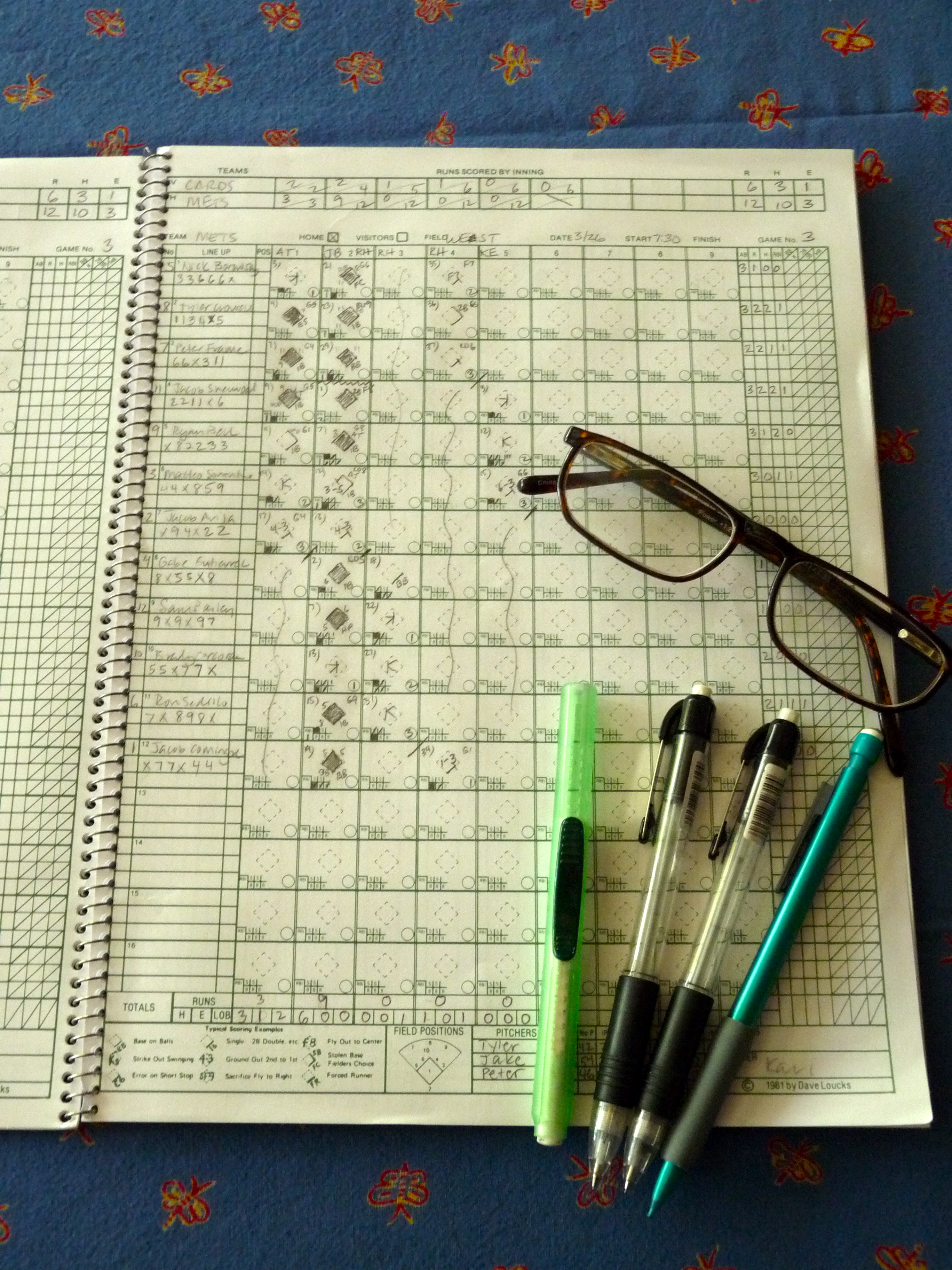
I like to score.
I recently posted the following on my Facebook status thing:
“Scorekeeper axiom: If you keep score long enough, they might ask you to write an article about it.”
And guess what? That’s exactly what happened. So, here’s my article, which, as I understand it, will be running in the Davis Enterprise as a two parter. It’s a bit long, as I had quite a lot to say about scorekeeping. Surprise.
It’s How You Play the Game
In common sports parlance, it’s not whether you win or lose, it’s how you play the game. We’ve all heard this a million times, and as parents and Little League fans, we’re totally on board: we want our players to try their best, and in the process learn sportsmanship, teamwork, and untold other life lessons. Obviously and absolutely. In our infinite sports wisdom, we focus not on the outcome of the game but rather on how it’s played. Yep, indeed, it’s all about the “how.”
For scorekeepers, however, there’s way, WAY more to the “how” question. For us, “how” the game is played is a deep and vast compendium of hows, wheres, whos and whats, and this is where the game gets really interesting.
Scorekeepers focus on what is measurable because that other stuff — the life lessons and whatnot — are totally intangible and decidedly unmeasurable. Baseball is, as we all know, a numbers game — in fact, it’s the mother of all numbers games. And for dedicated scorekeepers, it’s about keeping careful track of those numbers. It’s what we do and, well, it’s pretty darn fun.
So sure, a scorekeeper dutifully tracks what goes on inning by inning, and at the end of the game can tell you with proud conviction who was victorious. But, oh, there is so much more to that ever-complex “how” story.
Being a good scorekeeper is equal parts neatness, precision, and obsessive-compulsive disorder. It also requires superior focus, which in turn requires a superhuman and sometimes not-so-tactful ability to tune out all that wonderful bleacher blab. Truth be told, scorekeepers are geeks, and it doesn’t hurt to be a little anti-social.
For veteran and would-be scorekeepers alike, the season begins at a scorekeeper’s clinic a couple of weeks prior to opening day. Expert mom scorekeepers — the uber dynamic duo of Michael Ann Riley and Dianna Henrickson — lead 40 apprehensive trainees through a detailed, comprehensive outline that addresses every imaginable aspect of scorekeeping. For two fast-paced hours, Michael Ann and Dianna cover the rules, the definitions, the all important abbreviations and umpteen common and not-so-common scenarios. Dianna even offers an item-by-item tour of the contents of her own personal scorekeeping bag. In addition to the usual pencils, sharpeners, erasers and reading glasses, she suggests having a pack of gum on hand which she says will calm the nerves when things get tense (did she say tense?) or when your kiddo is up to bat. The 40 new scorekeepers leave knowing more than they did upon arrival, but their new skills can only be — will most certainly be — tested on the job.
Ah, the scorebook. The scorebook is an artful, if not intimidating, array of lines, boxes, and more lines and boxes. Once you recover from the sheer overwhelm of its layout, you come to appreciate its masterful use of space.
The details of each and every “at bat,” are entered in a box that measures 5/8 inch by 5/8 inch. Within each of these tiny thumbnail-sized squares, are an array of even tinier spaces — diamonds, circles, boxes, and still smaller boxes — into which information is recorded. It’s all quite slickly arranged and all I can say is, your pencil had better be sharp and your writing engineer-precise. It also becomes apparent that good eyesight or strong reading glasses are essential.
Once you’ve mastered the notations and abbreviations that correspond to the action you see on the field, it becomes simply a matter of writing the right thing in the right, impossibly small place. If you do that correctly and legibly, anybody can pick up your scorebook and read — play by play — how the game unfolded.
Clever folks, whoever thought all this up.
For purposes of this article, we’ll assume the scorekeeper is a mom. This, as it turns out, is a safe bet; the vast majority of scorekeepers at Davis Little League games are, in fact, moms, for reasons perhaps worth exploring in a future article. Not to say there aren’t a few dads here and there, but the profile, if you will, of the Little League scorekeeper is “mom.” Organized, methodical, detail-oriented mom.
Mom scorekeepers are a subculture all their own, and as much a part of the fauna at a Little League game as players, coaches and umps. They can be seen in the bleachers at every game, hunched over their scorebooks, pencils in hand, craning their necks to follow the play, cupping their ears to hear the umpire’s calls. They’re the ones who arrive early to collect lineups from each manager and can be found maniacally scribbling names and game information into their scorebooks, synchronizing their watches, and adjusting their positions for optimal viewing… all in advance of the first pitch.
Then, equipped with a stash of pre-sharpened pencils, a comfy chair, perhaps a set or two of reading glasses, and the aforementioned gum, our intrepid scorekeeper settles in for the next two hours to record every last detail of a game that is sure to be anything but routine. (A routine game has yet to be played on a Davis Little League field, at least as far as any scorekeeper is concerned.)
Once the umpire calls, “play ball,” the real work of the scorekeeper begins.
A scorekeeper can tell you who the players are, in what order they bat, and what their jersey numbers are. She tracks what happens on every single pitch. Did the batter swing, did he or she look — but not swing — at a good pitch? Was the ball hit, how was it hit, where did it go? How did the runner move from base to base? Did he or she steal, advance on an errant pitch, tag up on a high fly ball? How many runners crossed home plate? Was the pitcher responsible for those runs or were they the result of some early-season errors?
The scorekeeper records who is pitching, who is relieving, and exactly when each pitcher enters and leaves the game. She’ll note, with painstaking accuracy, how many balls are thrown — because, as it turns out, this matters a lot. Depending on the age of the pitcher, there will be a limit to the number of pitches he or she may throw. And, believe me, everybody cares — the coaches, the umpires, the parents, the board of directors — because we are committed to ensuring a player does not overwork, and potentially damage, his or her arm. It also matters because depending on how many pitches were thrown, a pitcher may not return to the mound for a day or perhaps two days, according to a strict formula based on age and pitch count. This has strategic implications, as you might guess. The pitch count alone accounts for more conferences on the mound, in the dugout, and between scorekeepers than any other dispute. It is probably the single most important statistic tracked by a Davis Little League scorekeeper.
Extra ambitious scorekeepers will also note who played which positions and what kind of action they saw while there. How well did they field the ball, did they throw any runners out, were they part of any double plays? Speaking of outs, how many are there, and how exactly did they occur?
Finally, the scorekeeper will note which teams are playing, on which field, and when they start and end the game. Additionally, the coaches, the umpires, and, of course, the scorekeepers are all noted. Some scorekeepers even observe and note the weather.
And, oh yes, who won.
Of course, the job of scorekeeper is not without its stresses. When all is going well, it’s pretty easy… scorekeeping is simply a matter of translating what happens on the field onto the scoresheet, and in most cases it is pretty straightforward. But not always. For example, a hard hit ball to short stop that results in the hitter beating out the throw to first may seem to the batter (and his parents in the bleachers!) to be a great hit. But to the pitcher (and his parents) it may be an obvious error on the part of the short stop who bobbled the ball for a moment before making a late throw. The outcome affects each player’s stats; the batter wants his grounder to short to be recorded as a hit and the pitcher most certainly does not. And even though we don’t keep stats in Little League, a player’s sense of his or her overall performance is at stake. Judgment in this case is left to the scorekeeper. And history is thus recorded, often to somebody’s dismay.
Scorekeepers are also summoned in the event of questions or conflicts. For example, we are expected to know at any given moment what the ball and strike count is. We may be called upon to reconcile a discrepancy between the umpire’s count and the brightly lit version on the scoreboard (a scoreboard often managed by younger siblings who ARE NOT PAYING ATTENTION. Ahem.)
Discrepancies in the ball/strike count can also be the result of mis-hearing an umpire. Even if an umpire is yelling his calls, he’s speaking through a mask that is pressed up against his mouth and all we hear in the stands is mmmpphhh and ummmthhh.
Maintaining concentration and an accurate record is all that is asked of the scorekeeper, and there is no small satisfaction in being the correct and final arbiter in a numbers dispute! Ah, the glory. On the other hand, a scorekeeper who cannot produce a quick and decisive answer for the umpire or manager lets everyone down.
Which begs the question: what’s in it for the scorekeeper?
I’ll venture that for most scorekeepers, it really all comes down to a love of numbers, order, and precision. Perhaps for a few, it was a matter of arriving too late to the pre-season parents meeting and it was the last volunteer job available. But for the rest of us, it’s just one of those perfect personality matches. Working in the snack shack or coordinating team photo day just doesn’t scratch the same itch.
I know I’m not alone in my obsession. I’ve observed a family — we won’t mention names — whose interest in scorekeeping crosses clearly into the realm of passion. At any given moment during one of their son’s games, mom, dad, grandma, and grandpa might all have their own version of a scorebook on their laps. On a recent occasion, I even saw the younger brother (8 years old) sitting next to mom with pencil in hand entering Ks and RBIs in his own book. A future scorekeeper in training!
Carrie Shaw, the mom of two longtime Little Leaguers and a veteran scorekeeper with countless seasons under her belt, says, “I scorekeep even when I’m not a scorekeeper because I just like it, and it keeps me focused on the game.”
For me, it’s really all about the zen. It’s the concentration, the focus on detail… the need to stay present and tuned into every moment. While it can be nice to just sit in the bleachers enjoying the rhythm of a Saturday afternoon Little League game — a wild rumpus on a sunny day in the pleasant company of friends and family — for me, I appreciate even more the details, the small, tiny dramas that are playing out on many parts of the field at one time. I like to see every pitch, every swing and every play. I enjoy the challenge of recording all of these events in fine detail, and love reconciling numbers in the end, like a giant sudoku puzzle, tallying columns and calculating statistics. It’s about order, precision, nuance and accuracy. Scorekeeping adds a level of depth to the experience of baseball and makes me appreciate all the more the effort the kids are putting into their game.
So, yep, absolutely, the old saying holds true: It’s not about winning or losing, it’s how you play the game.


