
Gorak Shep to Pangboche
April 15, 2011
Trip Day #17, Trek Day #11
It is all, mostly, downhill from here.
Today’s plan:
– For those with energy and super human fortitude, a short, pre-dawn climb to the top of Kala Patthar for a sunrise view of one of the most astonishing panoramas on earth. Kala Patthar is the 1000′ hill that looms over Gorak Shep, the trailhead of which is just steps from our tea house.
– A leisurely and late breakfast for the others of us.
– A 5-6-mile hike to Tokla (sometimes called Dughla, sometimes Thukla) for lunch
– Another 3-4-mile hike to Periche, maybe for the night.
– But, if we still have the energy, we’ll press on another 3-4 miles to Pangboche.
In all, if we get to Pangboche, we’ll have covered 12-14 miles and dropped an impressive 4200′, through and into completely different climate zones. And we’ll do it all fueled by super high-performance, oxygen-rich blood. And eggs and toast and oatmeal. And tea.
But first, back to last night..
So, how cold was our highest-elevation-ever (17,100′) night’s sleep? So cold that I wore on top: one medium- and one heavy-weight thermal, a thin pile vest, a down vest and a down sweater. On the bottom I wore: one light- and one heavy-weight pair of thermals, shell pants, 2 pairs of socks and down booties. I also wore a fleece hat and fuzzy gloves. I stuffed my silk cocoon inside a heavy down bag and covered all of that with a heavy blanket. I was warm, if somewhat restricted in movement.
And bonus: these were also the clothes I’d trek in–for the third straight day, minus the down booties. So dressing was a snap.
Slept great (don’t know why at this altitude) and woke up starving (good sign). But, unfortunately, I was way too spent to imagine a 4:00am ascent of Kala Patthar, even to see what is considered the best close up view of Mt. Everest and surrounding monster mountains. Disappointed about that, but just couldn’t do it. The note in my journal said my “go up” muscles were completely shot. I should also mention here that the achilles tendonitis that I went into the trip with did not seem to bother me much, if at all. I was so grateful for that! And advice to self: future trips to Everest Base Camp (umm..) shall include more than the month of rain-interrupted training that I got.
Karen and Laura also slept in, while Leslie and Rick opted to go for it. So glad at least a couple people in our party made it!
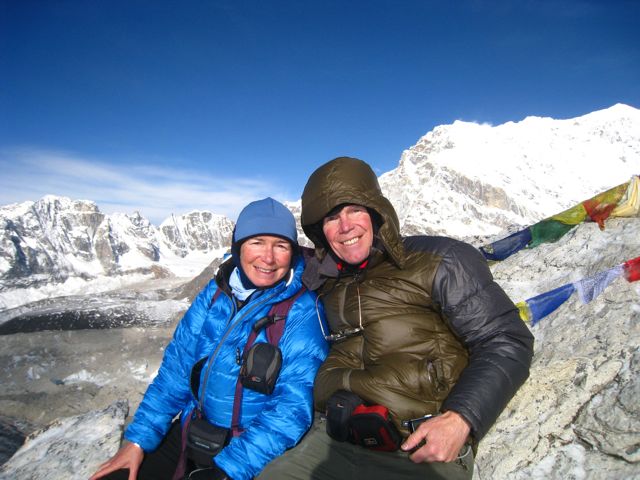
It took them two or three hours to get to the top (both said it was a slow slog) and here they are, smiling into the rising sun, at 18,176′!!
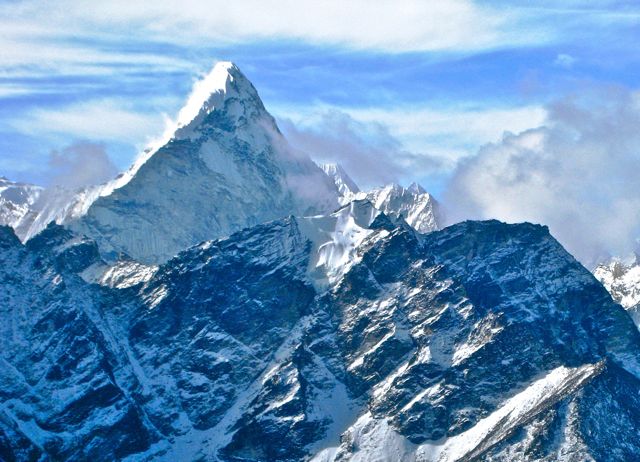
Here’s Leslie’s shot of Pumo Ri (23,507′), the prominent mountain to the north. Tibet is on the other side of that.
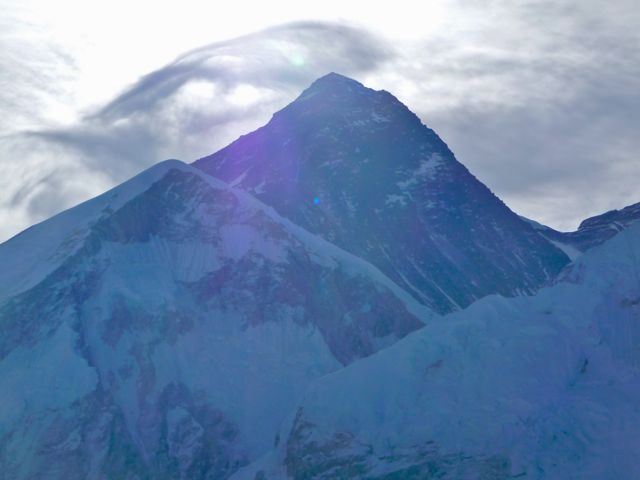
Here’s Rick’s shot looking east to the granddaddy of all mountains, Mt. Everest. They say sunset gives one, perhaps, a better view of this range, because the sun’s behind you and you get a nice alpin glow, but sunrise, even looking into the sun, is not bad!
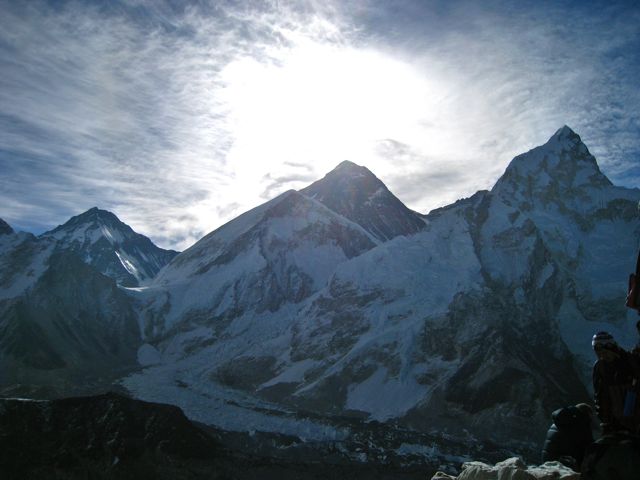
And here’s Leslie’s version of that stunning eastern view. The most prominent mountains are: Changtse (24,770′); Everest’s unnamed west shoulder; Mt. Everest (29,028′); and Nuptse (25,850′), which looks highest, but of course it’s not. The peak barely discernible between Everest and Nuptse on the backmost edge, is Lhotse (27,890′), the fourth highest mountain in the world. Below all that, you can sort of see the Khumbu Glacier wending its way down the valley, the northmost edge of which we’d been to the day before (the site of EBC).
Our heroes returned at about 8:30, we all had breakfast and planned to take off at about 9:00, retracing our steps to Lobuche, and then on to a new trail from there.
And, suddenly, I was moved by the fact we were headed back. We were about to say good bye to life above the tree line, to the thin, piercingly cold air, to the thrill of these astonishingly high elevations, and to the magnificence and nearness of earth’s highest mountains. As we were mobilizing outside the teahouse, I saw a sherpa silhouetted against a typical Himalayan mountain-scape and thought, wow, it’s been a remarkable couple of weeks. Lots more to see and experience, thankfully, but we’re definitely on the down part of the journey. It was a little sad.
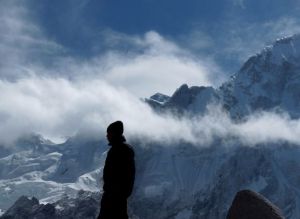
Here’s a shot Leslie took as we started our trip down. Trekking at cloud level… And I’d guess the temperature is about 15 degrees fahrenheit.
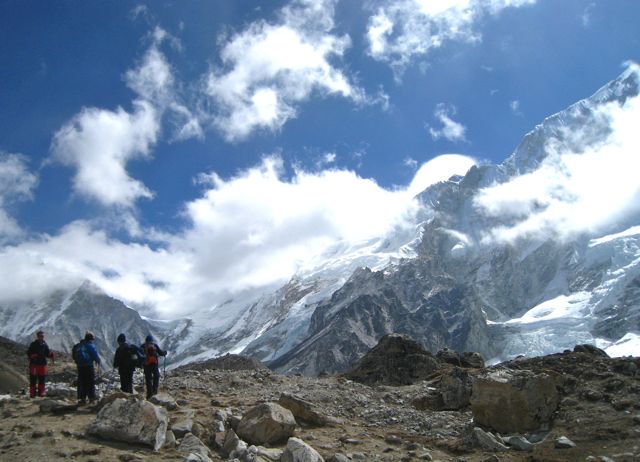
We actually climbed a hill before we dropped down to the trail along the moraine of the Khumbu Glacier, and as we did, we could look back at Gorak Shep. The hill that rises out of the dry lake bed on the left is Kala Patthar; you can see the trail etched into the side. Three or so miles as the crow flies, just barely hidden by the clouds, is Mt. Everest, and surrounding mountains Lhotse, Lingtren, Khumbutse, Changtse and Nuptse. I wouldn’t say we got blase about seeing Everest, but we definitely grew comfortable being in the shadow of these mammoth peaks for two weeks, the scale of which was just mind boggling.
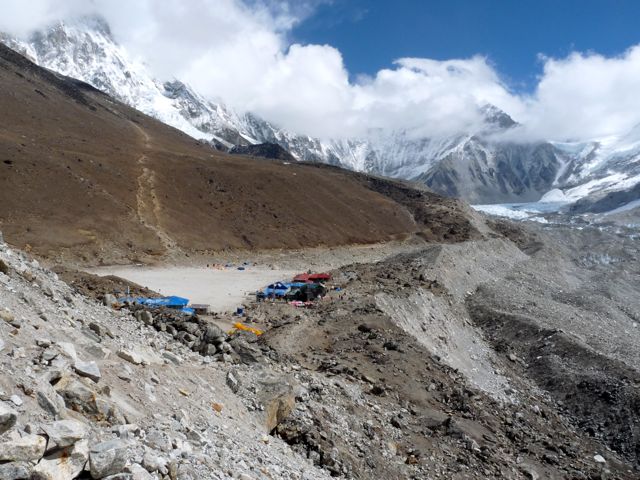
The weather started to worsen on the two-hour hike down to Lobuche. Between the bitter cold, the grey skies, the tedious, gravelly terrain, and the post-Everest anti-climax, I was feeling some let down. Lobuche, like Gorak Shep is pretty ramshackle, which I think I was too tired and nauseous to notice when we arrived two days before. I was glad we just used Lobuche as a pit stop, opting to continue on to Tokla (Dughla) for lunch.
Things got much better after leaving Lobouche, even though we were still retracing this bit of old ground. We passed a base camp for those who are planning an ascent of the east peak of Lobuche (the mountain, 20,075′), which is a good warm up for Everest. We could also see what we’d missed coming off of Cho La Pass two days before: Ama Dablam, one of the most striking of Himalayan mountains for its distinctive twin peaks. We’d only get glimpses, but it was spectacular so close up (better picture coming in tomorrow’s blog).
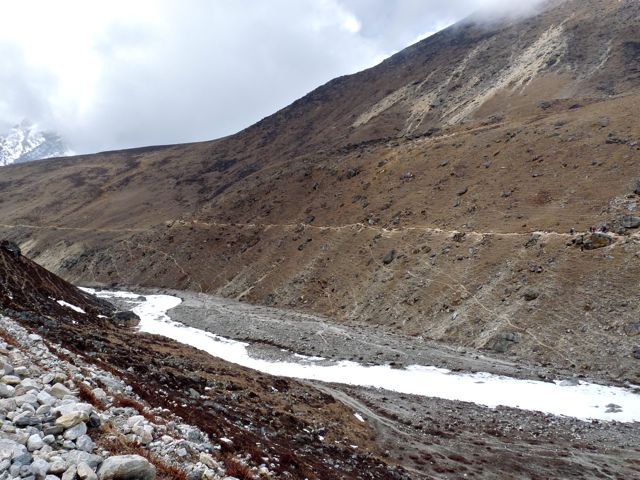
Finally, we got to the point in the trail where, for the next two days, we’d be on new (to us) ground–the main EBC trail. We were able to look across the canyon and get a good look at the trail we’d been on at the end of our Cho La Pass day.. looks like a piece of cake, no? The part you see here certainly was a manageable, river grade ascent, if a precariously narrow trail. The drop is not trivial either.. probably a couple hundred feet from trail to river at this point on the trail (higher down river).
Shortly after this we came upon a remarkable sight–a hilltop covered in stone memorials.
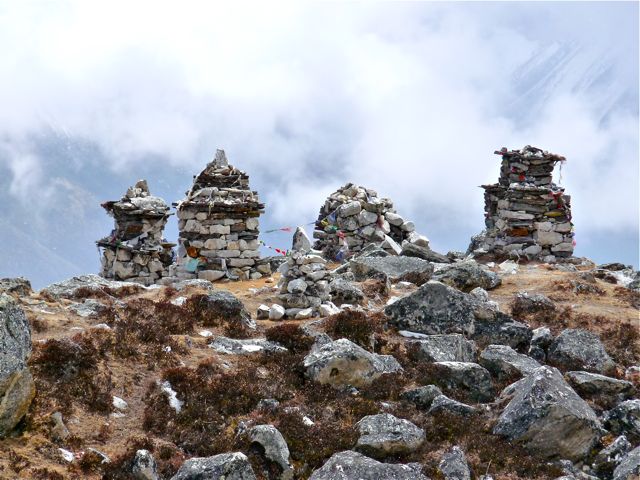
There were, perhaps, 100 memorials of varying sizes and designs.
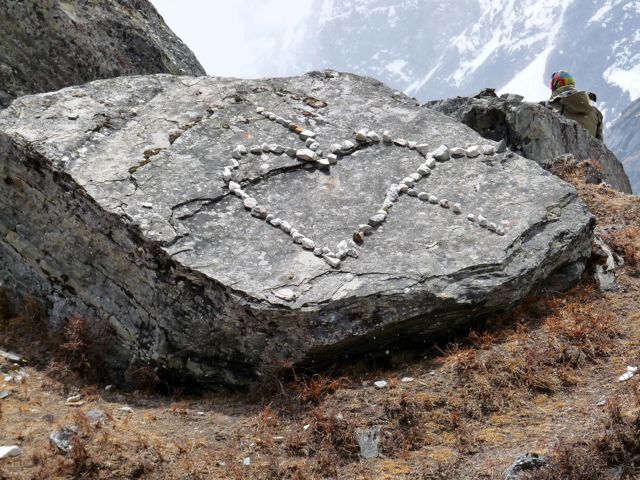
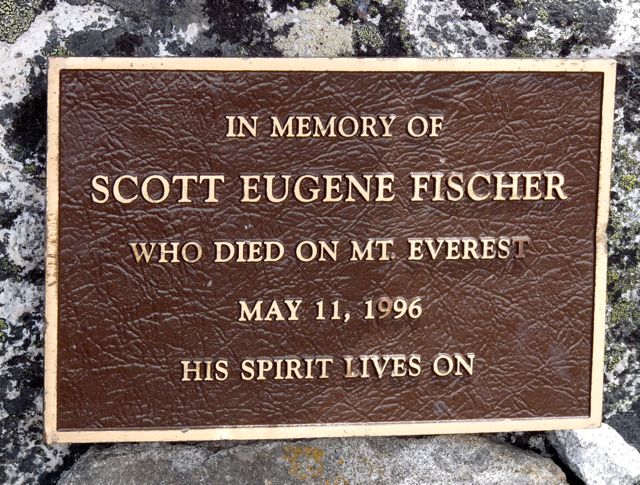
They included this one, below, a tribute to Scott Fischer, the famous American mountain guide who died in the disastrous May 10, 1996 snowstorm on Everest, the worst tragedy in Everest history, documented in Jon Krakauer’s book, “Into Thin Air” (and numerous movies).
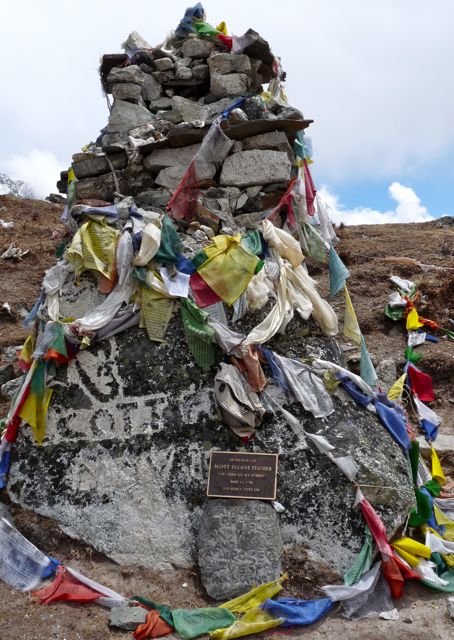
The largest memorial was in honor of local Babu Chhiri Sherpa, who summited Everest 10 times, but died after falling into a crevasse on his 11th attempt in 2001. He has numerous crazy records, like: summited twice in a two-week period in 1995; spent 21 hours at the summit without oxygen; summited faster than anyone in 16 hours and 56 minutes.
Interestingly, shortly after we’d begun our descent off this memorial hill, Homnath and Karen, who were hiking together at that moment, ran into a man named Apa Sherpa. Hom knows Apa and introduced Karen which was a huge thrill, because Apa is the world famous Nepalese sherpa known for having more Everest ascents than anyone in the world. He was on his way up to base camp and a few weeks later would climb Everest for the 21st time! While I didn’t get a chance to meet him on the trail (bummer!), I did meet him in San Francisco 6 months later at a fundraiser for the American Himalayan Foundation, which I wrote about here. (Which includes a good photo of him in a business suit!)
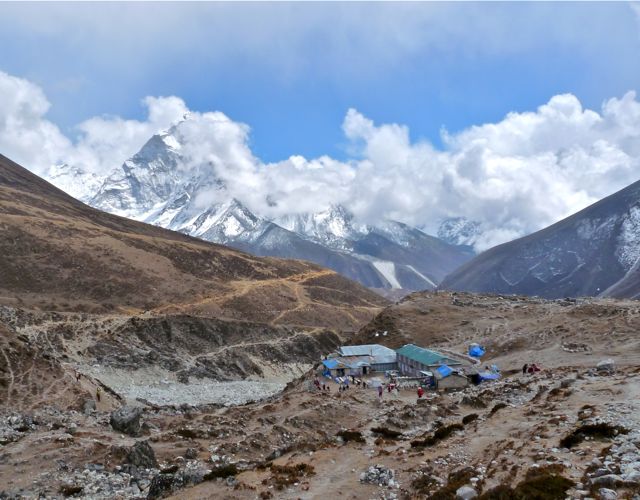
Then we came upon the lovely little settlement, Tokla (or Dughla or Thukla..):
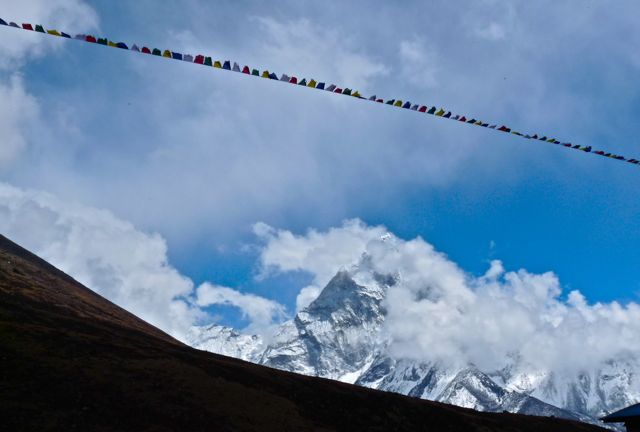
With the longest string of prayer flags strung across the canyon we’d seen yet:
And ate here:
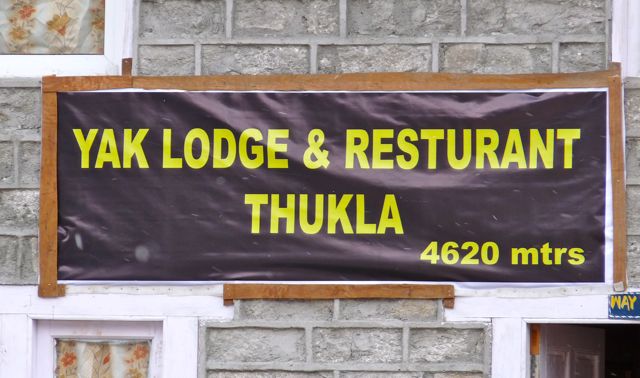
I had a grilled peanut butter and jelly sandwich which was just about the best thing I’d ever eaten. The place was one of the sweeter places we stopped, a very lovely interior in a beautiful setting. We were definitely feeling high on oxygen, having dropped already 2000′ but having oxygen-filled red blood cells enough for 17,000!
I left the restaurant a little before the others, wanting to spend some time alone on the trail. Hom caught up after about a half an hour and we ambled briskly down the giant grassy face of a huge hill with no discreet trail. We descended about 900′ in a very short distance, talking all about Hom’s family, life outside of leading treks and other things. It was really fun.
Here, we’re almost to the bottom. Again the scale is totally deceiving. That mountain directly in front of us rises 3500′ from that valley floor and there’s another mountain, just out of the picture, that rises another 3000′ above that. Everything is so incredibly massive and imposing.
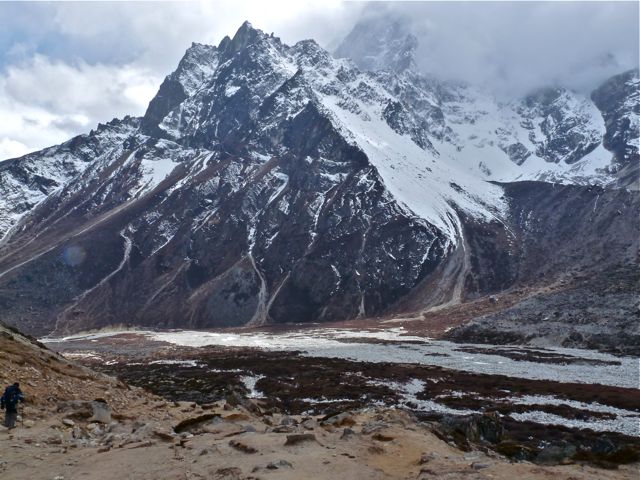
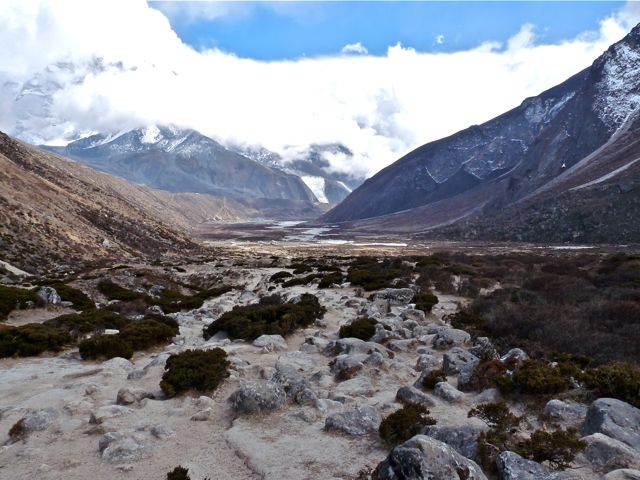
Once at the bottom of our hill, we found ourselves on a huge, vast valley floor, in the middle of which is the Khumba Khola river, and hiked about an hour–2 1/2 to 3 miles–to Pheriche. The area seemed rich for grazing and maybe farming. It’s about 14,000′. Here are some shots of that area:
Looking down the valley, Pheriche is far in the distance:
We passed many dozens of walled off farms and/or pastures. Note the stone craft.
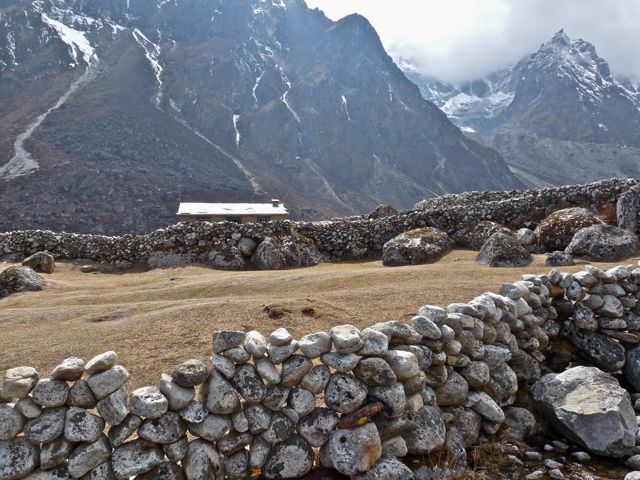
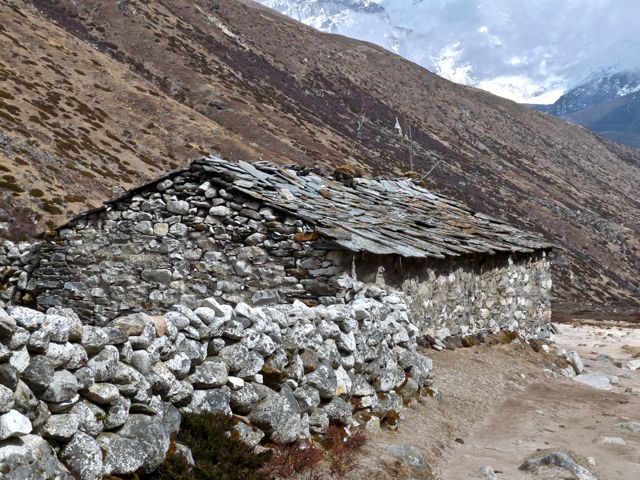
Here’s a stone house, though I saw no people anywhere…
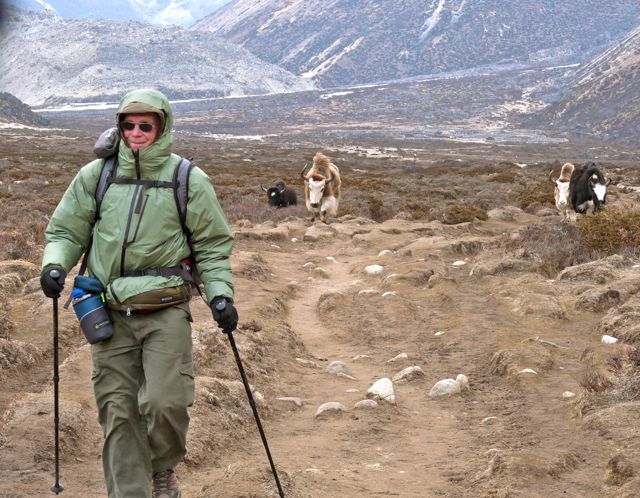
Here’s Rick with a bunch of dzopkios & yaks in pursuit; they were roaming free down there. It is incredibly cold (15-20 degree fahrenheit?) and windy. I read that Pheriche is known for being notoriously cold; the wind howls up the valley. We had to walk fast to stay warm, while avoiding endless networks of surprise hillocks and streamlets. Easy to twist an ankle, but nobody did.
Pheriche is a largish village with lots of tea houses and restaurants and stores. It was surprising to see so much activity–the first we’d really seen since Namche Bazaar a week before. I thought it was one of the more interesting places we passed through, but none of us managed to get a picture. Pheriche also has a medical clinic where, among other things, they specialize in altitude sickness. Lectures are given there, as they were in Machermo, for those traveling to Everest Base Camp along this main route.
We were to have stayed in Pheriche, but it was early and we still had energy, so we decided to press on to Pangboche, a couple more hours and another 3 1/2 to 4 miles.
This part of the trail was a true delight! We left Pheriche (13,911′), crossed the Khumbu Khola river and climbed and climbed up a canyon trail until we were high above the water. Eventually, the Imja Khola river joined from another canyon and we ended up following a much more raging waterway. We were following the contours of a very steep canyon wall, gently losing elevation at river grade until we reached Pangboche (12,894′).
We didn’t see very many trekkers all day long, which surprised me, as we were now on the main EBC trail. Hom posited that it was because bad weather precluded planes landing in Lukla, which meant no influx of trekkers, suggesting visitors come in waves that depend on a plane’s ability to land.
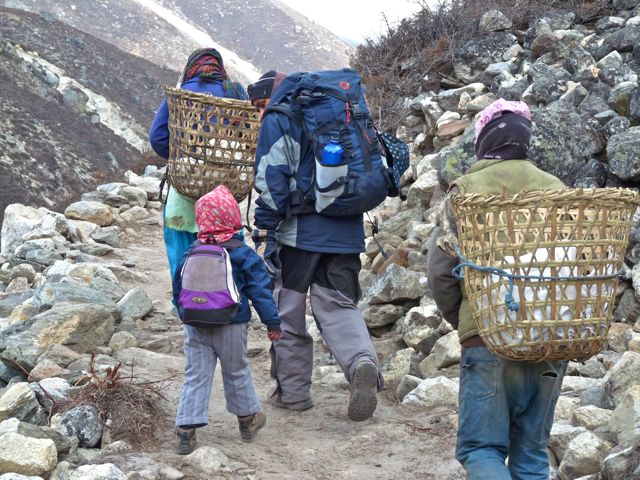
We did see local families on the trail. Hom (in center of group below) said most were on their way to Namche Bazaar for the Saturday market (next day). That explains relatively empty baskets. Part of our push on to Pangboche was to get closer to Namche in order to have time to see that market, which closes in mid afternoon. Families come from all over the Solo-Khumbu region to shop there, which can mean a multi-day trip for some.
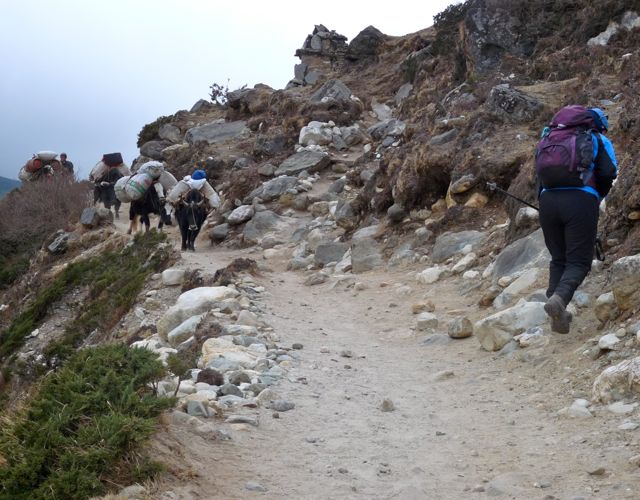
We also saw lots of yak trains. Here Leslie is moving off trail to allow them space to pass. It’s a very steep drop-off to the left.
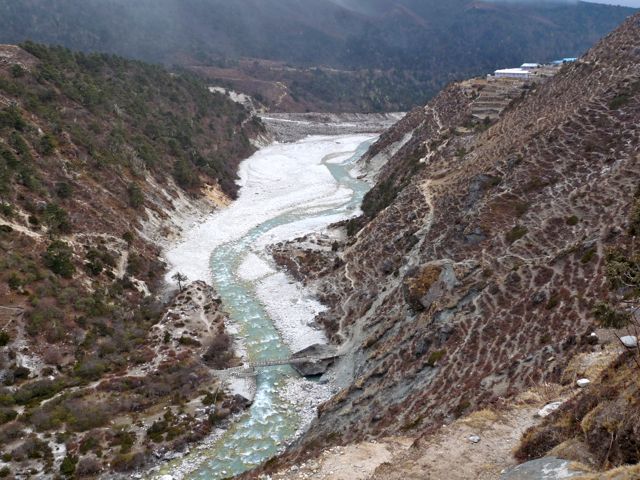
Along the way, we also had spectacular views of the river way below (now the enlarged Imla Khola):
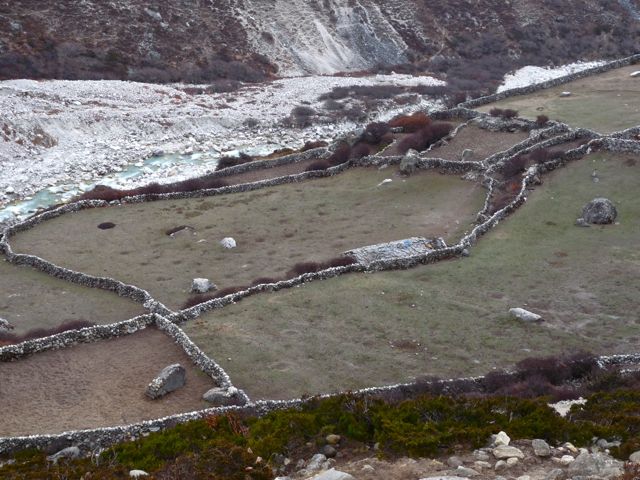
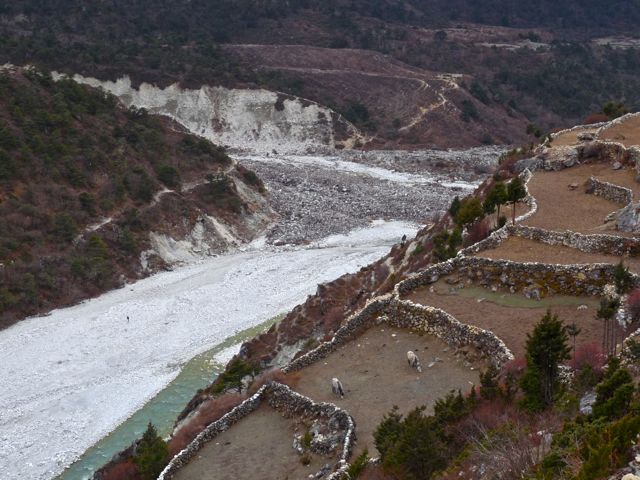
Below, terraced farms framed by stone walls:
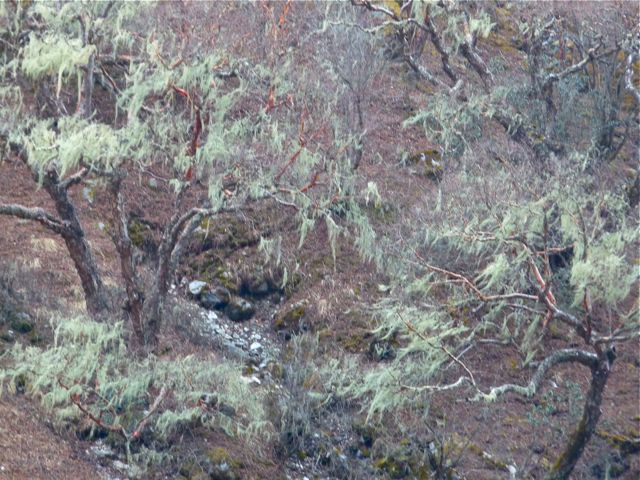
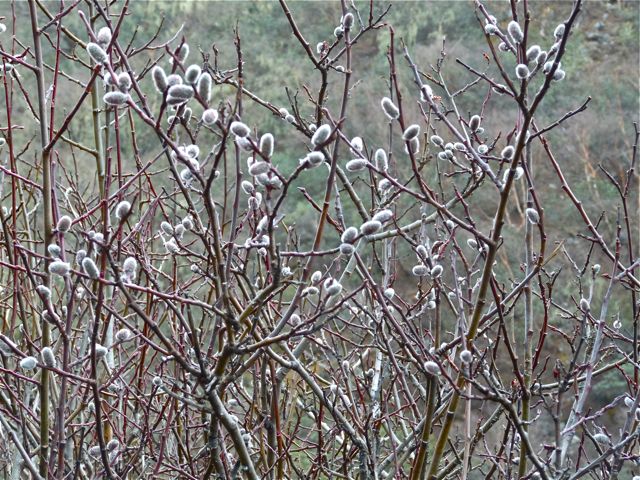
All kinds of vegetation: juniper and rhododendron (not yet in bloom), trees with great gobs of moss dripping from their branches, pussy willows and other things I couldn’t identify.
And we finally arrived to the very sweet hillside village of Pangboche, and our tea house:
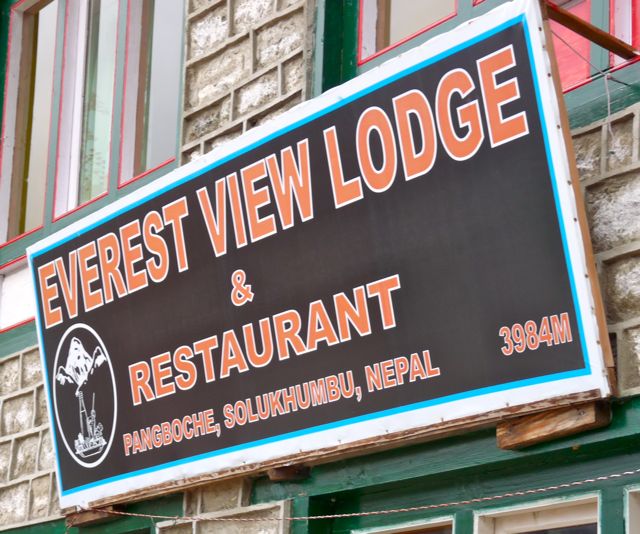
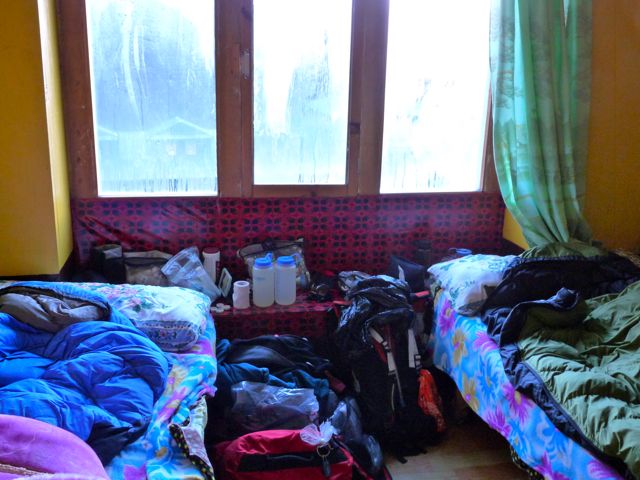
The Everest View Lodge was not only charming, it was clean, the lights worked, there were colorful, clean blankets on the beds, curtains, carpet (sort of), a jaw dropping view, and a really nice bathroom (still just a hole in the ground, but a clean hole).
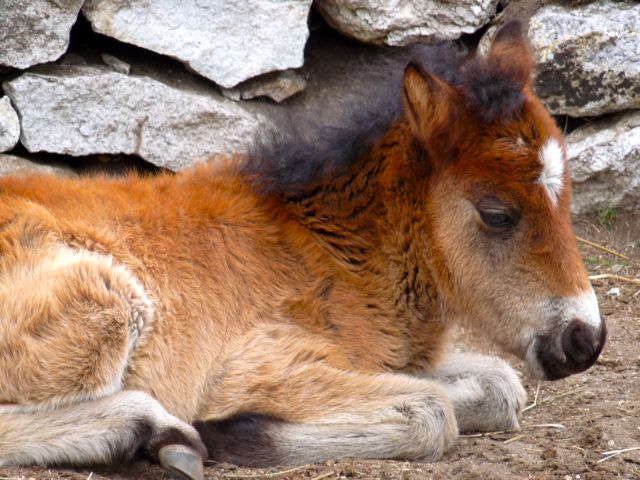
Plus a welcome pony:
Dinner was: fried rice with egg (me); potato pancake with chile sauce (Laura); macaroni with cabbage (Karen); dal bhat with egg (Leslie); fried noodles with egg, plus mashed potato with yak cheese (Rick).
It was amazing how different the world looked this evening, compared to where we’d started that morning. We’d covered a lot of mileage and dropped a lot of elevation. And now: vegetation! We enjoyed a great political conversation with a Danish man and his 20-something son, then went to bed early.

 Life of Wry