
Dole to Machermo
April 9, 2011
Trip Day #11, Trek Day #5
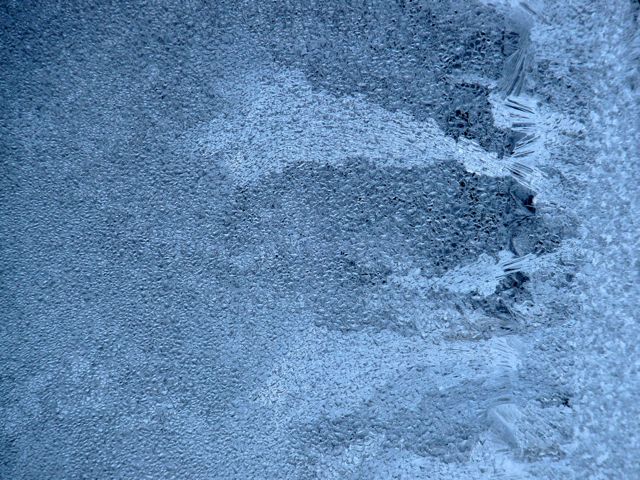
Woke up in Dole. First evidence that it was a very cold night: frozen windows in our room. The ice is on the inside.
Still, and I’ll never forget this, cold and frosty as it was, Leslie pulled out her flute and played music as we packed up our duffle bags. It made things feel warm and happy. I just loved that.
I went out to look around and found snow! Lots of it. (Well, a lot for this California girl.) The sun had not yet appeared from behind the mountains so it was shady, but it was clear and the mountains were sharp and dramatic against the paleness of the early morning sky.
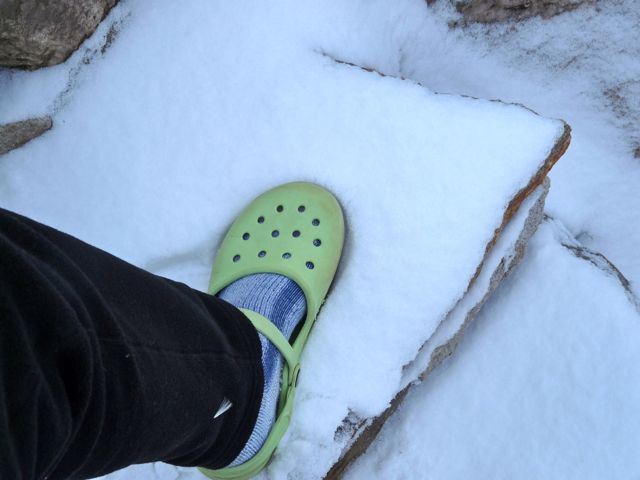
Things to note in this picture: 1) Crocs are my footwear of choice around the tea houses, especially good for wearing to and from the bathrooms at night (bathrooms.. I’ll call them that, but they were just small rooms with holes in the ground). The thought bubble above my head says, “I remember buying these Crocs in Talum, a small beach village on the Yucatan peninsula in Mexico. It was so warm there…” 2) You can see a rogue down feather stuck to my fleece pant leg because these are what I slept in and the feather must have come from my sleeping bag, and 3) the aforementioned snow; about 2 inches fell during the night.
This day was going to be a relatively short day, in order to limit our rate of ascent. I cannot find a nice hike profile graphic on the web, so I’ll just say that we went from Dole (13,484′) to Machermo (14,649′)… it was a short distance (about 2.5 miles), but 1,200 feet of elevation gain, most of it early on, which felt significant enough.
Notably, this day we climbed to my highest-ever elevation. My previous high was Mt. Whitney (14,500′) which Jim, Peter and I climbed last summer, the highest point in the United States (minus Mt. McKinley in Alaska). I was excited about this. And, of course, thinking a lot about elevation issues.
The trek began with a fairly tricky descent out of Dole on a slippery, snow-covered slope. I’ll just say, some of us have less experience in snow than others, and for us, it was slow going! Here’s a flat, snow-covered portion of the trail, before the steepness begins. You can tell I’m moving gingerly.
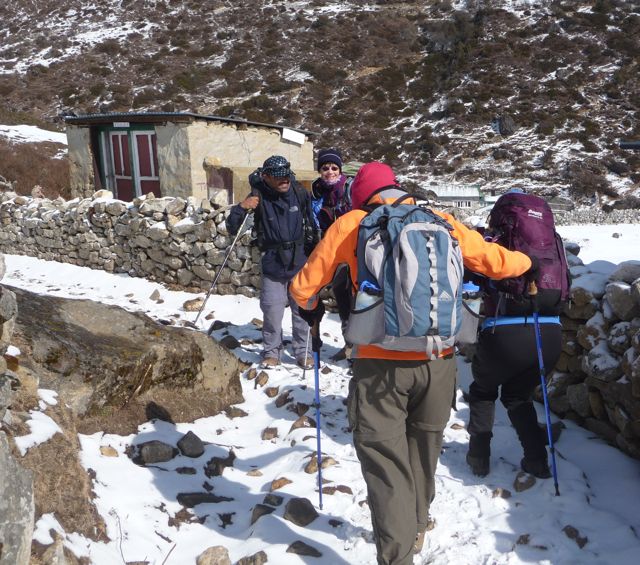
Once out of that, we began a steep climb, about 800′, up an increasingly barren hillside, covered in tundra grasses and dotted with scrub junipers. The sun came out and it got warmer.
As we climbed, we got a great view of Dole behind us, covered in snow:
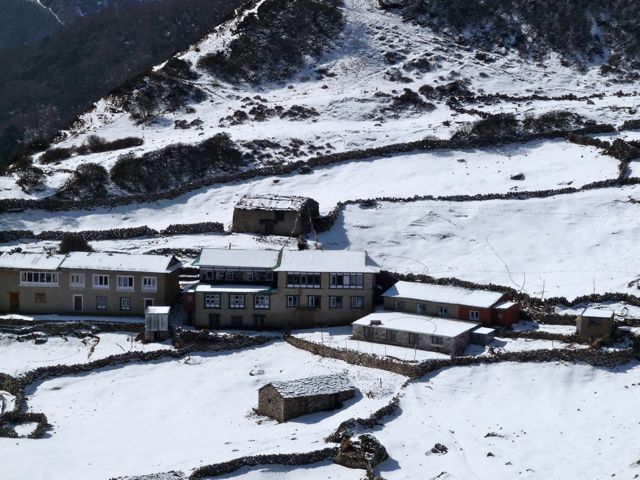
In this one, it looks like Dole could just slip right off the mountain. This view is south, back in the direction from which we’ve come.
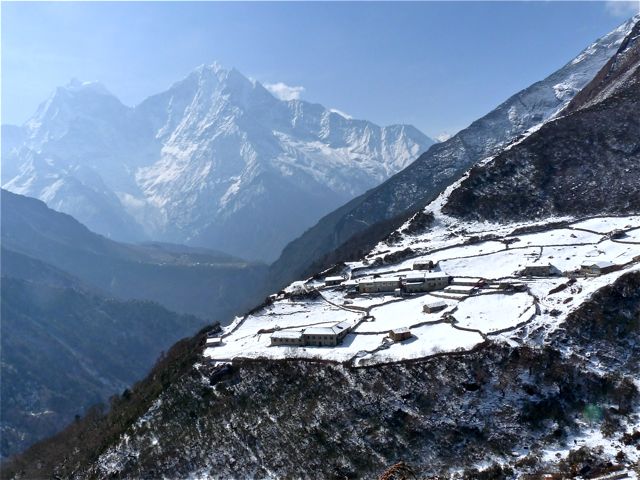
We continued our traverse north up through the valley, hugging the mountain along the western slope. We could see Thamserku (21,675′) and Kantaga (21,932′) off to the right and behind, and Cho Oyu (26,864′) the world’s sixth highest peak, ahead and to the north. Again, the Dodh Kosi river is far below and we can make out a trail on the eastern slope that goes from Gokyo to Phortse.
After about an hour and a half, we rested briefly outside this lodge in the small settlement of Lhabarma.
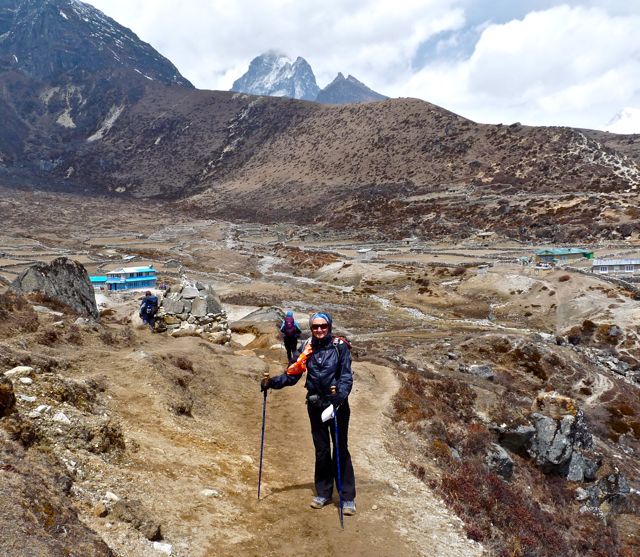
Then we hiked up a gentle slope for another hour or so. It got muddy, so we ambled up the slope to get on dry ground. After a while, we got to Luza, tucked into a side valley, and hung out a while eating peanuts and peanut M&Ms, drinking a bunch of water, etc. Here’s Laura on the ridge above, just before we descended into Luza. It’s clouding up, and is freezing, but no precipitation.
And Luza. These tea house names are all overstatements. The settings and views are spectacular, but the accommodations are very primative. Not a criticism at all… I never expected to even stay in buildings. Still, the names are funny.
It was a short trek from Luza to Machermo, up a few hundred feet over tundra covered slopes. This is pretty nice walking; the ground’s soft, but firm, nice after all the rock and stone steps and such.
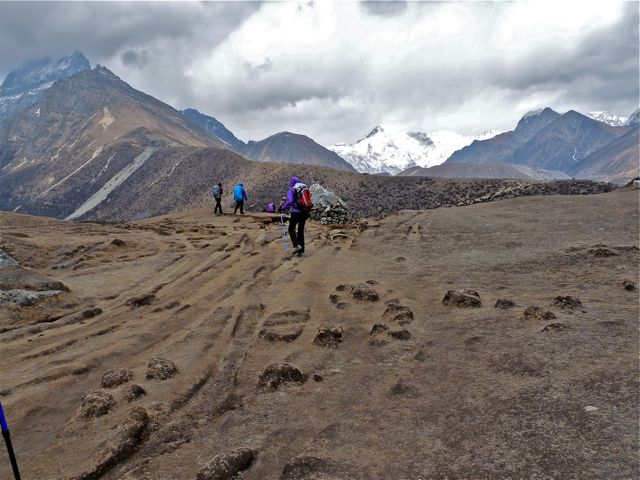
We then arrived in Machermo, the last major settlement before Gokyo. Machermo is tucked into a wide, flat-bottomed valley below the terminal moraine of the Ngozumpa Glacier. We would spend a few days in and around the Ngozumpa Glacier, which is the largest in the Himalaya and comes off the slopes of Cho Oyu, about 12 miles north.
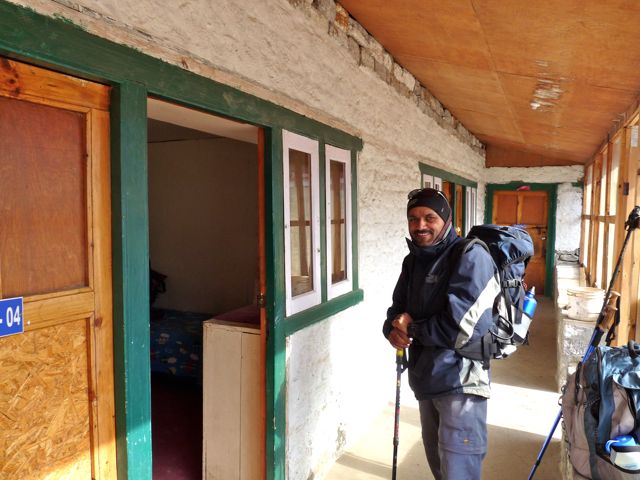
We had lunch and settled into our rooms. That’s Hom standing in the hallway outside the room Laura and I shared here:
The trek today was only about 3 hours, so after lunch, Hom took a few of us out for a scramble up the slopes above Machermo. Karen had been sick all day (altitude), so opted out of the walk. We climbed another couple hundred feet (climb high, sleep low), but I wouldn’t call it an enjoyable hike. It was windy, very cold, started to snow a little, and it was extremely treacherous footing. It was total hell on my achilles tendons (which have been very messed up for months), as we were twisting and jamming all over the place. Later we realized we’d been tromping over all kinds of delicate plant life and felt kind of bad about that.
We came down in time to attend a 3:00pm lecture on AMS (Acute Mountain Sickness) at the medical facility–the International Porter Protection Group rescue post–staffed by international (and young!) medics.
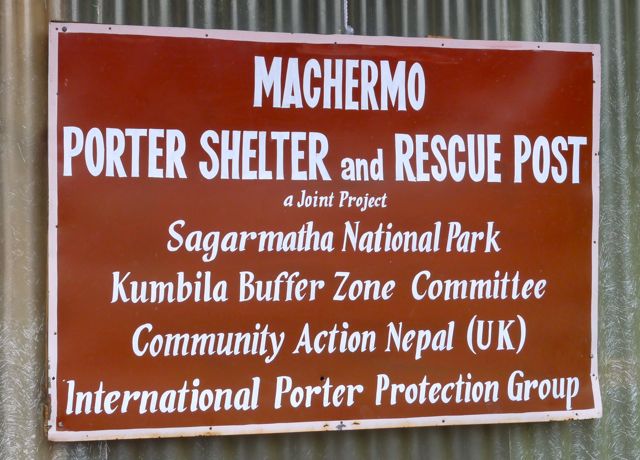
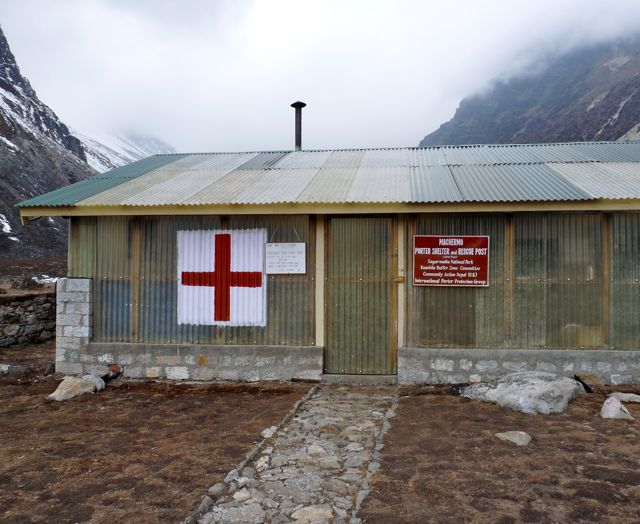
Machermo is situated in what they call, “Death Valley.” It’s called that because should someone get a bad case of AMS here, they cannot descend fast enough in a short enough time to reverse the effects. So they’ve built a medical facility here to treat trekkers and porters as needed. The center also offers daily lectures to educate people about the dangers of AMS. There is a heliport on site for evacuations for life threatening AMS cases.
The hour long lecture was attended by about 30 trekkers and guides staying in the five or so tea houses in Machermo, and was presented by an earnest and young doctor from England, with supervising doctors looking on and occasionally prompting her. It was fascinating and timely. A bucket load of info. We donated to their program and in return they gave each of us a pulse ox test to measure the efficiency of our oxygenation. The range within the larger group was incredible (anywhere from 75% to low 90s) and that spoke to each person’s own physiology and adaptation. It’s entirely genetic and not a sign at all of somebody’s level of fitness.
Gave us much to think about. To diamox, or not to diamox. My high pulse ox (so high it raised eyebrows among the medical staff) was a good indication, though not a guarantee, that I would not suffer serious AMS, but I had a low grade headache and I wondered if that might go away if I started diamox. But I was still otherwise asymptomatic, so I didn’t. Yet. The only real downside of taking diamox is that it’s a diuretic so when you’re on it, you have to 1) drink massive volumes of water to keep from getting dehydrated, and 2) have to pee all the time. This seemed to me enough of a disincentive that I wanted to avoid it if at all possible. If any of the other symptoms of AMS were present (nausea, loss of appetite, inability to sleep, GI issues, dizzyness), then I’d definitely start, but the mild headache seemed manageable.
After the lecture, we returned to our tea house and had tea and cookies around the stove–Hom, Pradip, Reggy (the teacher from Frieberg on sabbatical) and us–which eventually, again, morphed into dinner. So fun.
At one point that evening, I ran into Allie (recall, Allie Pepper, the 35-year-old Aussie woman attempting an Everest climb sans O2) in the hallway, both on our way to the bathroom. We got to talking and one of the things that came up was how to properly use a Nepalese toilet. I thought I knew (I mean, it’s just a hole in the ground, right?), but was open to hearing what she had to say, so we went together to the bathroom nearest our rooms and she showed me how it’s supposed to work. Not complicated: there is typically a bucket in the corner, full of water, with a pitcher that usually hangs by its handle over the side. After doing one’s business in the hole (often just a hole, but sometimes it’s actually a porcelain insert with flat, grooved foot rests on the sides and a smooth, sloped shoot between), one is to “flush” contents using the pitcher filled with water from the bucket. Aaand… I didn’t really know this. So now I did. Which was helpful. Thanks, Allie!
Anyway, hung out in the dining room for a while after dinner, then it was bedtime–guessing it was around 8:00 or 9:00pm. Yawn. By this time, the bathroom on our side of the tea house had become unusable for some reason. This meant we had to cross the courtyard (in the snow that had started getting heavier) to use the truly disgusting facilities on the other side of the teahouse. The floor inside that stall was covered in pee (most of it frozen into an uneven, yellow, shiny, slick death trap type thing), mud, and discarded TP, and it was hard to keep pant legs from getting mixed up in all of that while in a crouch. It was also hard to keep from slipping on the frozen water and pee, so I decided this was a good time to test drive my P-EZ, a gadget I’d purchased online before the trip and which had seemed to work pretty well at home–in my warm, well-lit, evenly-surfaced bathroom. In the Himalayas, in the dark, on an icy, slippery, undulating floor, my P-EZ utterly failed me. The effort turned out to be the low point of the trip thus far. I’ll leave it at that.
Still, bathroom experience aside, I got a great night’s sleep at 14,600′. Everything was awesome.

 Life of Wry