
The Trek Begins: Kathmandu to Lukla to Phakding
April 5, 2011
Trip Day #7, Trek Day #1
Not sure what time any of us got to bed the night before, as it was a frenzy of packing duffel bags, weighing duffel bags, repacking duffel bags, reweighing duffel bags, you know. (Goal was to keep them under 20kg.. respecting limits established by people who look out for porter welfare.) We’d interspersed the packing chore with things like learning how to use the Steri-Pen (a water filtering system we’d later abandon in favor of iodine tablets), or strategizing hydration systems (water bottles, Camelback or both), or conversations about uphill versus downhill socks. Majorly important things! So, it’d been a late night.
This day started off pretty sweetly. We’d gotten an extra early wake up call (5:15) and ordered room service tea. That was so civilized. The mood was calm, a lot calmer than the night before.
The Shanker Hotel lobby was another story altogether. There was a swarm of trekkers–since this hotel seems to be used by many trekking companies–everyone up at an ungodly hour, full of anticipation, with their stomachs in knots. People seemed to be packing and repacking their bags right there in the lobby, gear everywhere. Was hectic. The scene reminded me in many ways of Lone Pine, California where all the hotels are filled with hikers, up well before dawn, planning ascents of Whitney. It also had the same international feel. Mostly, though, great anticipation.
For my part, I was concerned that my training (only one month, in the flats, in weather too rainy to get out much) was insufficient for the altitude and mountainous terrain. I was also concerned about a pair of injured achilles tendons and hoped one wouldn’t blow at some point. There were the usual other uncertainties about potable water, edible food, suitable clothing, adequate gear, compatibility with fellow trekkers, fear of exposure…
But still… I could mostly put all that aside, since whatever would be would be, and felt pretty relaxed and well prepared. And was in a GREAT mood. The trek part was finally here. Everything had been SO fun and easy up to this point.. I was starting to get this feeling the high would last the whole trip.
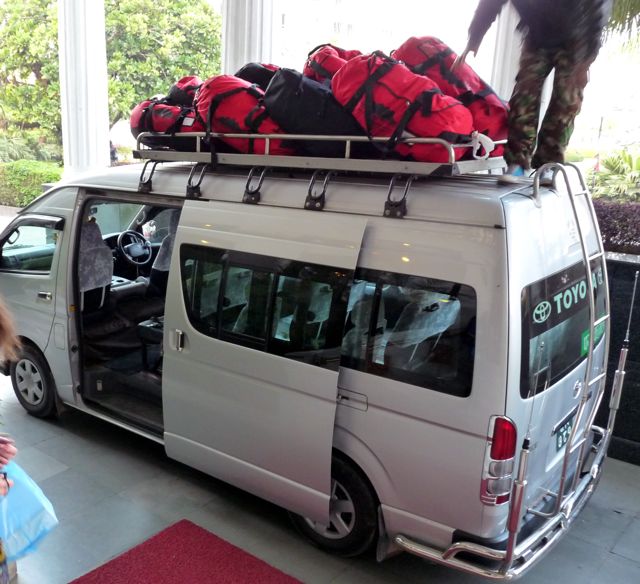
We grabbed our to-go breakfasts and climbed into the van. (Note the duffels on top.)
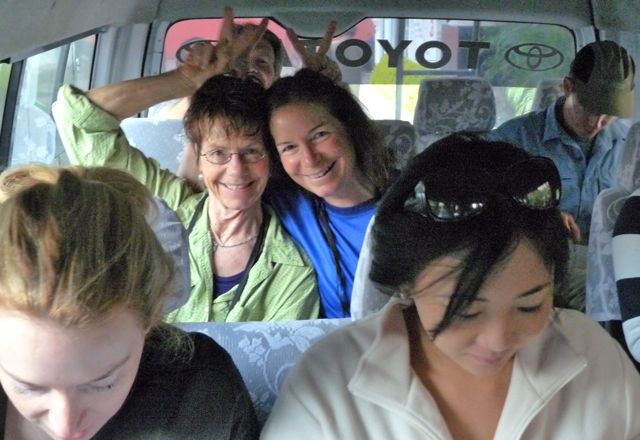
Here are Karen and Leslie. Goofily happy. You can also see in this picture Emily and Rie in front, and David with his head down in back, all from Australia. We’d meet these guys a few times on the trail over the course of the next couple weeks and at the end we’d learn about their series of very unfortunate events: one would suffer bad arthritis in her knees and barely be able to walk, one would be hauled off the mountain on a donkey due to altitude sickness, and one would spend 5 days laid up with serious GI issues. Two would not accomplish their goal of climbing Island Peak. I believe David persevered and made it the whole way, not sure who made it to Base Camp. I’m not entirely sure they came out of the trip friends. But at this point, all we have is optimism and eagerness; nobody really knows what is to come…
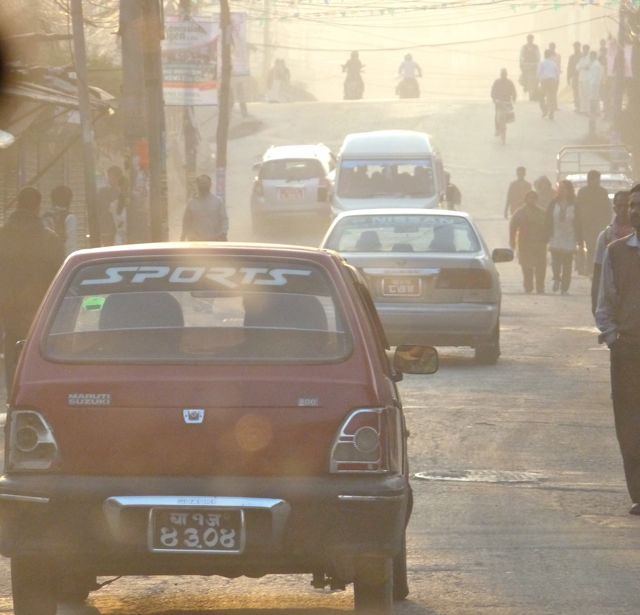
So… this is the commute in early morning traffic on our way to the airport. I love this shot. Your basic, average Tuesday morning in Kathmandu.
We then spent an hour or so in the very chaotic domestic terminal at Tribhuvan International and another hour sitting in a bus on the tarmac, waiting for clearance to land at the airport in Lukla. The weather has to be just right or flights are canceled (we are all grateful for this). Some people wait days to get out of Kathmandu, which can seriously mess with your trekking itinerary (or they wait several days in Lukla, unable to get back to Kathmandu). Later, we would run into lots of people on the trek whose flights had been canceled due to unsafe flying conditions. Interestingly, this can result in surges of trekkers on the trail and challenges at the tea houses. Tea houses may go a day or two with no customers, followed by a rush they can barely accommodate.
Anyway, we got lucky with the weather and would fly!
Lukla’s Tenzing-Hillary Airport was built in 1964 by Edmond Hillary (and the runway was only paved in 2004). Before the airport was carved out of grazing pasture, Lukla wasn’t even a village (even by Nepali standards). Lukla, by the way, means place of many goats and sheep.
The landing strip is considered one of more dangerous in the world. There is a huge mountain on one end, a 3000 foot drop on the other, and it’s at 9318 feet, so you don’t exactly have full power. The runway is 575 yards long (seemed way shorter) and has an 18% gradient. It’s very impressive. (Check out the photo of the strip and a plane taking off on the April 18 blog.)
In the meantime, check out this video for a look at the approach and the runway. Really. I’ll wait.
(Was that amazing?)
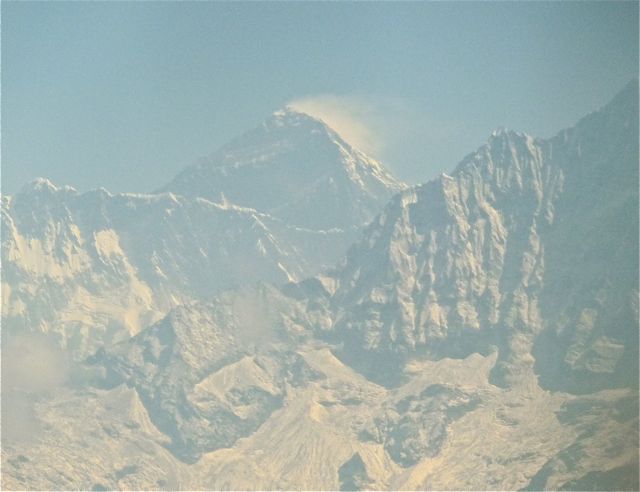
I’m glad I hadn’t seen this video before the trip. As it turned out, however, the flight was fun; I feel a lot more comfortable in small planes. This one was a 20-seater, with a pair of pilots and a flight attendant. They passed out cotton balls for our ears and excellent little candies. The four of us knew to get a seat on the left for the best views. We flew over terraced farms in the Himalayan foothills and caught our first glimpse of Mount Everest (roundish top, diagonal formations, windblown snow). Extremely thrilling.
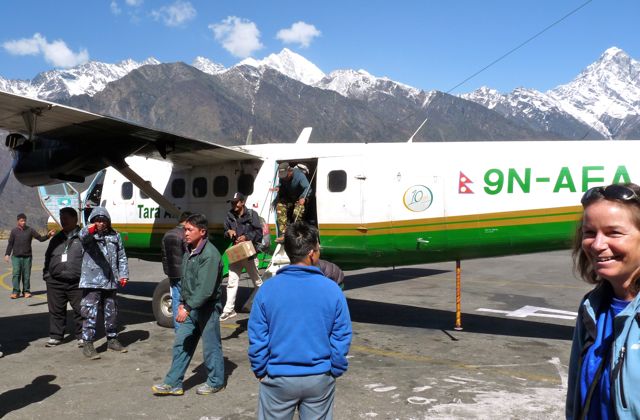
We landed with great certainty (nothing like a small plane!). This is our plane (Tara Air), and Leslie looking relieved.
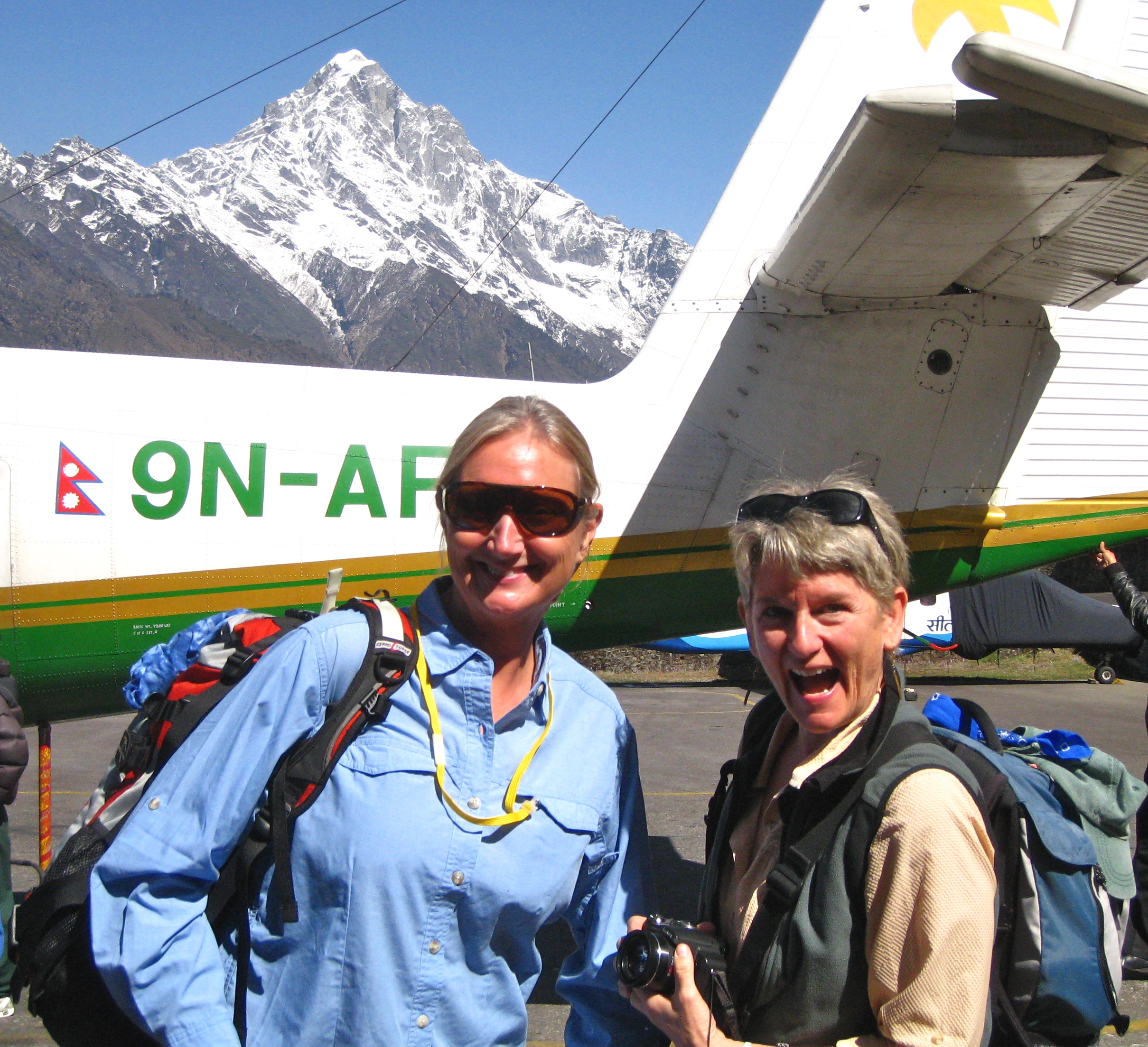
And Laura and me, also looking thrilled to be on terra firma in the high Himalaya!
Two weeks later, on our departure from Lukla, we’d spend a few hours watching countless planes come and go, and we’d see how truly routine it all is. Planes would land, turn right into the parking and loading zone, 20 trekkers would get off, and airport workers would quickly empty the cargo bin of duffels. Then, 20 trekkers would pile onto the plane, new duffels would quickly get loaded, and the plane would proceed to the runway (50 yards away). They wouldn’t even shut off the motor. Sometimes someone would deliver cups of tea to the pilots.
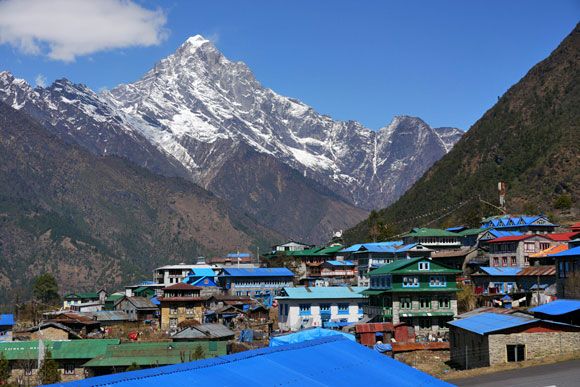
I found this nice picture of Lukla, which is better than any of mine:
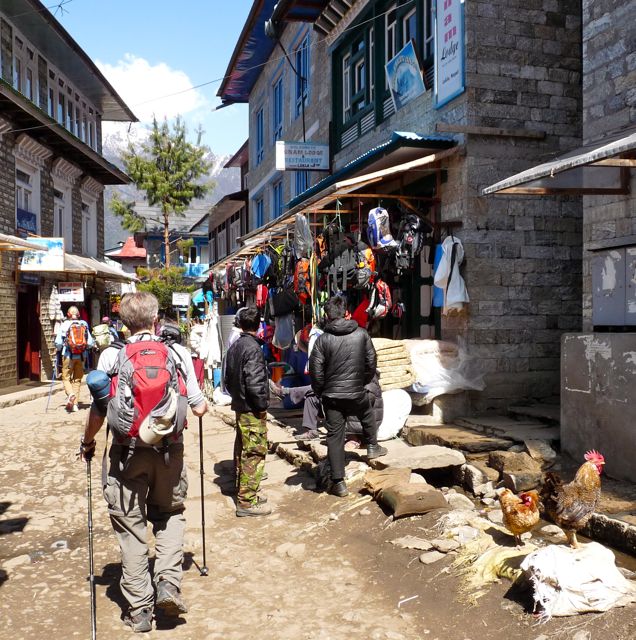
I did take this one, below, just steps out of the airport building…it’s Rick, a couple of store fronts and, of course, some chickens. It’s very charming.
First order of business upon leaving the Lukla airport, was to have a cup of tea and formally meet our assistant guide and porters.
They had all greeted us at the baggage counter, promptly gathered up our bags and vanished up some crowded, steep, stone steps. We caught up to them at the North Face Resort, a short walk from the airport.
(As with so many of the inns and tea houses, the names were sort of an overstatement. The accommodations were a lot more than I expected on this trek, but they were still very modest, and at the higher elevations very primitive. I’ll address all that later.)
At the North Face Resort, Hom, our head guide (37 years old) introduced us to Pradip, our assistant guide (23) and our three porters, Pemba (17), Asaman (27) and Rincha (52). We ordered some tea (ginger for me, which would become a regular choice in a rotation that would also include lemon, banana, mint and masala teas) and had somewhat of a conversation. Both our guides spoke good English, the porters much less.
Here are Homnath and Pradip.
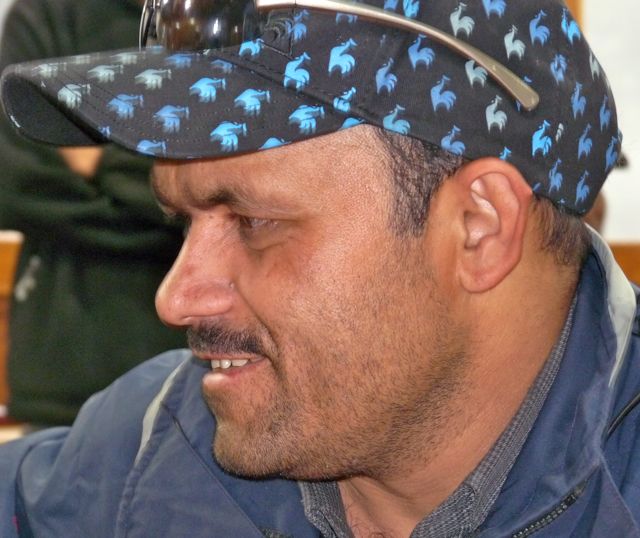
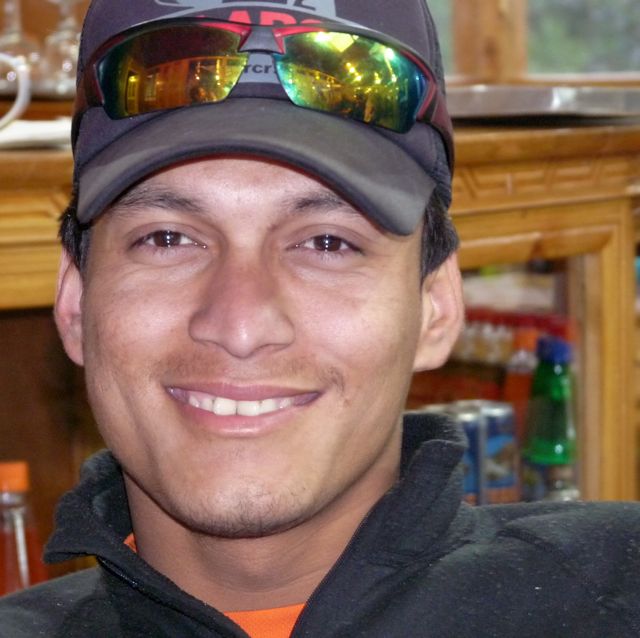
After tea, it was time to load up. The porters would carry our 5 duffels, their own belongings, and our guides’ stuff for the full thirteen days of the trek. They’d also carry some extra provisions (cookies, for example, in a large, heavy metal box) and medical supplies.
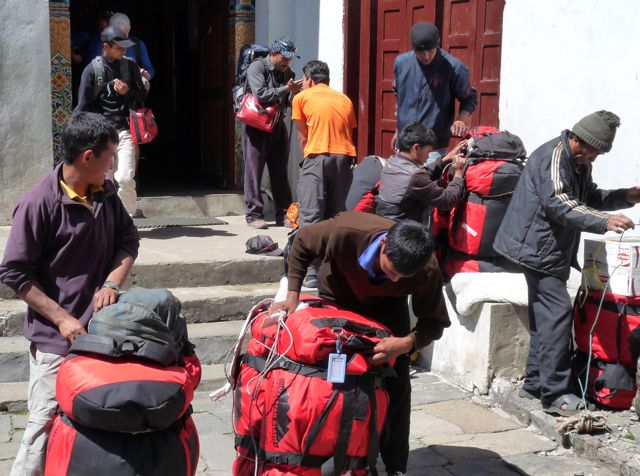
Typical of many of the trekking porters we saw along the way, they carried 2 duffels each, for a total of about 75-90 pounds, and bind them together fairly crudely with some rope. They attached a thick strip of fabric to the load which they then wrapped around their forehead. The weight of the load was born largely by their head and neck (no straps at all around their hips), with some of the weight distributed and balanced along their back (they always walk slightly bent over).
Here are Asaman and Rincha, and below, Pemba.
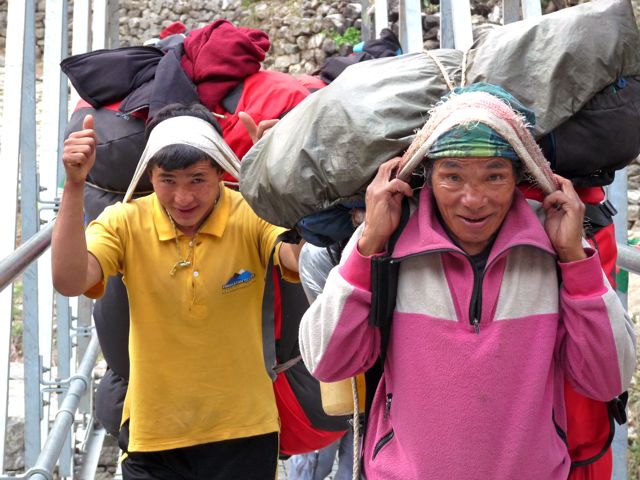
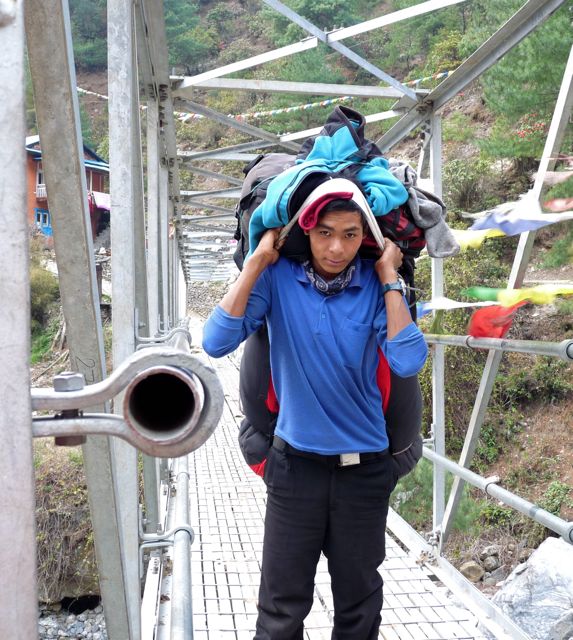
And here’s one more, taken later in the trip:
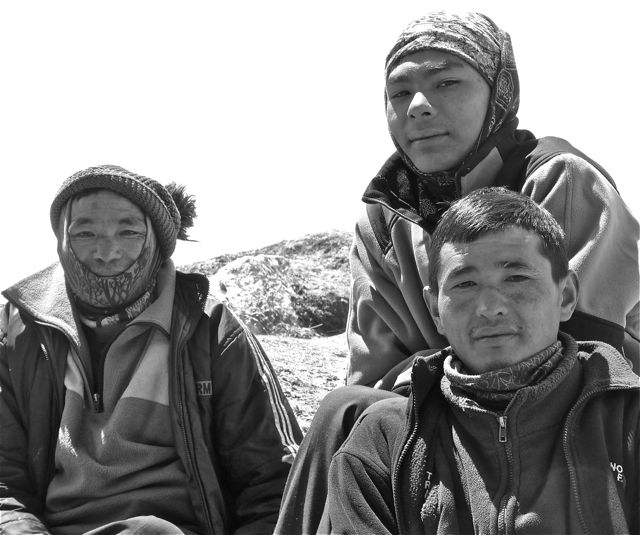
A few comments about our porters:
Throughout the trip, Pemba, Asaman and Rincha would show up outside our doors first thing in the morning, collect our duffels and head out. We wouldn’t see them again until we arrived at that day’s destination, several hours after they’d arrived (at least). Not only did they carry these amazingly heavy loads over very rugged terrain wearing inadequate footwear and marginally suitable clothing… they did it very, very fast!
Meanwhile, we’d carefully and obsessively adjust the numerous straps and buckles on our small daypacks in order to perfectly balance and distribute the 15 lbs of water, snacks and extra clothes that we’d carry. We’d also wear high tech synthetic clothing designed for every possible weather condition, adjusting as needed to subtle weather changes along the way. And, of course, we wore the finest and latest in high-tech footwear. We were such the trekker geeks (nearly all trekkers are). It’s sensible, of course, but couldn’t help feeling wimpy.. and not a little self-conscious.
I just can’t tell you. What porters were called upon to do was both impressive and disturbing. We were entirely grateful for our porters.. AND had to fight off the impulse to challenge the conditions under which they worked (for meager pay).
On the one hand, carrying loads up and down the mountain is a fundamental part of life in the Himalaya. There are no roads. There are no cars. Everything that a person needs has to be carried up the mountain. With few exceptions (food that’s grown up there, animals that breed up there, and some native raw materials), everything we saw, anywhere along the way, had been carried in on the backs of humans or animals. The trails are crowded with men, women, children and pack animals hauling stuff up and down the mountains. Constantly. Everywhere. Everyone is quite accustomed to it and their bodies have (presumably) adapted (to some degree anyway). Our porters are carrying on, as they have for generations.
On the other hand, it seems a fine line between fair exchange and exploitation. There are, we’re told, great efforts being made to institute protections for Sherpas and porters–load limits, decent wages, medical care, and I don’t know what all. Grateful trekkers by and large tip well at the end of their trips, which is small compensation, but something. In the last 50 years, as trekking in this formerly untraveled region has exploded, consciousness about the human and environmental impacts has increased, but there’s a long way to go.
I thought about it a lot (because you’re constantly observing it and have a lot of time to think), not just about the porters, but about all the impacts that tens of thousands of foreigners annually (and growing) must have on the daily lives of these mountain communities and people. The invasion of a once remote and quiet culture was hard to reconcile… even if the invaders are largely culturally sensitive hiker types.
It always felt invasive. The introduction of modern life was often clumsy and tacky. It always felt like a clash.. a culture clash, an economic clash, a material clash, a religious clash.. etc.
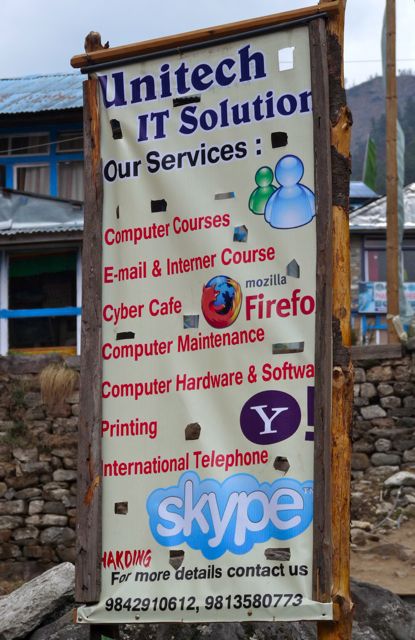
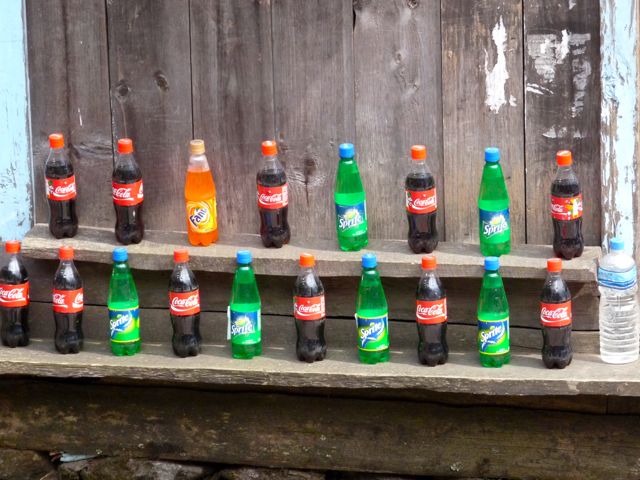
Anyway, lots more to say on the subject… but moving on for now to the actual trek…
After finishing our tea, we took off through the village of Lukla, passing stores, cafes, teahouses and lots of village life. The streets were crowded with people and animals.
This is a dzopkyo.
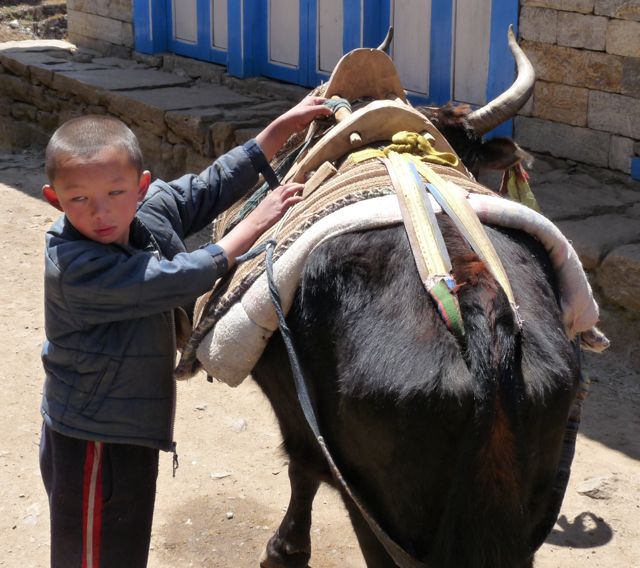
They can be saddled up (like the young man is doing here) or used to haul great loads (the ultimate, all-purpose beast of burden). Dzopkyos are actually a hybrid between yaks and cows, but it gets a bit more complicated, as males are often called Dzos while females are technically called Dzomos. Not knowing how to pronounce any of that, I just called them yaks.
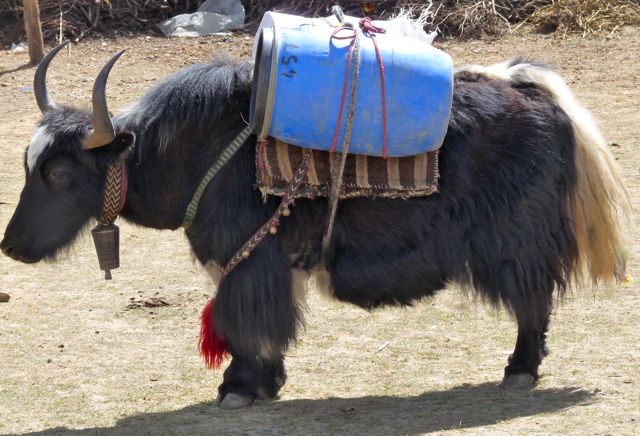
Yaks are, actually, hairier and are the more predominant pack animal at the higher elevations (over about 14,000). Below is a yak. Everything you’d ever want to know about yaks is here. They were very cool and shared the trail well with trekkers.
They also left a LOT of poop on the trail.
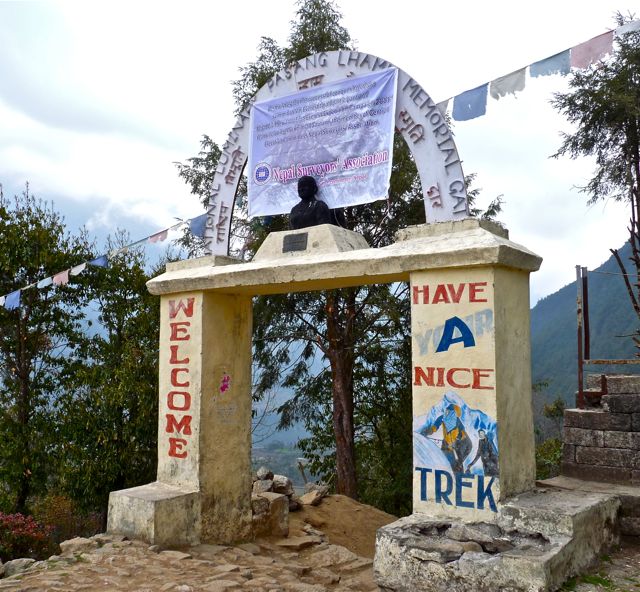
All treks in this region officially begin as you pass through this gate on the edge of town. We started our trek at about 10:45. It was sunny and fairly warm… I’m guessing in the high 40s or low 50s. (That would certainly not last..)
(I actually took this picture on the return trip, which is why it’s cloudy).
This is a map of where we are going to be trekking for the next few of days (better seen if you click on it).
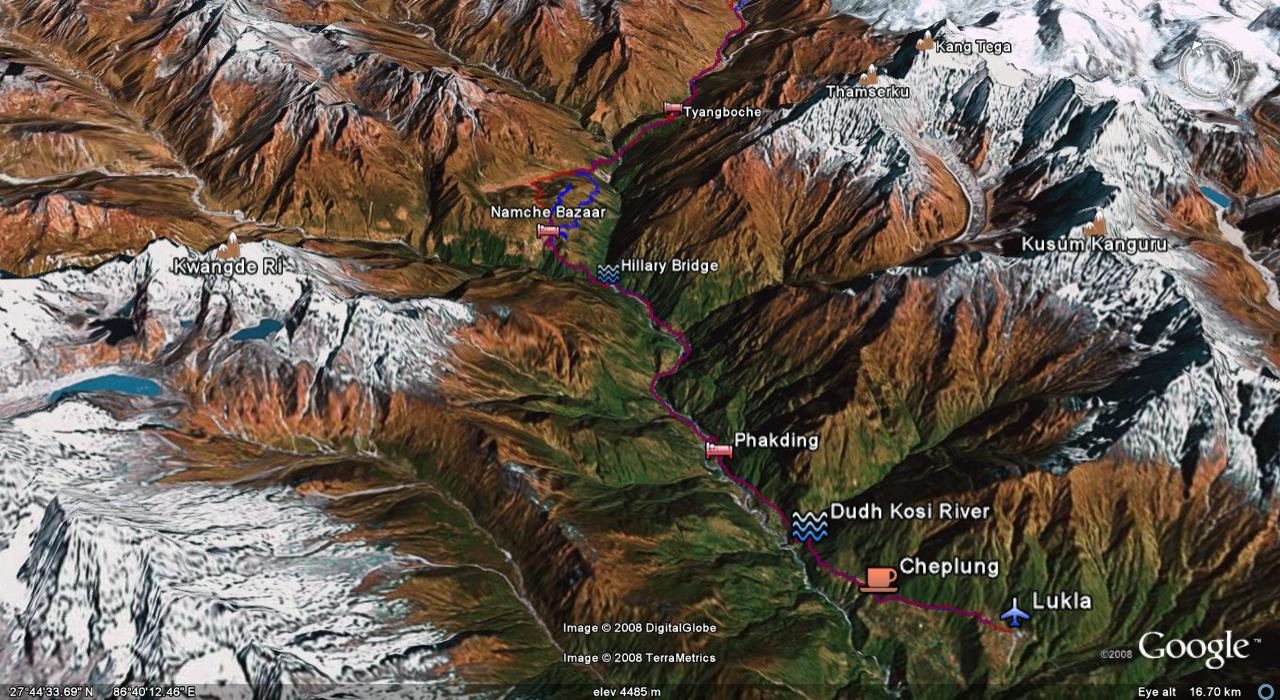
Essentially, we’re hiking up the Dodh Kosi river canyon. You can see Lukla in the bottom right corner. We’ll have lunch in Cheplung and stay our first night in Phakding. We’ll cross the river numerous times on suspension bridges (wait’ll you see those) high above the water on our way to Namche Bazaar, where we’ll spend two nights.
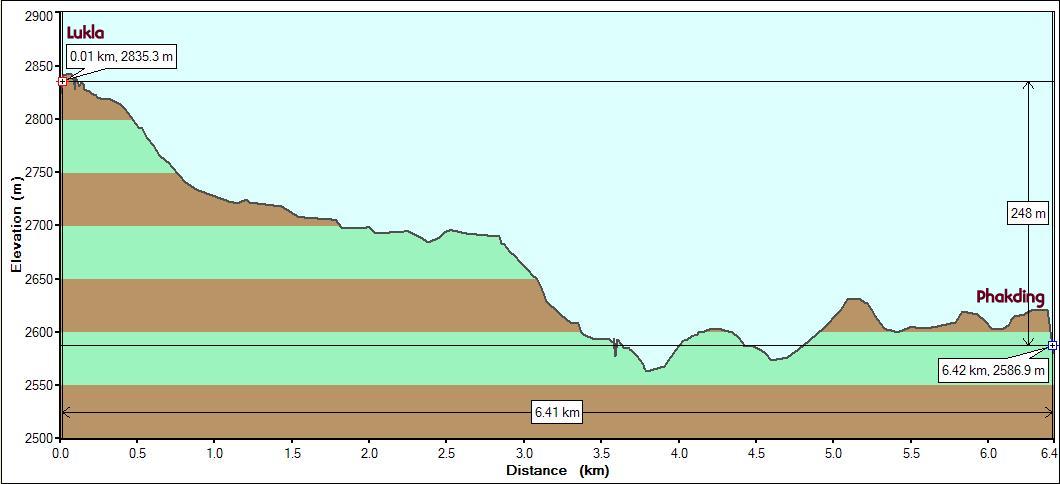
But back to day one… it’s a short hike, only 4 1/2 miles, with a net drop in elevation, from 9318′(Lukla) to 8563′ (Phakding). Easy peasy. Here’s a profile:
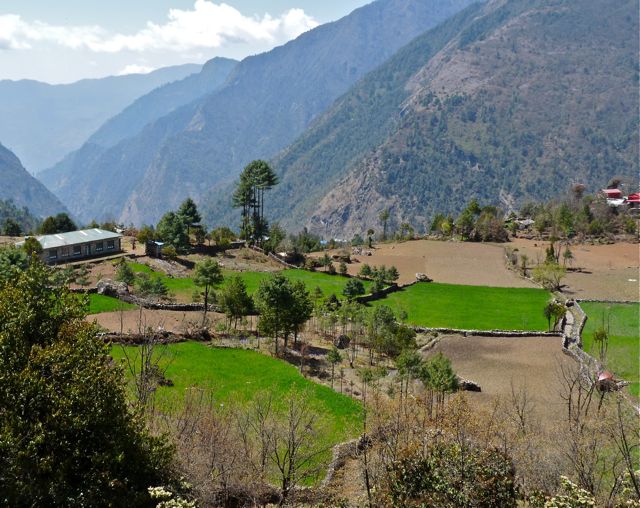
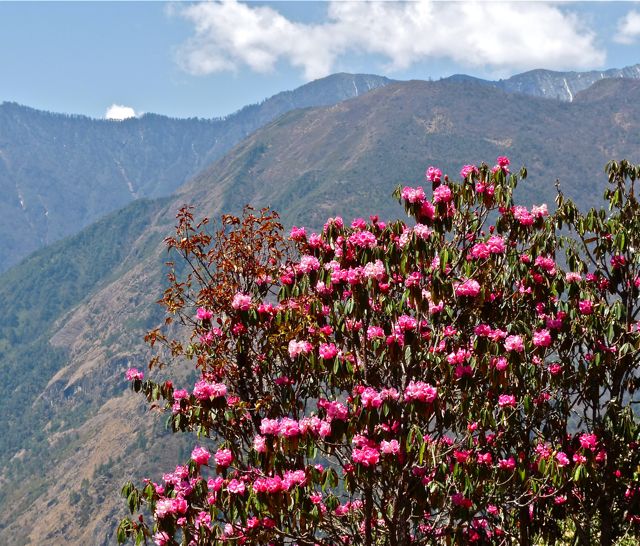
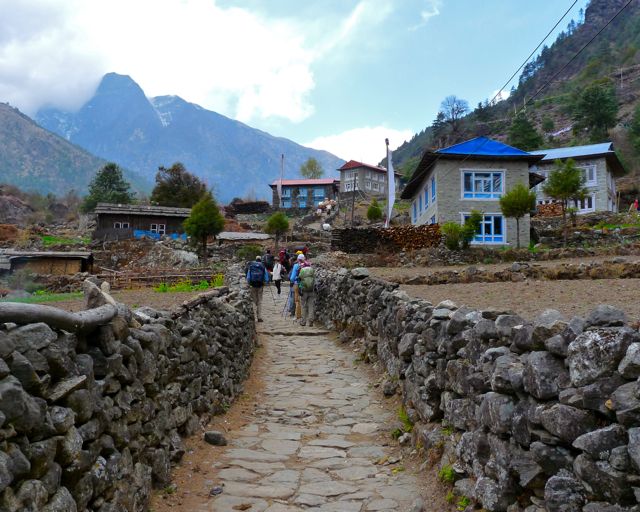
Here’s what it looks like along the way.
Farmland:
Blooming Rhododendrons:
Villages:
And lots of Buddhist religious structures:
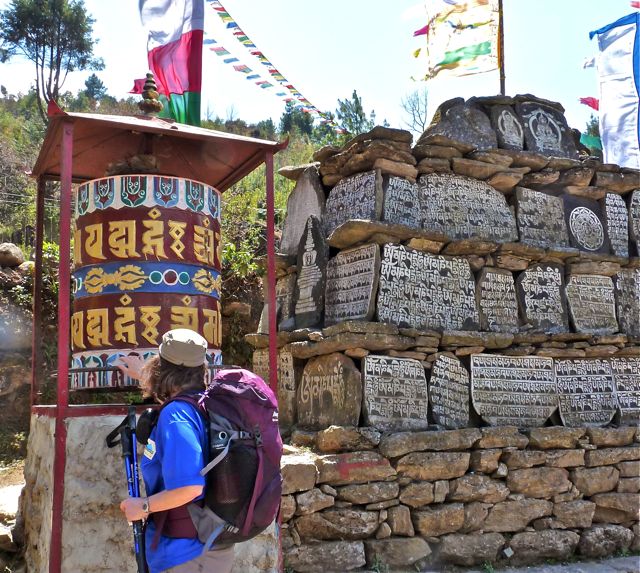
Leslie is spinning a prayer wheel (always clockwise), there are carved mani stones to the right (with Om Mani Padme Hum written in sanskrit on them), and prayer flags are blowing. Below, I’m standing in front of a stupa, and you can also see a couple prayer flag posts. In all cases, it is traditional to pass on the left of sacred structures, keeping it to your right (I read that this imitates the path of the sun, but I’m not sure).
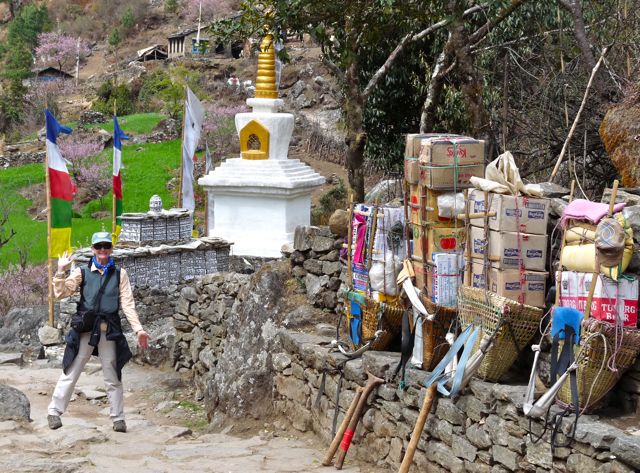
Also of note in this picture are the four loads sitting on the wall. The porters are lying on the ground resting, just out of camera range. In their baskets are probably cases of beer (I see Tuborg brand) or laundry soap. The baskets are extremely typical; everyone carries them (except us). You can also see the straps that go around the porters’ foreheads, and the thick, squat walking sticks they all carry (and sit on from time to time).
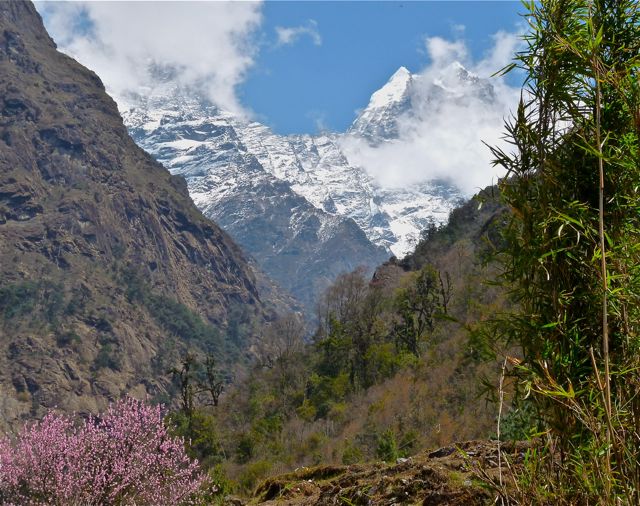
Here is the first view of Kusum Kangaru (20,889′), which was just beautiful and would be in view for many days on this trek. We had our first trail lunch looking up at this, in a teahouse in Cheplung.
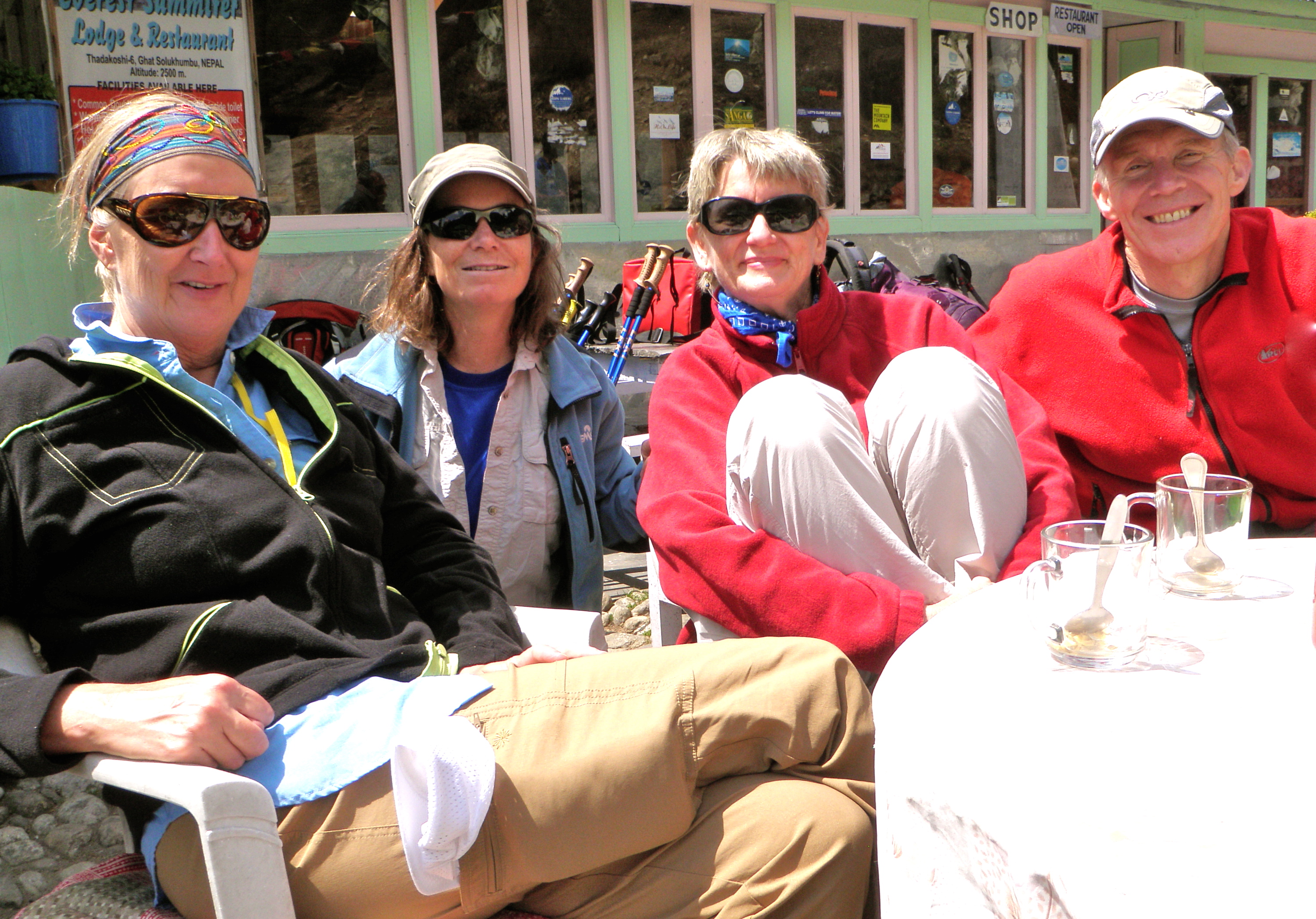
At lunch, we all tended to order the same thing to simplify and expedite the process. This day, it was a big plate of fried rice with egg, vegetables and cheese. And tea. Always tea. Here is a picture Karen took of Laura, Leslie, me and Rick.
After lunch, we continued on, sharing the narrow, often steep trail with dzos, locals, porters, and other trekkers. The red rooftop below gives a sense of how steep the trail is. The pack animals (dzos, yaks and donkeys) never seem to have trouble managing steep stairs.
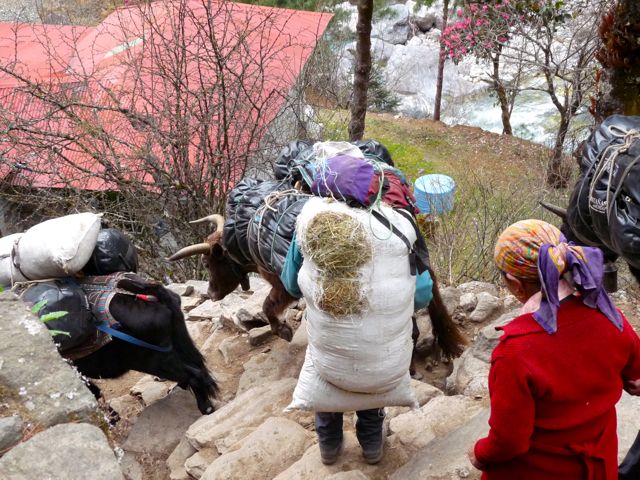
The things that impressed me most on day one of our trek were the number of people (locals, trekkers, porters), the villages and village life I didn’t expect to encounter, the number of pack animals, and the garbage. I just had no sense of any of this prior to arriving. After day three, we’d leave most of the crowds behind (very nice!) but I just had no idea we’d find ourselves in the middle of communities of mountain people.
Regarding the garbage… while it wasn’t a lot, it was definitely there. It certainly wasn’t left by trekkers, who, by and large, have a pretty strong environmental ethic.
The reality is, trekkers and climbers are a relatively new addition to the Khumbu region. It’s really only been since 1953, when Mt. Everest was first climbed by Edmond Hillary and Tenzing Norgay, that visitors have started pouring into this area. I think there are increasing efforts underway to introduce all kinds of environmental regulations, largely at the initiation of foreign visitors and global environmental and mountaineering organizations. It very much seems like an area in huge transition.
Anyway..
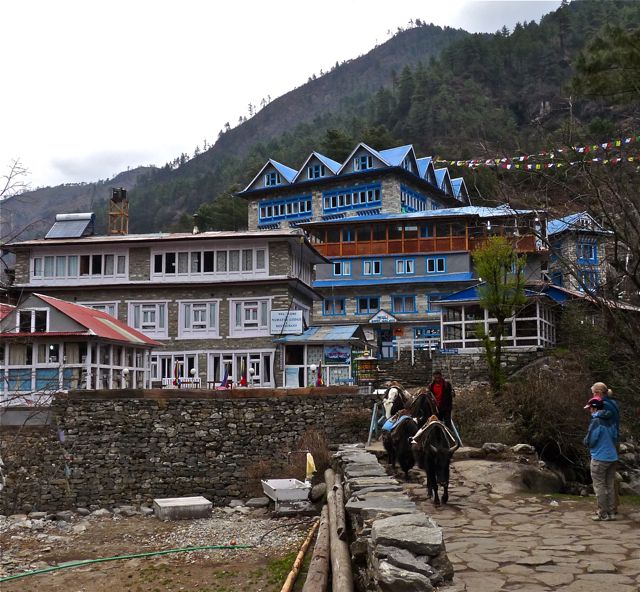
We got to the smallish village of Phakding in the late afternoon. That is our teahouse, straight ahead, the Beer Garden Hotel (blue, four story building). The level with the red siding is the dining room, which had a great view of Phakding, the valley and terraced farms, the river far below and the mountains far, far above!
Here’s the inside of the dining room:
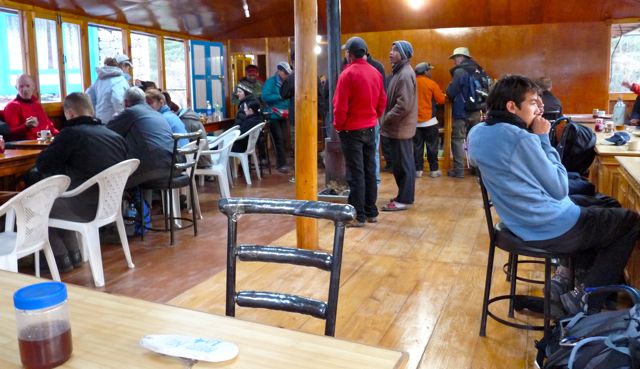
This is very typical of what we’d find in every teahouse: a large room with windows and bench seating around the perimeter, a stove in the middle (barely visible here), and trekkers & guides everywhere. They’d fuel the stove with yak dung (no smell from the dung, but it’d smell intensely of kerosene), usually firing it up in the late afternoon. It’d be warm in the dining room with lots of lively conversation and card games. We’d often hang out in there after the day’s hike (as it was the only warm place) drinking tea and talking to people from all over the world. It was pretty damn fun.
Phakding was one of the larger villages we stayed in, so we took the opportunity to explore a little. That afternoon, we went to a bakery for cinnamon rolls, and to a little shop that had internet access. The higher elevation places, especially those along the trail we eventually veered off on (well off the main Everest Base Camp trail), did not have those kinds of amenities.
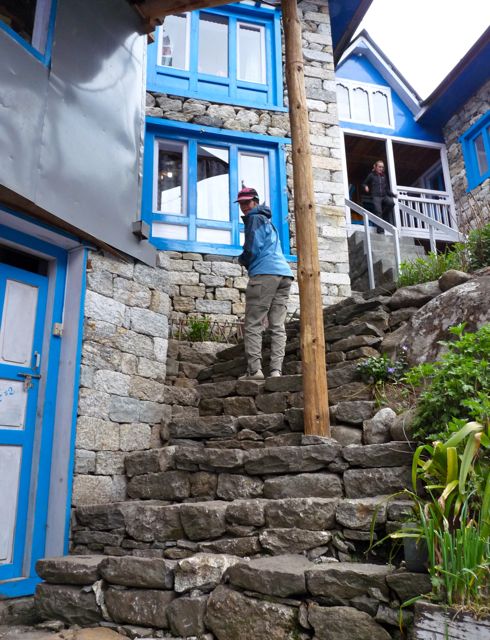
These are the steps up to our room. It was pretty charming with lovely little gardens. This is doable at this elevation. Teahouses would get increasingly primitive the higher we went.
And this is our fancy dancy room. Having a bathroom and all that space was unique.
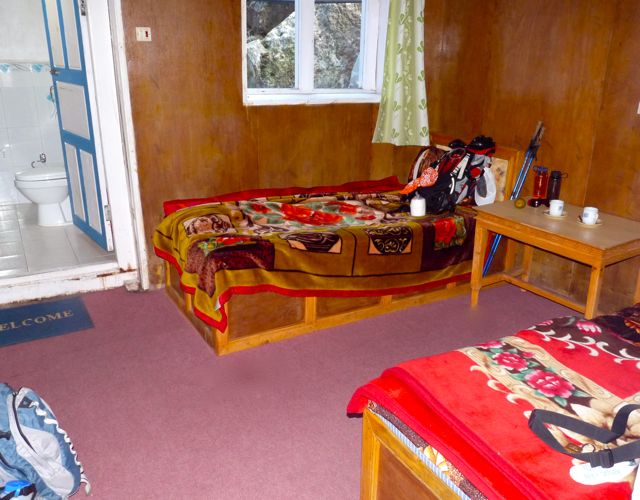
We always had electricity, but never heat. This is what I wore to bed: fleece pants, socks, fleece turtleneck, expedition weight thermal top, and a down vest. I probably also wore a fleece cap and mittens (but I failed to note that in my journal…so not sure). I brought a silk liner that I placed inside the down bag they provided. We’d put the blankets that you see on the bed over us for extra insulation. It got colder in the higher elevations and I’d add a pile vest, a down sweater, thermal bottoms, down booties and a fleece buff around my neck.
So, yeah… cold.
It also ended up raining really hard this night. We all lay in anxious anticipation of what that meant for the coming days… snow at the higher elevations? Would they close Cho La Pass? Would we need to change our route? Forgo Everest Base Camp? Were we going to spend our next few days soaked and cold? The prospect of any or all of that was daunting.
Even so, we went to bed at 8:00 and slept super well and toastily.

 Life of Wry