
Hola Pedro, como estas?
December 7, 2011
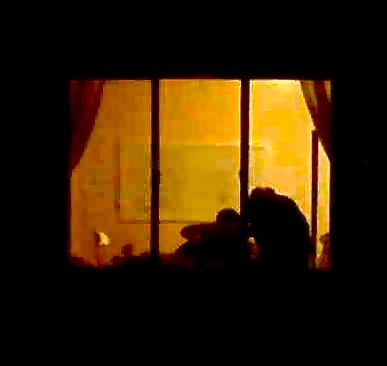
Here’s a stealthy little picture I took last week. I’m sitting in my car, on the street outside this house, about 30 yards away. The silhouette on the right is Peter’s new spanish tutor. And, of course, that would be Peter on the left.
Bad me for taking this picture, but I’m so excited.
It’s a longer story than I really have time to tell at this moment, but has to do with Peter having a miserable time last year in spanish–his first experience with junior high school language instruction–after seven years of being in a spanish immersion elementary school. And has everything to do with the lousy and inconsistent way kids transition from Cesar Chavez Elementary to one of three junior high schools in town, and the resistance on the part of secondary school spanish teachers to embrace the new world language standards and practices approved by the school board over two years ago, which, by the way, were based on copious research and statistics and real world language integration experiences. (And, by the way again, were also the product of something like five years of work on the part of a very committed and thorough committee working with a 3/4 of a million dollar grant. Not a small effort.)
The upshot: Peter ended up in a “drill and kill” Spanish 2 class, when he should have been in a Spanish 3 class. The appropriate placement level is determined by the results of a new-ish proficiency test administered to all immersion students, but the test results are not used by all the junior highs. Inconsistent articulation, in school district parlance. That’s for starters.
In fact, I believe his spanish proficiency actually went down after his first year of secondary school instruction, based on observable speaking, reading and writing skills (or the diminishing thereof). But we can’t determine that for sure because his junior high has declined to administer that same proficiency test. The other junior highs are using it, however. More inconsistencies.
Sigh. It’ll be a big mess when the three junior highs merge again in high school.
More sadly, however, his junior high school teacher’s conventional emphasis on grammar at the expense of communication (the exact opposite of how he’d learned and related to the language for seven years) was sort of startling (and grammar, de-emphasized at Chavez generally, was never Peter’s strong suit anyway). After a year of endless worksheets, his morale and love of language was pretty much in the toilet, because, it turns out, he’d been pretty proud of his attaining fluency in spanish, and suddenly, his ability to speak and write and read fluently was not valued. Rather, he was expected to accurately conjugate verbs and spell, and while that should have been a cake walk, he resented it and checked out. The teacher’s patience for Peter’s I’m above this attitude ran out early, perhaps understandably. The problem, in my view, was the program didn’t reward him for his proficiency, it punished him for his lack of mechanics. It didn’t build on what he’d mastered, it found ways to diminish his mastery and embarrass him for his mistakes. He may have ended the year with a B, but flirted with Ds at various points. This was a kid who was functionally fluent in spanish, taking a relatively remedial spanish class! And, he was so demoralized, he decided not to even take spanish this year. Just heartbreaking, and so unnecessary. Again, in fairness, it wasn’t solely his teacher’s fault; he lost interest. Many other kids did fine. But she lost Peter.
Which just killed me. Not because I want him to get As all the time, but because the whole point of taking that huge leap of faith and going with an elementary school program that was taught entirely in a foreign language was to cultivate a certain cultural awareness, interest and appreciation, and to come out of that experience with not only a respect for another culture, but language proficiency that would last a lifetime.
Language learning is supposed to be about communication and conversation, and the ability to be in a foreign country and be able to get around, interact, integrate, function. It’s about proficiency, not grammar. Nevermind the very useful role basic conversational proficiency will have ongoingly in the state of California where half of our population is hispanic.
Our kids need conversational competence.
And they provide that at Chavez by teaching kids the language by talking to them in the language, by making it just a part of their day-to-day school experience. The school offers the usual school curriculum and activities, along with an introduction to cultural traditions from spanish speaking countries the world over. It is all seamless. And beautifully well done.
It was exactly the way we all learned our own native languages. In 6th grade, I don’t think I could have told you anything about the structure of my native english language. But I could certainly speak it.You could have plopped me right down in the center of exotic England, and I’d have had no trouble getting around and no trouble engaging the locals. At all.Totally conversationally competent.
So, this tutor is someone who gets all that. She’s taught in the immersion school and understands how kids learn language. She also understands the difficulties in merging entirely different language learning philosophies. She’ll prepare him for re-entry into the conventional program (conventional–arghh!–despite the school board’s commitment to transition to the more evolved and effective approach to teaching world languages), but along the way will rev up his fluency and, hopefully rebuild his morale and passion for language.
Most exciting for me is his eagerness to get back into spanish. One session with her and he 1) likes her a lot and 2) seems pleased to be back on a spanish speaking track. It’s way out of character for Peter to be so willing to give up his precious after school time for anything academic. It tells me how strong his bond is with spanish and how very proud he’d felt about his accomplishments with the language.
I’m really grateful for that. And surprisingly relieved.
So I took a picture.

 Life of Wry