
Half Dome by Moonlight
October 11, 2011
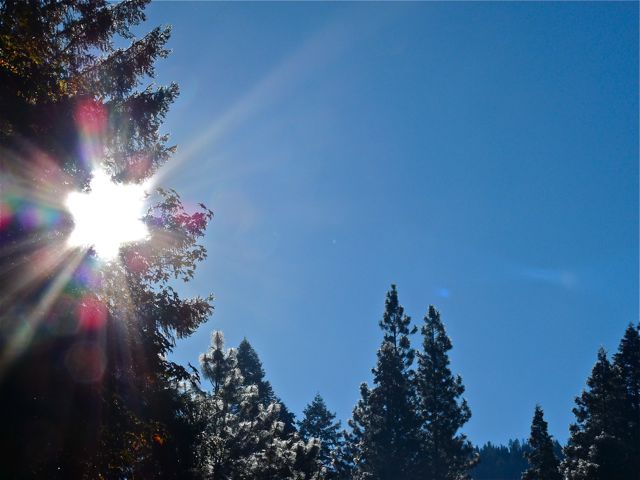
It was raining when we arrived on Monday afternoon, and drippy on our canvas roof for most of the night, but by Tuesday morning, nothing but sunshine. Nothing like the clarity of the air in the mountains after a rain storm.
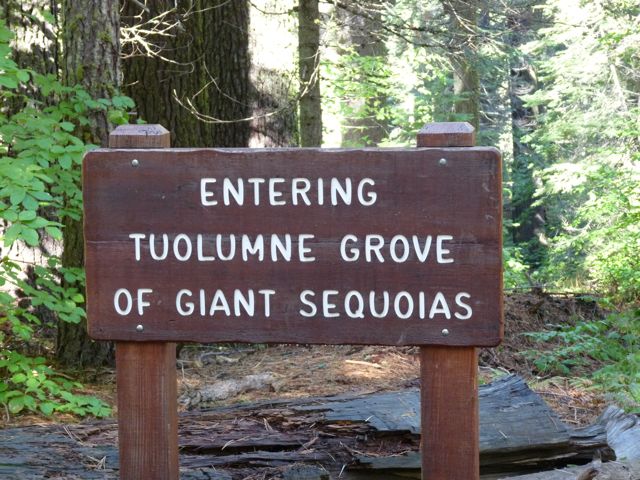
Explored Tuolumne Grove, a 2-mile walk up near Crane Flat, a place we’d passed for years and wondered about, but never visited. Worthwhile.
We also did another short hike up to Inspiration point. This one had some good elevation gain (4500′ to 5400′) and offered a nice view down the valley.

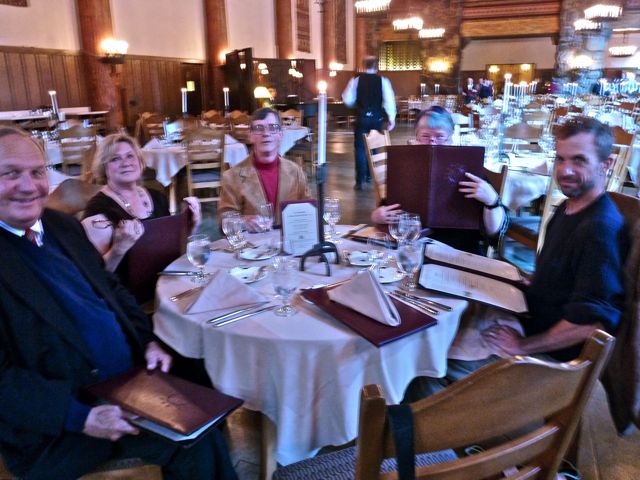
We drank champagne in Susan’s and Jim’s room at the Ahwahnee to celebrate their 25th anniversary, and then had a really good dinner in the Ahwahnee’s impressive dining room.
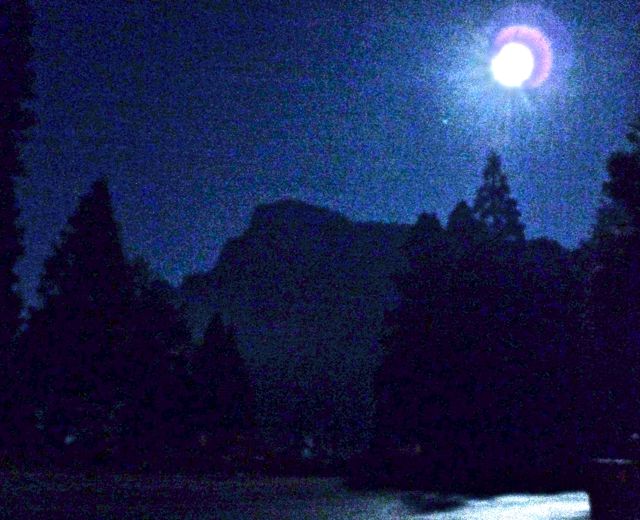
We got back in time to take a short walk.
You know, full moon illuminating granite walls. Crazy beautiful.
Yosemite on a Monday
October 10, 2011

Some Yosemite unusualness:
Going during the week.
Going to the Valley.
Staying in Curry Village.
Being there in the rain.
Being there in the Fall.
Being there without Peter.
Not going on a big hike.
Being there only a couple days.
All of that’s happened before, plenty of times, but it’s not the usual. Usually, Jim, Peter and I go to Tuolumne Meadows for a long, planned vacation in the warm, dry summer, and hike a lot.
Still, even with the unusualness, felt the same sense of coming home and an intense longing to just stay.
The Things We Love
October 9, 2011

Most tournament weekends begin this way: a before-dawn trip downtown to get coffee and baked goods for the road.
It’s the early start on the day. It’s a huge cup of cafe au lait and a pastry someone else has made, all ready to go. It’s the guy who knows your order (and we only go here on tournament mornings, mind you, because it’s the only place open). It’s the quiet in the car, or NPR. It’s the light fog layer over the wetlands. It’s looking forward to a day of watching your favorite kiddo play baseball.
All of it.
On Writing
October 8, 2011
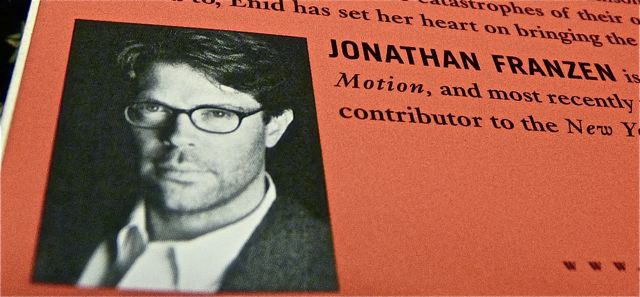
We weren’t allowed to take pictures, so using this from the back of the book I’m reading.
Attended Jonathan Franzen’s talk tonight at the Mondavi. Things that stuck, in no particular order (really, this is random and is mostly an emptying of my short term memory bank):
1. He was quirky, but thoughtful. He was not a smooth speaker, nor did he appear entirely comfortable with the format, but he was very articulate once he found his bearings. He read his prepared comments, appeared somewhat lost or self-conscious at the beginning, laughed a bit nervously, but, damn, the comments, once he got rolling, were rapid-fire brilliance. During Q&A, he was halting, but genuine and delivered a few real gems.
2. Recurring themes were shame, guilt and depression, and the/his process of overcoming or dealing with these through writing.
3. A good process/exercise might be to make a list of things about which I feel guilty, about which I feel shame; these are bases for characters, stories. He talked about his own shame, and ran down a list: guilt at leaving his marriage when his wife was 35, childless; shame at not being more sexually experienced; guilt for this and that.. it was an interesting list. He talked about how his books are all about character, and he works on “what the story is that defines these characters” He puts contemporaneous people into stressful circumstances. Focuses on one moment and then spreads the moment out. The goal is to pick up a character’s story when they’re in maximum crisis, dramatic and unpredictable. You get good stuff when you inhabit the person at the moment of intense crisis. (This was an awesome part of his talk and took me right to his character in Corrections, Chip Lambert, who is SO Jonathan Franzen, so in crisis. And he admitted that, in fact, lots of characters are autobiographical, and his stories biographical, like Gary being his brother, experiences like Alfred wetting the bed–I haven’t gotten to that part in the book–being something that happened to his dad, and so on.)
4. Autobiographical writing. His answer to this, however, was long and started with, no, his books are not autobiographical, but in another way, it’s all autobiographical, nearly by definition. You can’t write in an unautobiographical way. Everyone’s got one autobiographical book in them and after that, who knows.
5. Writer’s block (not a concept he likes) arises when you think you should be writing when actually you don’t want to. He joked he’s dealt with writer’s block for 26 of his 30 years of writing. It implies that we should ordinarily experience an utter free flowing of words, which doesn’t happen typically. Writing comes when you’re ready. Being blocked when you think you should write leads to depression; being where you don’t want to be leads to depression; being with somebody you don’t want to be with leads to depression. Brain/ body go on strike.
6. When his mom was dying, he wanted, before she was gone, a sense of how she liked his books, his writing. She said it was not about him. Her life was about her. The lesson she left him with was, ‘worry not about what others think about you, because they aren’t, they are more concerned with their own life.’ She was more concerned with the last days of her life, for her, it was about her, as it usually is.
7. When he’s thinking about whether he’s going to lend his name to a work (of someone else’s), he reads it, and looks for cliches. No cliches on the first page, or he won’t continue. In a whole book, maybe one every ten pages. He went on to talk about cliches–the good, the bad.
8. Social media is like cigarettes used to be, you’re waiting for your next hit, your next opportunity to be stimulated.
9. Read Sabbath’s Theater (Phillip Roth); The Great Gatsby (F. Scott Fitzgerald); Kafka (um..); Ian McEwan (not sure which); The Blue Flower (Penelope Fitzgerald); Age of Innocence (Edith Wharton); Elmore Leonard. These were some of the books and/or authors he mentioned, drew inspiration from, or just thought they were good.
10. A guy asked why black people don’t appear in his novels, or rather, he identified, very specifically, the relatively few references in various of Franzen’s books. “Well-researched” was Franzen’s initial response and he appeared not a little uncomfortable with the question. He went on to say, he was only uncomfortable with part of it (I can’t remember which part, though he was specific), then fessed up: he was uncomfortable with the whole question, all racial issues (and questions) are uncomfortable. I know I felt uncomfortable for him, as I was sure the guy had a point. Franzen responded that it’s true, there are few instances of black experience, or black characters, and it’s because his life experience is such. He could, perhaps should, and that would be good, but it’s not his experience. He went on to say he checks “goodness” (he didn’t say political correctness) at the door and goes with truth. It seemed not an excuse, he seemed not on the defense, just his truth. Earlier in the talk, he’d talked about “good art” versus “good personhood,” and I think that applies here, too. He spoke about that being a conflict for writers. Anyway, that was the last question and the talk ended right there and fairly abruptly as he muttered something to the interviewer (a professor, presumably, from the UCD english department who wasn’t very adept at asking questions or drawing Franzen out at all) and then walked right off the stage. I don’t even remember clapping.
The trouble with my summary is it’s so limited. I thought if I could write as soon as I got home, I might remember the best parts.. but, no.. this is not a good summary. And it’s too out of context to be meaningful for anyone reading it. His thoughts in my words?…. uh, no. Let’s not do that.
What was more significant for me was the experience of seeing him and hearing him and putting a human face and voice to the phenomenal words that I’ve read. It was also hugely inspiring. It’s good to listen to authors, especially ones I find so brilliant. It’s good to see he’s accessible, not as a person in my life, but as a human. That means writing is not such a ridiculously abstract and unattainable pursuit.
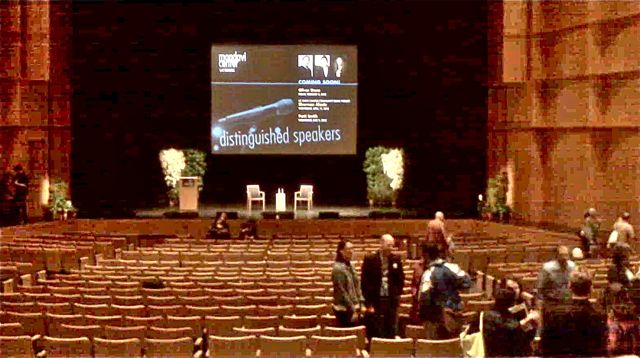
Here’s the stage:
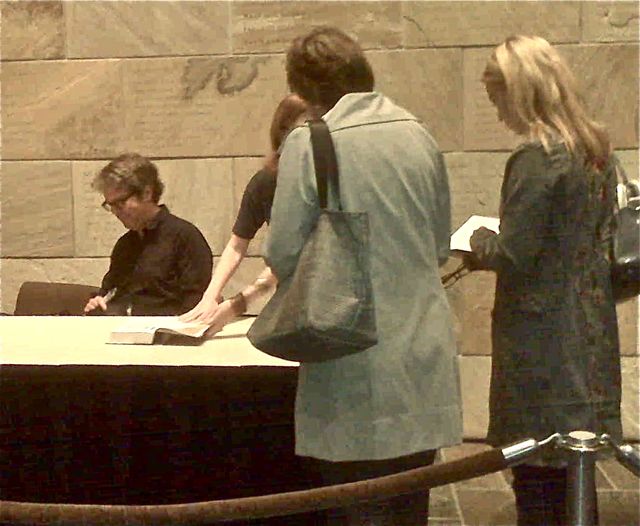
And here’s Franzen at the book signing table afterward:
Bari Joyful
October 7, 2011
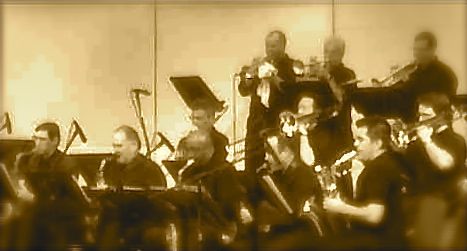
Five saxes, five trumpets, four trombones, and a six person rhythm section combined to b-l-a-s-t, with great flare and musicianship, ten surprisingly distinct arrangements by Tito Puente last night. It was rousing and very attention-getting. Explosively rousing! I–who struggles a little to understand and enjoy band music–could hardly hold still. I tracked our place in the program because I wanted to remember the names of the songs, not because I was counting songs until the end, which is what I kinda do at band concerts. The music was deeply beatful. Beatful, yes. Should be a word.
Fun, too, was seeing Peter (in the row in front of me, and many seats to the left–calculatedly far away and among his friends), so engaged. He appeared utterly fascinated by his band teacher who was playing trumpet–fascinated and twitchy in that way kids are when they see their teachers being actual real people in the world. He also looked to be transfixed by the moves and sounds of the phenomenal bari sax player. He even, even, turned to catch my eye a few times with a look of “can you believe this!” and “that’s MY instrument!”
I was gratified beyond words to hear the band leader talk of Tito Puente so admiringly and smartly, and describe his music as joyful and complex, sure that Peter was being drugged for a lifetime with this appreciation for latin jazz.
It was all just very cool.
~ ~ ~
NOTES:
– That’s Clyde Quick, Holmes’ band teacher, on trumpet, top row, left most. – This is the Sacramento Jazz Orchestra, and the concert was at Sac State’s music hall.
Under the Umbrella
October 6, 2011
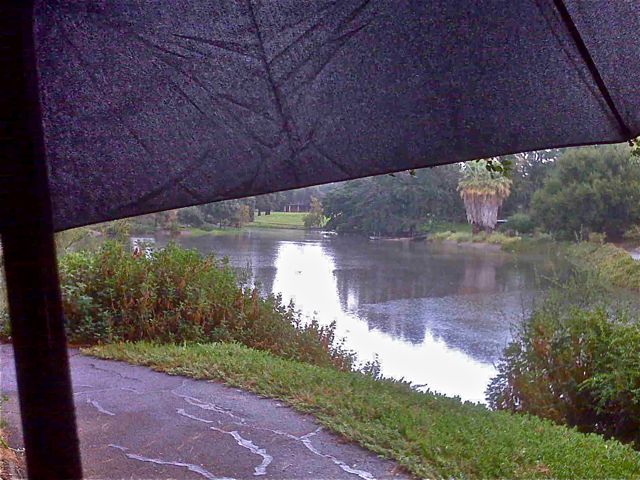
You can’t tell, but it’s raining cats/dogs here along the western-ish banks of Putah Creek. That’s me, under the umbrella. More interesting is the conversation; you can get a lot in over the course of a 5-mile walk plus cafe time.
Glad umbrellas don’t have ears.
Live
October 5, 2011
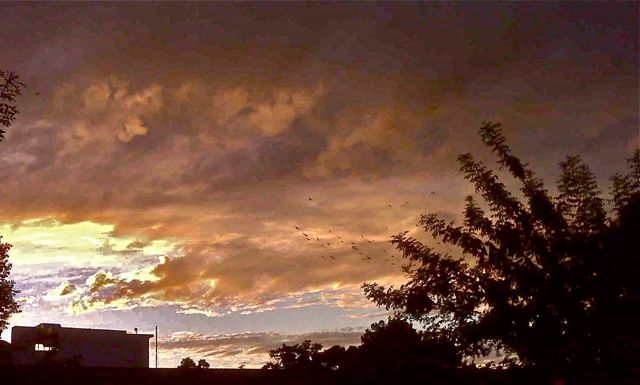
Steve Jobs died today. Looked again at his commencement address at Stanford, back in 2005. A great presentation of three stories and a few well stated words of advice. I liked a lot of it, especially this:
Remembering that I’ll be dead soon is the most important tool I’ve ever encountered to help me make the big choices in life. Because almost everything — all external expectations, all pride, all fear of embarrassment or failure – these things just fall away in the face of death, leaving only what is truly important. Remembering that you are going to die is the best way I know to avoid the trap of thinking you have something to lose. You are already naked. There is no reason not to follow your heart. Stay hungry. Stay foolish.
-Steve Jobs 1955-2011
A sad, yet oddly inspiring day.
Remembered another quote on the subject:
When asked what surprised him most about humanity, he answered, “Man, because he is so anxious about the future that he doesn’t enjoy the present, the result being that he doesn’t live in the present or the future. He lives as if he is never going to die, and then dies having never really lived.”
-Dalai Lama
Exercise for Weirdos
October 4, 2011

How many hours does it take to figure out the perfect combination of cardio, strengthening, stretching and balancing exercises to maximize performance and minimize injury and sustain a healthy body for, oh, I don’t know, say, the next 40 years?
Too many hours. All day actually.
My current perfect formula is courtesy of the last couple physical therapists I’ve been working with. At least it’s largely informed by the dozen or so visits in the last couple months. So helpful these guys are!
And lest you think I’ve gone off the deep end of obsessive fitness wackadoodle mania, or am committing some kind of exercise fanaticide, well, I’m not. I just hurt and am tired of it.
Being the former PE major type that I am, I don’t take this stuff lightly, nor do I settle for the kind of total body fitness program promoted in Cosmo or O Magazine. I’m hard core. But I’m also 55 and, did I already say, injured?
And it’s waaaay not the first time I’ve done this… come up with the perfect daily regimen. In fact, I have so many such perfect daily regimens in my collection, developed over years (and years), the task today was all the harder, because I hate to let go of some of the brilliant exercises and clever sequences I’ve put together in the past. But the sad truth is, if I held on to all of it, the damn thing would take me 3 hours a day. And that’s not happening. So I had to let go of some of it and prioritize certain body parts.
After futzing with it all day (really), I have a doable daily cardio goal, a sensible strengthening plan that divides into body regions and distributes sanely over the course of the week, and some awesome stretching that addresses, especially, the injured and traumatized areas.
I test drove the whole thing today and it all feels great, and best of all doesn’t take too, too long:
Cardio: an hour; Strength/stretch/balance stuff: 40 minutes. Per day. Six days a week. Or at least until I’m out of the woods.
It’s pretty, too. All in tables, with attractive colored headers identifying the day and/or category, neatly numbered so all I have to do is look at the day and follow the plan. Takes all the randomness out of it. You can call it anal retentiveness gone totally, insanely amok, but it works for me. Especially now that it’s done.
Chalk this up to being responsible, at least on the health front. Because we’re supposed to, right? It’s like one of the legs of that all important, well-balanced stool. Right?
I’m rolling my eyes, too. But happy.
Seasonal Transitions and Awkward Haiku
October 3, 2011

Grey sky and lemon
cookies, tangerine tea and
editing. How fun.
All Our Friends are on Parado
October 2, 2011
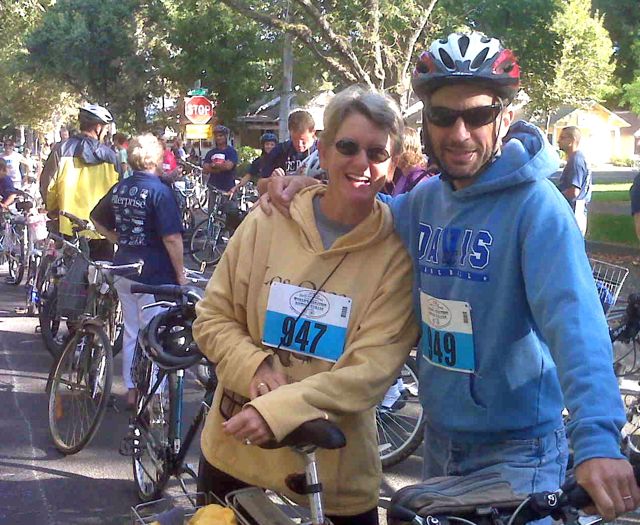
So, it was that World’s Greatest Bicycle Parade day in Davis. Nice event, nice idea for a fundraiser, so many folks ya know.. all that feel-good-community stuff. And chances are very good that 1) lots of money was raised, and 2) Davis broke its own Guinness world record for longest human bike parade with less than three lengths between riders over a course that was more than four miles.. or whatever the record was.. with probably somewhere around 1000 people.
News at 11.
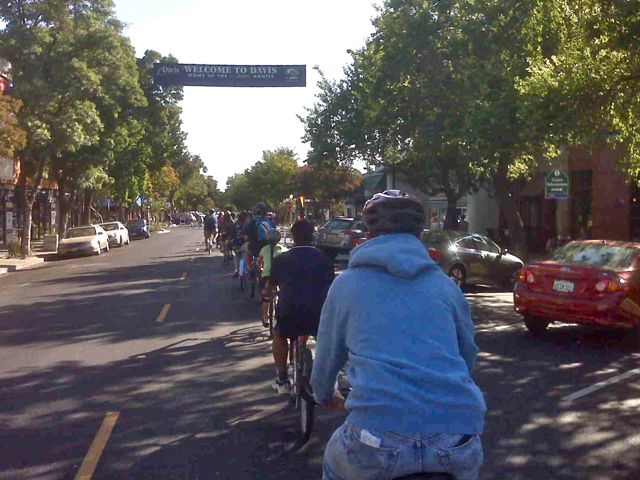
We were very middle of the pack. It was quite fun.
Yay us.
All morning, I kept saying to myself, “all our friends are on parado.” This is a phrase I’ve said to myself for decades and always brings a secret inside smile. My own little private joke. It comes from a t-shirt I bought in Bangkok (or maybe it was Singapore) and is one of those foreign apparel products that mangles the english language and makes english speaking tourists laugh hysterically, like, “omg, look how they spelled rok and role!”
I know. I was young.
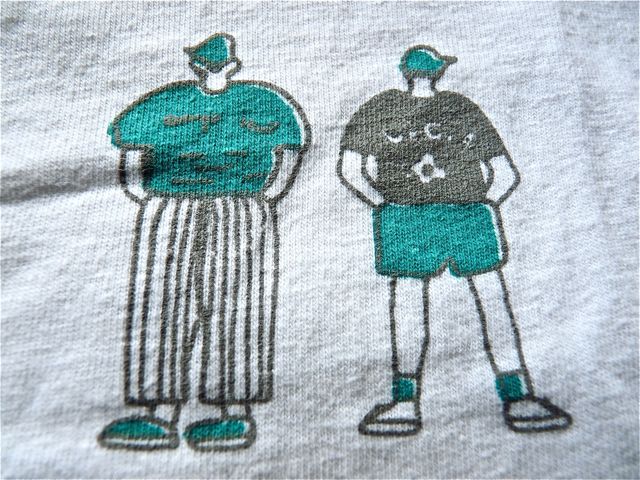
Anyway, here’s what the shirt looks like:

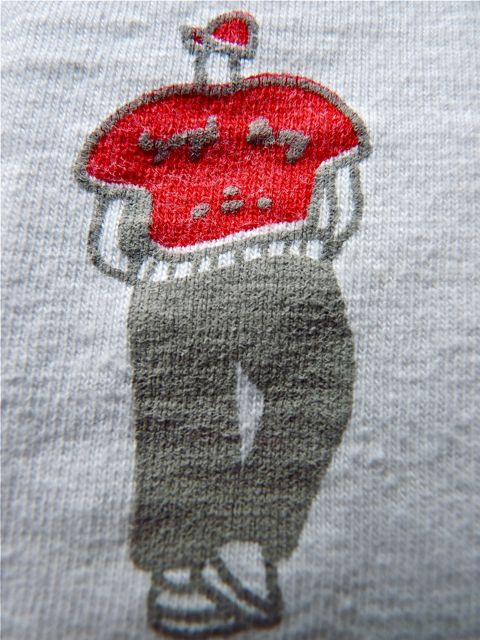
And here’s the text, close up:

Don’t you think it fits today’s parade pretty perfectly (you can read it better if you click)?
I wasn’t above having a good laugh over shirts like this, insensitive, naive, apolitically correct (or is that politically incorrect?) youth that I was. Now I might probably think they do that on purpose. Who’s having the last laugh now?
Of all the wonderful things one can buy in Bangkok or Singapore…
Still… I just love this shirt.

 Life of Wry