
On Writing
October 8, 2011
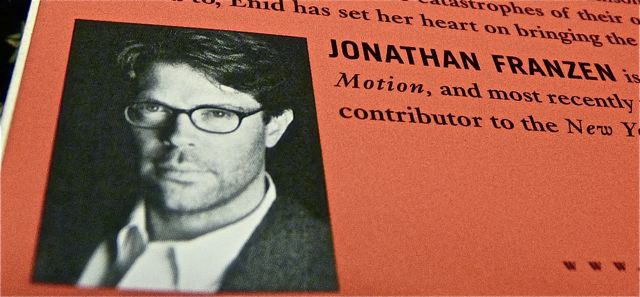
We weren’t allowed to take pictures, so using this from the back of the book I’m reading.
Attended Jonathan Franzen’s talk tonight at the Mondavi. Things that stuck, in no particular order (really, this is random and is mostly an emptying of my short term memory bank):
1. He was quirky, but thoughtful. He was not a smooth speaker, nor did he appear entirely comfortable with the format, but he was very articulate once he found his bearings. He read his prepared comments, appeared somewhat lost or self-conscious at the beginning, laughed a bit nervously, but, damn, the comments, once he got rolling, were rapid-fire brilliance. During Q&A, he was halting, but genuine and delivered a few real gems.
2. Recurring themes were shame, guilt and depression, and the/his process of overcoming or dealing with these through writing.
3. A good process/exercise might be to make a list of things about which I feel guilty, about which I feel shame; these are bases for characters, stories. He talked about his own shame, and ran down a list: guilt at leaving his marriage when his wife was 35, childless; shame at not being more sexually experienced; guilt for this and that.. it was an interesting list. He talked about how his books are all about character, and he works on “what the story is that defines these characters” He puts contemporaneous people into stressful circumstances. Focuses on one moment and then spreads the moment out. The goal is to pick up a character’s story when they’re in maximum crisis, dramatic and unpredictable. You get good stuff when you inhabit the person at the moment of intense crisis. (This was an awesome part of his talk and took me right to his character in Corrections, Chip Lambert, who is SO Jonathan Franzen, so in crisis. And he admitted that, in fact, lots of characters are autobiographical, and his stories biographical, like Gary being his brother, experiences like Alfred wetting the bed–I haven’t gotten to that part in the book–being something that happened to his dad, and so on.)
4. Autobiographical writing. His answer to this, however, was long and started with, no, his books are not autobiographical, but in another way, it’s all autobiographical, nearly by definition. You can’t write in an unautobiographical way. Everyone’s got one autobiographical book in them and after that, who knows.
5. Writer’s block (not a concept he likes) arises when you think you should be writing when actually you don’t want to. He joked he’s dealt with writer’s block for 26 of his 30 years of writing. It implies that we should ordinarily experience an utter free flowing of words, which doesn’t happen typically. Writing comes when you’re ready. Being blocked when you think you should write leads to depression; being where you don’t want to be leads to depression; being with somebody you don’t want to be with leads to depression. Brain/ body go on strike.
6. When his mom was dying, he wanted, before she was gone, a sense of how she liked his books, his writing. She said it was not about him. Her life was about her. The lesson she left him with was, ‘worry not about what others think about you, because they aren’t, they are more concerned with their own life.’ She was more concerned with the last days of her life, for her, it was about her, as it usually is.
7. When he’s thinking about whether he’s going to lend his name to a work (of someone else’s), he reads it, and looks for cliches. No cliches on the first page, or he won’t continue. In a whole book, maybe one every ten pages. He went on to talk about cliches–the good, the bad.
8. Social media is like cigarettes used to be, you’re waiting for your next hit, your next opportunity to be stimulated.
9. Read Sabbath’s Theater (Phillip Roth); The Great Gatsby (F. Scott Fitzgerald); Kafka (um..); Ian McEwan (not sure which); The Blue Flower (Penelope Fitzgerald); Age of Innocence (Edith Wharton); Elmore Leonard. These were some of the books and/or authors he mentioned, drew inspiration from, or just thought they were good.
10. A guy asked why black people don’t appear in his novels, or rather, he identified, very specifically, the relatively few references in various of Franzen’s books. “Well-researched” was Franzen’s initial response and he appeared not a little uncomfortable with the question. He went on to say, he was only uncomfortable with part of it (I can’t remember which part, though he was specific), then fessed up: he was uncomfortable with the whole question, all racial issues (and questions) are uncomfortable. I know I felt uncomfortable for him, as I was sure the guy had a point. Franzen responded that it’s true, there are few instances of black experience, or black characters, and it’s because his life experience is such. He could, perhaps should, and that would be good, but it’s not his experience. He went on to say he checks “goodness” (he didn’t say political correctness) at the door and goes with truth. It seemed not an excuse, he seemed not on the defense, just his truth. Earlier in the talk, he’d talked about “good art” versus “good personhood,” and I think that applies here, too. He spoke about that being a conflict for writers. Anyway, that was the last question and the talk ended right there and fairly abruptly as he muttered something to the interviewer (a professor, presumably, from the UCD english department who wasn’t very adept at asking questions or drawing Franzen out at all) and then walked right off the stage. I don’t even remember clapping.
The trouble with my summary is it’s so limited. I thought if I could write as soon as I got home, I might remember the best parts.. but, no.. this is not a good summary. And it’s too out of context to be meaningful for anyone reading it. His thoughts in my words?…. uh, no. Let’s not do that.
What was more significant for me was the experience of seeing him and hearing him and putting a human face and voice to the phenomenal words that I’ve read. It was also hugely inspiring. It’s good to listen to authors, especially ones I find so brilliant. It’s good to see he’s accessible, not as a person in my life, but as a human. That means writing is not such a ridiculously abstract and unattainable pursuit.
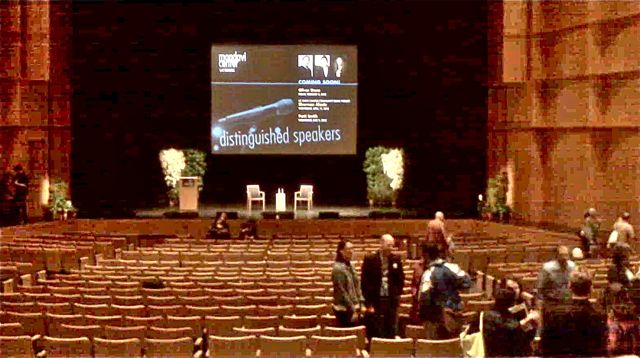
Here’s the stage:
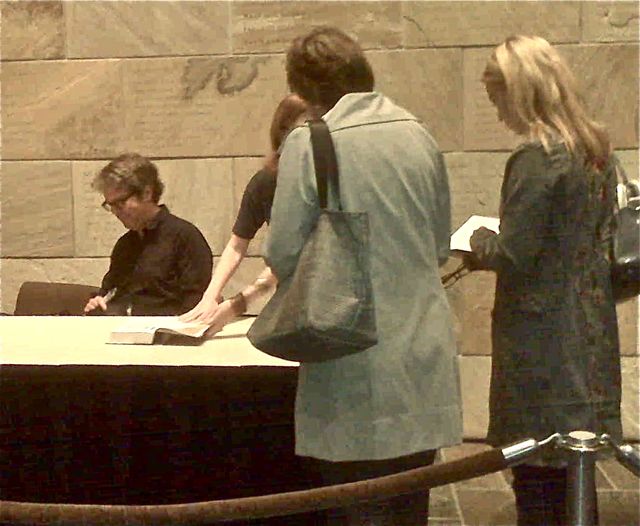
And here’s Franzen at the book signing table afterward:

 Life of Wry