
It’s How You Play the Game
April 4, 2010
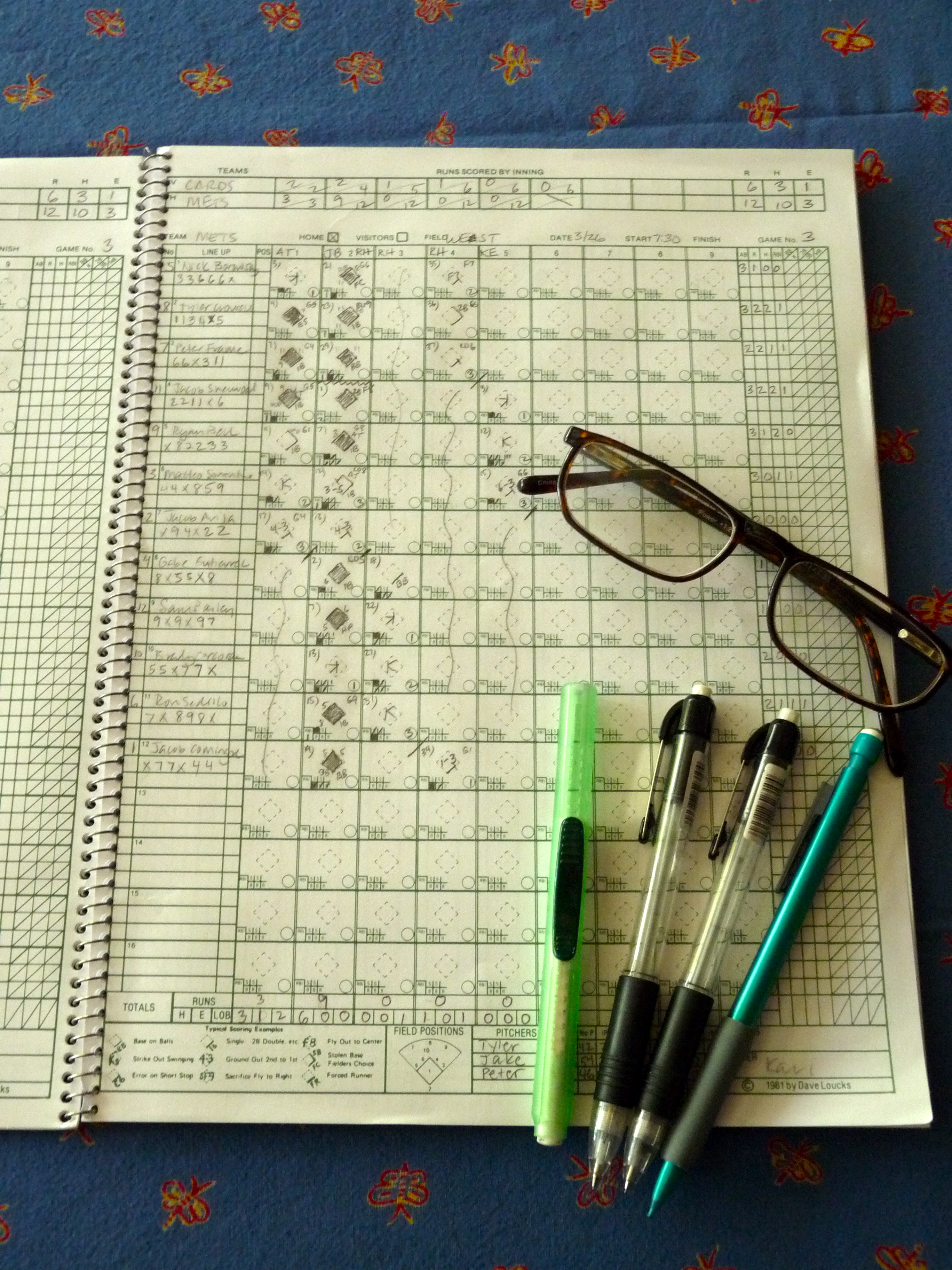
I like to score.
I recently posted the following on my Facebook status thing:
“Scorekeeper axiom: If you keep score long enough, they might ask you to write an article about it.”
And guess what? That’s exactly what happened. So, here’s my article, which, as I understand it, will be running in the Davis Enterprise as a two parter. It’s a bit long, as I had quite a lot to say about scorekeeping. Surprise.
It’s How You Play the Game
In common sports parlance, it’s not whether you win or lose, it’s how you play the game. We’ve all heard this a million times, and as parents and Little League fans, we’re totally on board: we want our players to try their best, and in the process learn sportsmanship, teamwork, and untold other life lessons. Obviously and absolutely. In our infinite sports wisdom, we focus not on the outcome of the game but rather on how it’s played. Yep, indeed, it’s all about the “how.”
For scorekeepers, however, there’s way, WAY more to the “how” question. For us, “how” the game is played is a deep and vast compendium of hows, wheres, whos and whats, and this is where the game gets really interesting.
Scorekeepers focus on what is measurable because that other stuff — the life lessons and whatnot — are totally intangible and decidedly unmeasurable. Baseball is, as we all know, a numbers game — in fact, it’s the mother of all numbers games. And for dedicated scorekeepers, it’s about keeping careful track of those numbers. It’s what we do and, well, it’s pretty darn fun.
So sure, a scorekeeper dutifully tracks what goes on inning by inning, and at the end of the game can tell you with proud conviction who was victorious. But, oh, there is so much more to that ever-complex “how” story.
Being a good scorekeeper is equal parts neatness, precision, and obsessive-compulsive disorder. It also requires superior focus, which in turn requires a superhuman and sometimes not-so-tactful ability to tune out all that wonderful bleacher blab. Truth be told, scorekeepers are geeks, and it doesn’t hurt to be a little anti-social.
For veteran and would-be scorekeepers alike, the season begins at a scorekeeper’s clinic a couple of weeks prior to opening day. Expert mom scorekeepers — the uber dynamic duo of Michael Ann Riley and Dianna Henrickson — lead 40 apprehensive trainees through a detailed, comprehensive outline that addresses every imaginable aspect of scorekeeping. For two fast-paced hours, Michael Ann and Dianna cover the rules, the definitions, the all important abbreviations and umpteen common and not-so-common scenarios. Dianna even offers an item-by-item tour of the contents of her own personal scorekeeping bag. In addition to the usual pencils, sharpeners, erasers and reading glasses, she suggests having a pack of gum on hand which she says will calm the nerves when things get tense (did she say tense?) or when your kiddo is up to bat. The 40 new scorekeepers leave knowing more than they did upon arrival, but their new skills can only be — will most certainly be — tested on the job.
Ah, the scorebook. The scorebook is an artful, if not intimidating, array of lines, boxes, and more lines and boxes. Once you recover from the sheer overwhelm of its layout, you come to appreciate its masterful use of space.
The details of each and every “at bat,” are entered in a box that measures 5/8 inch by 5/8 inch. Within each of these tiny thumbnail-sized squares, are an array of even tinier spaces — diamonds, circles, boxes, and still smaller boxes — into which information is recorded. It’s all quite slickly arranged and all I can say is, your pencil had better be sharp and your writing engineer-precise. It also becomes apparent that good eyesight or strong reading glasses are essential.
Once you’ve mastered the notations and abbreviations that correspond to the action you see on the field, it becomes simply a matter of writing the right thing in the right, impossibly small place. If you do that correctly and legibly, anybody can pick up your scorebook and read — play by play — how the game unfolded.
Clever folks, whoever thought all this up.
For purposes of this article, we’ll assume the scorekeeper is a mom. This, as it turns out, is a safe bet; the vast majority of scorekeepers at Davis Little League games are, in fact, moms, for reasons perhaps worth exploring in a future article. Not to say there aren’t a few dads here and there, but the profile, if you will, of the Little League scorekeeper is “mom.” Organized, methodical, detail-oriented mom.
Mom scorekeepers are a subculture all their own, and as much a part of the fauna at a Little League game as players, coaches and umps. They can be seen in the bleachers at every game, hunched over their scorebooks, pencils in hand, craning their necks to follow the play, cupping their ears to hear the umpire’s calls. They’re the ones who arrive early to collect lineups from each manager and can be found maniacally scribbling names and game information into their scorebooks, synchronizing their watches, and adjusting their positions for optimal viewing… all in advance of the first pitch.
Then, equipped with a stash of pre-sharpened pencils, a comfy chair, perhaps a set or two of reading glasses, and the aforementioned gum, our intrepid scorekeeper settles in for the next two hours to record every last detail of a game that is sure to be anything but routine. (A routine game has yet to be played on a Davis Little League field, at least as far as any scorekeeper is concerned.)
Once the umpire calls, “play ball,” the real work of the scorekeeper begins.
A scorekeeper can tell you who the players are, in what order they bat, and what their jersey numbers are. She tracks what happens on every single pitch. Did the batter swing, did he or she look — but not swing — at a good pitch? Was the ball hit, how was it hit, where did it go? How did the runner move from base to base? Did he or she steal, advance on an errant pitch, tag up on a high fly ball? How many runners crossed home plate? Was the pitcher responsible for those runs or were they the result of some early-season errors?
The scorekeeper records who is pitching, who is relieving, and exactly when each pitcher enters and leaves the game. She’ll note, with painstaking accuracy, how many balls are thrown — because, as it turns out, this matters a lot. Depending on the age of the pitcher, there will be a limit to the number of pitches he or she may throw. And, believe me, everybody cares — the coaches, the umpires, the parents, the board of directors — because we are committed to ensuring a player does not overwork, and potentially damage, his or her arm. It also matters because depending on how many pitches were thrown, a pitcher may not return to the mound for a day or perhaps two days, according to a strict formula based on age and pitch count. This has strategic implications, as you might guess. The pitch count alone accounts for more conferences on the mound, in the dugout, and between scorekeepers than any other dispute. It is probably the single most important statistic tracked by a Davis Little League scorekeeper.
Extra ambitious scorekeepers will also note who played which positions and what kind of action they saw while there. How well did they field the ball, did they throw any runners out, were they part of any double plays? Speaking of outs, how many are there, and how exactly did they occur?
Finally, the scorekeeper will note which teams are playing, on which field, and when they start and end the game. Additionally, the coaches, the umpires, and, of course, the scorekeepers are all noted. Some scorekeepers even observe and note the weather.
And, oh yes, who won.
Of course, the job of scorekeeper is not without its stresses. When all is going well, it’s pretty easy… scorekeeping is simply a matter of translating what happens on the field onto the scoresheet, and in most cases it is pretty straightforward. But not always. For example, a hard hit ball to short stop that results in the hitter beating out the throw to first may seem to the batter (and his parents in the bleachers!) to be a great hit. But to the pitcher (and his parents) it may be an obvious error on the part of the short stop who bobbled the ball for a moment before making a late throw. The outcome affects each player’s stats; the batter wants his grounder to short to be recorded as a hit and the pitcher most certainly does not. And even though we don’t keep stats in Little League, a player’s sense of his or her overall performance is at stake. Judgment in this case is left to the scorekeeper. And history is thus recorded, often to somebody’s dismay.
Scorekeepers are also summoned in the event of questions or conflicts. For example, we are expected to know at any given moment what the ball and strike count is. We may be called upon to reconcile a discrepancy between the umpire’s count and the brightly lit version on the scoreboard (a scoreboard often managed by younger siblings who ARE NOT PAYING ATTENTION. Ahem.)
Discrepancies in the ball/strike count can also be the result of mis-hearing an umpire. Even if an umpire is yelling his calls, he’s speaking through a mask that is pressed up against his mouth and all we hear in the stands is mmmpphhh and ummmthhh.
Maintaining concentration and an accurate record is all that is asked of the scorekeeper, and there is no small satisfaction in being the correct and final arbiter in a numbers dispute! Ah, the glory. On the other hand, a scorekeeper who cannot produce a quick and decisive answer for the umpire or manager lets everyone down.
Which begs the question: what’s in it for the scorekeeper?
I’ll venture that for most scorekeepers, it really all comes down to a love of numbers, order, and precision. Perhaps for a few, it was a matter of arriving too late to the pre-season parents meeting and it was the last volunteer job available. But for the rest of us, it’s just one of those perfect personality matches. Working in the snack shack or coordinating team photo day just doesn’t scratch the same itch.
I know I’m not alone in my obsession. I’ve observed a family — we won’t mention names — whose interest in scorekeeping crosses clearly into the realm of passion. At any given moment during one of their son’s games, mom, dad, grandma, and grandpa might all have their own version of a scorebook on their laps. On a recent occasion, I even saw the younger brother (8 years old) sitting next to mom with pencil in hand entering Ks and RBIs in his own book. A future scorekeeper in training!
Carrie Shaw, the mom of two longtime Little Leaguers and a veteran scorekeeper with countless seasons under her belt, says, “I scorekeep even when I’m not a scorekeeper because I just like it, and it keeps me focused on the game.”
For me, it’s really all about the zen. It’s the concentration, the focus on detail… the need to stay present and tuned into every moment. While it can be nice to just sit in the bleachers enjoying the rhythm of a Saturday afternoon Little League game — a wild rumpus on a sunny day in the pleasant company of friends and family — for me, I appreciate even more the details, the small, tiny dramas that are playing out on many parts of the field at one time. I like to see every pitch, every swing and every play. I enjoy the challenge of recording all of these events in fine detail, and love reconciling numbers in the end, like a giant sudoku puzzle, tallying columns and calculating statistics. It’s about order, precision, nuance and accuracy. Scorekeeping adds a level of depth to the experience of baseball and makes me appreciate all the more the effort the kids are putting into their game.
So, yep, absolutely, the old saying holds true: It’s not about winning or losing, it’s how you play the game.
It’s Spring. What a releaf.
April 4, 2010

I know. It’s been, like, a year since I posted something. Can I make up for it by posting my latest favorite pun? How about a commitment to posting at least semi-regularly? (She said to nobody. I mean, this is just for me, right? Right. So, let’s lose the guilt. Jeez. So unattractive.)
Let’s start over.
Hey, it’s Spring!

 Life of Wry